Every Movie That Beat 'The Irishman' at the Oscars
It was nominated for 10 Academy Awards and won zero.
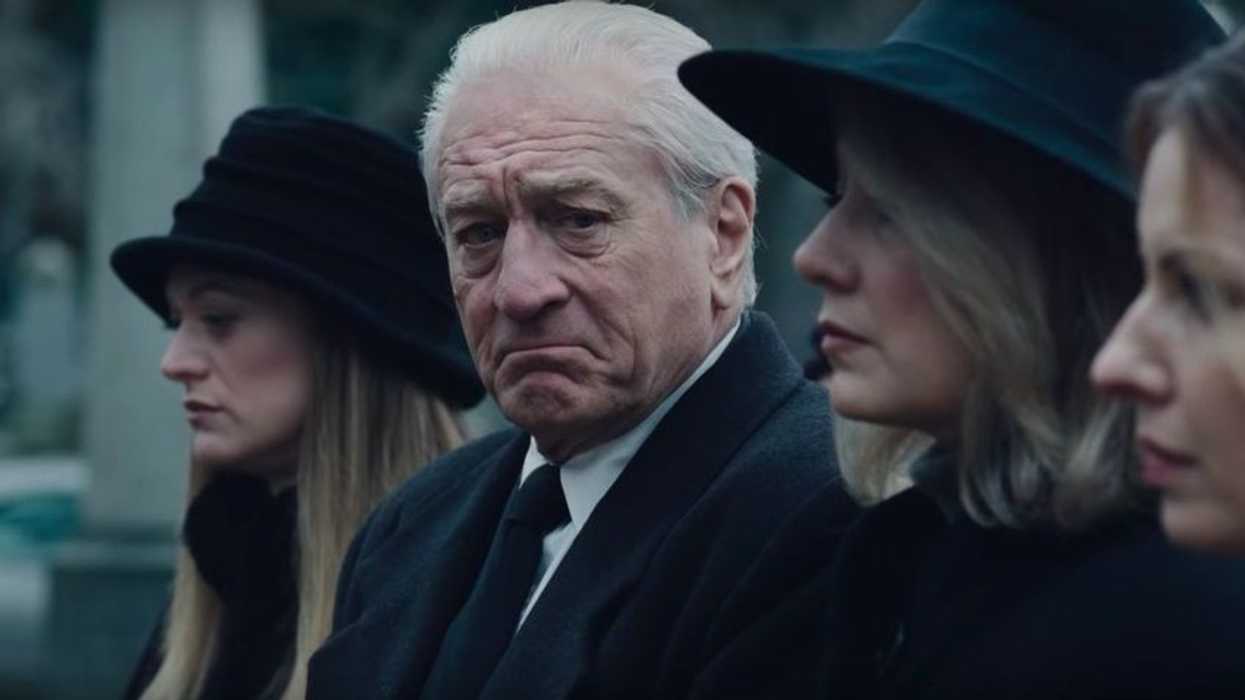
'The Irishman' (2019)
Martin Scorsese's 2019 movie The Irishman is a modern classic, no two ways about it. The movie, which follows the life of a truck driver turned mob hitman who was working for Jimmy Hoffa during his famous disappearance, united the iconic director with a cast of heavy hitters, including Al Pacino, Robert De Niro, Joe Pesci, Anna Paquin, and Harvey Keitel. Empire called it the 28th greatest movie of the 21st century in 2020. Rolling Stone called it the 30th best just three years later.
Plus, it was nominated for a whopping 10 Oscars, tying as the second most nominated film at the 92nd Academy Awards, behind Joker. The trouble is, it didn't win a single one of those Oscars. How did that happen? Here, we'll break down the movies that beat it out for every category in which it was nominated.
'Ford v Ferrari'
Ford v Ferrari was on a very even playing field with The Irishman, considering it was also telling a true story (about engineers trying to make a Ford that can compete in a race with a Ferrari) with a respected director (James Mangold) helming a star-studded cast (Matt Damon, Christian Bale, Jon Bernthal).
It was anybody's game for the Best Editing award, and it ultimately went to the car movie, probably thanks to the splashier car racing sequences that showed off that department's skills in a more front-and-center way.
'Little Women'
As a period piece that spans multiple decades, The Irishman might have seemed like a shoo-in for the Best Costume Design Oscar. However, Greta Gerwig's Little Women swept in with authentic-looking costumes representing a period that was even longer ago (the Louisa May Alcott novel takes place in the 1800s, whereas The Irishman takes place between the 1950s and the 1970s).
'Jojo Rabbit'
The winner in that year's Best Adapted Screenplay category was the satirical Taika Waititi dramedy Jojo Rabbit, which follows the life of a 10-year-old (Roman Griffin Davis) who is part of the Hitler Youth during World War II and has Adolf Hitler (Waititi) himself as his imaginary friend. The movie was based on the 2008 novel Caging Skies by Christine Leunens, making it eligible in the same category as The Irishman, which is based on Charles Brandt's 2004 narrative nonfiction book I Heard You Paint Houses.
Jojo Rabbit screenwriter Steven Zaillian already had an Adapted Screenplay Oscar on his mantel (for writing Steven Spielberg's Schindler's List, which was based on the 1982 historical novel Schindler's Ark by Thomas Keneally), so one can suppose he wasn't too hurt about this loss, especially considering the fact that it was Waititi's first and so far only win.
'1917'
The World War I action drama 1917 follows two soldiers (George MacKay and Dean-Charles Chapman) racing against the clock to deliver an urgent message that will prevent the deaths of hundreds of soldiers. The movie, which was directed and co-written by Sam Mendes (with Krysty Wilson-Cairns), was a shoo-in for the Best Cinematography Oscar thanks to the audacious series of extended, single-take shots that are meant to make the entire movie look like one long take. Well played, Roger Deakins.
While The Irishman didn't have a chance of winning Best Cinematography that year, it also lost to 1917 for Best Visual Effects, likely for the same reason. Bringing an entire war to life while working within the limitations of a series of long takes is a pretty impressive feat that makes even the digital de-aging technology used to craft Scorsese's decades-spanning story feel crude and unsophisticated.
'Once Upon a Time... in Hollywood'
Quentin Tarantino's Once Upon a Time... in Hollywood is the type of Hollywood-mythologizing movie that the Academy loves to reward. Just look at their history. Movies about movies that have won big at the Oscars include The Artist, La La Land, Hugo, Sunset Boulevard, A Star is Born, and beyond. Not only is OUATIH imbued with love for Hollywood history (to the point that it features actors portraying major cinematic figures such as Bruce Lee and Steve McQueen), it presents a vision of history where the murder of Sharon Tate never happened. The event shook Hollywood and Los Angeles at large to its foundation, so Tarantino's storytelling choices packed a particular punch.
The Hollywood factor, combined with the fact that it was also a period piece (set in the late 1960s), made OUATIH an irresistible choice for Best Production Design over The Irishman. Additionally, Brad Pitt won Best Supporting Actor for his portrayal of stuntman Cliff Booth (who will return to the big screen in the upcoming David Fincher-directed sequel The Further Mis-Adventures of Cliff Booth). By winning his first acting Oscar (he had previously won Best Picture as a producer for 2013's 12 Years a Slave), Pitt beat out two nominees from The Irishman, namely Joe Pesci and Al Pacino, who gave the Scorsese movie overlapping nominations in the category.
'Parasite'
Bong Joon Ho's genre-bending movie Parasite, a satirical take on capitalism that followed a poor South Korean family infiltrating the staff of a wealthy family, was a massive success. It struck a nerve at the box office, grossing $258.1 million against a budget of just $11.4 million. It was also the most awarded movie of the ceremony, with four Oscars under its belt.
Two of those categories were ones in which The Irishman was also nominated. First, Bong Joon Ho won Best Director over Martin Scorsese (who has only one Oscar out of 16 nominations, for directing the 2006 Best Picture winner The Departed). Then Parasite took home the big prize with a Best Picture win, making it only the second International production to win Best Picture (after The Artist, which is a French silent film and thus technically makes Parasite the first foreign-language feature to win). In the Best Picture category, Parasite also won out over fellow Irishman-usurpers Ford v Ferrari, Jojo Rabbit, Little Women, 1917, and Once Upon a Time... in Hollywood.
Do you think The Irishman deserved to win any or all of the categories in which it was nominated? Share your thoughts in the comments below!