Whenever I’m sitting down to tackle a new screenwriting project, my anxiety shoots through the roof. It usually stays at that peak until my first draft is completed, but that initial hit of it while staring at the blank page can be pretty overwhelming. Screenwriter Rich Ronat seems to agree, as he sat down with Film Courage and talked about his process with first “anxiety drafts”.
Let’s take a look at some of his processes and how you can work them into your own writing process.
What is an Anxiety Draft?
An anxiety draft can essentially be treated like a really quickly written first draft of anything. My anxiety while writing is at its worst when an idea I have hasn’t been materialized on the page yet, no matter how much of a work in progress it might be. The easiest way to get rid of this anxiety is to just speed-run a draft as quickly as you possibly can so that you can at least know that it can be done. Do not pay attention to the quality of your work because you know you’re just going to edit it later. Don’t rewrite scenes before you’re finished either, because everything is likely going to change a million times over, so why extend that process? Just write to write, and once you reach the end, take a deep breath and take a break.
Stephen King’s Six Week Rule
An interesting ideology that Ronat brings up in his own process is Stephen King’s rule after writing a first draft. The argument is to throw your completed first draft into a drawer for a minimum of six weeks, and don’t think about it or look at it at all. Separate yourself from this side of your work entirely, so that when the time eventually comes for you to be able to look at it all again, you can do it from a mostly objective lens.
I’ve done a version of this before where I put my script down for a while, not a set time necessarily, and then try to rewrite my favorite key scenes from memory, while incorporating some of the filler from my first draft into the new version. Surprisingly, for how out of order this sounds when I write it, it lets everything evolve into a new form at the same time without having to wait for an extra step to be completed. Your ending can change along with your first act simultaneously.
What to Do When You Get Back
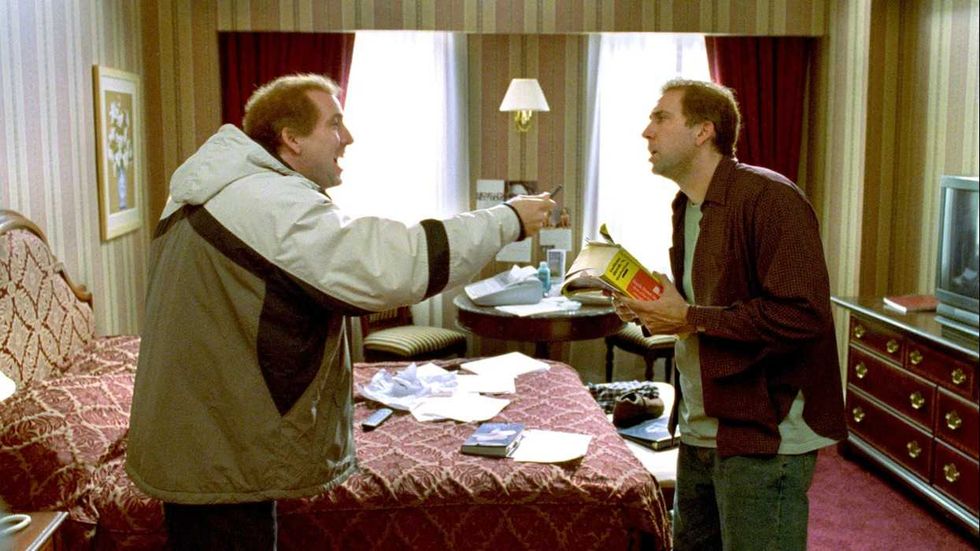
'Adaptation'
Credit: Columbia Pictures
I like to think of the distancing portion of the writing process as if it’s any kind of recovery process for physical activity. Rest is imperative to your recovery, and being able to come back stronger than ever. But once that rest time has appropriately been spent, you better get up and come back at the next draft harder than ever.
No one is coming to save you is a cheesy line, but it’s typically applicable in the film industry, and even more applicable to writers. Writing is perhaps the most isolating job in such a collaborative field. The amount of self-accountability and discipline you must have as a writer cannot be overstated. You have to be able to believe in and advocate for yourself better than anyone else would. Part of this is having a circle of friends that you trust to be able to give feedback on your work. But another huge part of this process is…
Don’t Ask For Feedback Too Early
Getting feedback on your work is integral to how people perceive it, and how others outside of your circle will eventually interpret it subjectively, and you should always be down to receive constructive feedback…at the right time, that is.
A screenplay or a rough cut of a film are both intense works in progress that getting too much feedback too early on can kind of be relatively pointless, and could discourage you unnecessarily. So much of the pressing feedback you would be getting at this stage is going to be stuff that you already know needs to be changed, so why bother having it told to you over and over again?
Wait until you feel as though you have a relatively solid foundation, because if you’re struggling to come up with things that you know need to be changed, that’s your sign that it’s time for feedback. You’ve been so locked in on this project for so long that seeing it from any other perspective than the one you’ve already formed is incredibly difficult. This is where the fresh eyes of constructive feedback become the most important.
If the right person gives you the right feedback, you’ll likely be able to fix a problem you didn’t even realize you were having, and on top of that, it can totally reignite your passion for the project if it hits you at the right time. The moral of the story here is simple: write a first draft as fast as you can, but don’t share it as fast as you can. Let your ideas marinate, and edit without the looming pressure of someone else’s viewpoint. Once you’ve crossed that threshold, you’re ready for outside perspectives.