How ‘Duel’ Announced Steven Spielberg to the World
This terrifying road movie preceded Jaws.
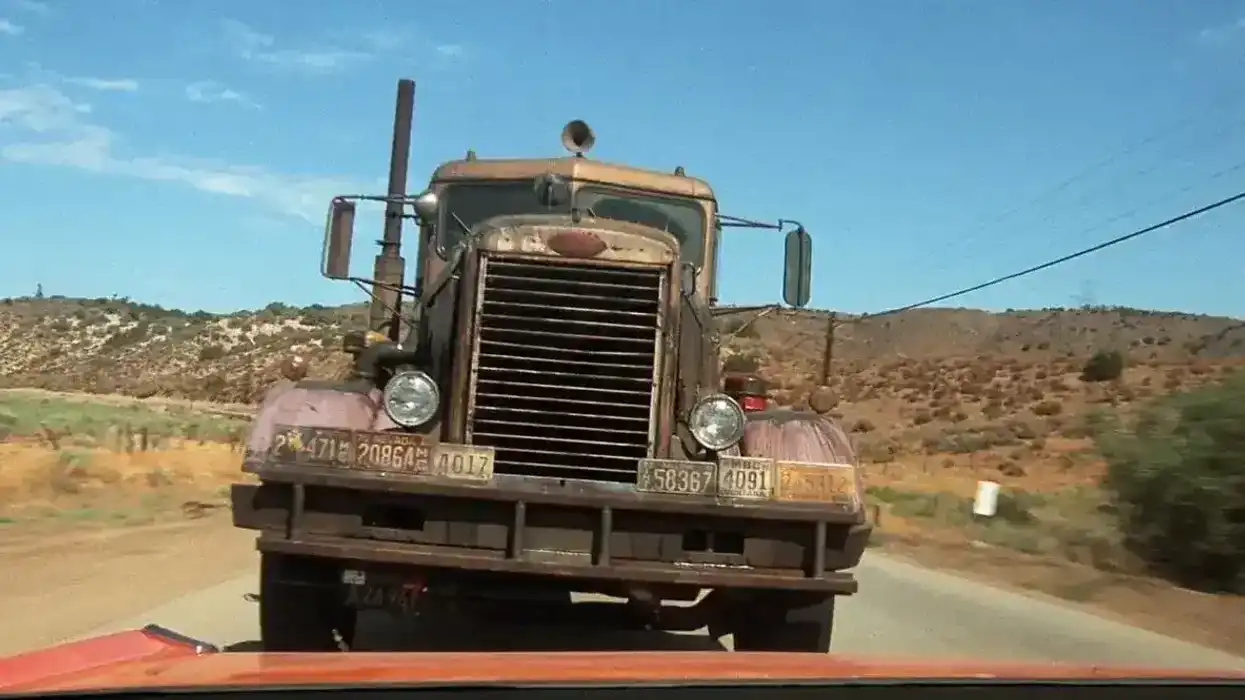
'Duel' (1971)
Before his all-time classic Jaws (1975) turned Steven Spielberg into a household name, the director had already made a modest-budget thriller that showcased the arrival of a master filmmaker.
Duel (1971) may have preceded Jaws by four years, but it was as elaborate a depiction of a filmmaker’s unparalleled approach to suspense filmmaking as possible. The film, a thrilling road movie, follows mild-mannered David Mann (Dennis Weaver) as he drives through sun-soaked California on a routine trip and finds himself in a relentless cat-and-mouse chase with a truck.
Steven Spielberg turns the screw of suspense filmmaking with impeccable precision and craft, making what could have been an everyday experience into a fast-paced survival thriller.
How did Spielberg make the ordinary feel terrifying? Why was Duel the real arrival of a master filmmaker?
Let’s jump right in and explore.
How Spielberg Made The Ordinary Feel Terrifying
Duel, believed to have been shot on a tight budget in 10 to 14 days, on location, is one of Steven Spielberg’s most terrifying movies, if not his most terrifying. Yes, you read that right. A strong case can be made that this Jaws predecessor could actually be a more agonizingly brilliant filmmaking experience than his most revered classic, and the reason lies in how the director made the ordinary feel terrifying. While the comparison between the two films, just like in the case of any work of art, is entirely subjective, let’s observe why Duel works so well.
What makes the movie so effective is how Spielberg takes an everyday experience, elevates it, and then amplifies it. The initial tussle between the truck driver and David Mann can be considered a typical example of an ego clash on a highway. This is the part that Spielberg elevates with thrilling, real-location filmmaking. When we understand that this is a little more than just an ego clash, Spielberg turns the screw harder, making the experience thrilling and then terrifying.
While the world of the movie never stops feeling “real”, when David Mann feels like his life is under a direct threat, it becomes an out-and-out survival thriller.
The massive tanker truck that chases Mann’s car feels like a force of nature. Even though the open landscapes on both sides might make you feel like the protagonist is safe, this notion is as far away from the truth as possible. The moment the viewers realize that this is a “duel” and not just an ego clash, their minds are likely to wander as to just how far the truck driver might be willing to go.
Dennis Weaver’s performance as David Mann grounds the freakish nature of the thrilling cinematic experience. As the film progresses, Mann’s confidence begins to waver, and eventually, he feels like the truck driver actually wants to kill him. It is the manner in which Spielberg introduces such a primal threat to an innocent man’s life that makes the film superbly terrifying, thrilling, and vividly indicative of a filmmaker who was about to direct multiple classics after this one.
Building Tension Through Silence
As you could imagine, the dialogue in Duel is sparse, and that’s precisely what builds and then escalates the film’s core tension. Steven Spielberg drops a visual storytelling masterclass through this movie.
David Mann is made to look and sound like an ordinary working man with a regular car and a regular life. As the Duel with the truck driver begins, Spielberg heavily leans into visual mastery and ambient sounds, drowning out the need for unnecessary words. What makes the film’s tension palpable is the fact that we cannot put a face to the truck driver for the longest stretch of the film. This, in its own way, is a clever deployment of “silence.” Not only does the antagonist not speak, but you don’t even see their face.
The movie’s pacing deliberately relies on actual events that are directly related to both David Mann and the driver’s on-road decisions. This creates a fascinating cinematic experience that feels incredibly real. We have no idea what will happen next, and it’s like we are seeing two characters openly unravel in real time.
Why Duel Announced The Arrival Of A Master
Few filmmakers in film history announced their “arrival” as elaborately as Steven Spielberg did with Duel. When we use a word like “arrival”, this is pretty much what we’re talking about. Not only did this movie show us what Spielberg was capable of, but it also showcased his incredible ability to do so on an extremely tight budget. Both facts made a considerable mark on his filmmaking resume at the tender age of 24.
A film like Duel does not rely on a crafty screenplay, heavy dialogue, or multiple characters entering the story at various stages. This places even greater emphasis on the director’s ability to create a thrilling cinematic experience, which Spielberg did with absolute finesse.
Duel proved that Spielberg could create maximum impact with minimal resources and time, a quality that is highly respected in the world of filmmaking. However, most importantly, the director who is so highly revered today showcased his impeccable talent by depicting an unfaltering commitment to the craft and everything it stands for.
Summing It Up
Duel is one of the most glaringly brilliant examples of a raw filmmaking talent announcing his arrival to the world. The film is a ferocious thriller made by a young filmmaker who calmly embraced the lack of resources at his disposal and made a movie that is considered, even today, as one of his most underrated works.
Which is your favorite Steven Spielberg movie? Tell us in the comments below.
- Richard Linklater on Why 'Last Flag Flying' is a Road Movie, Not a War Movie ›
- The Story Behind How ‘Mad Max: Fury Road’ Was Filmed Without a Finished Script | No Film School ›
- 9 Travel & Road Trip Movies That’ll Make You Want to Hit the Road | No Film School ›
- Spielberg's Philosophy That Inspired Generations of Dreamers ›