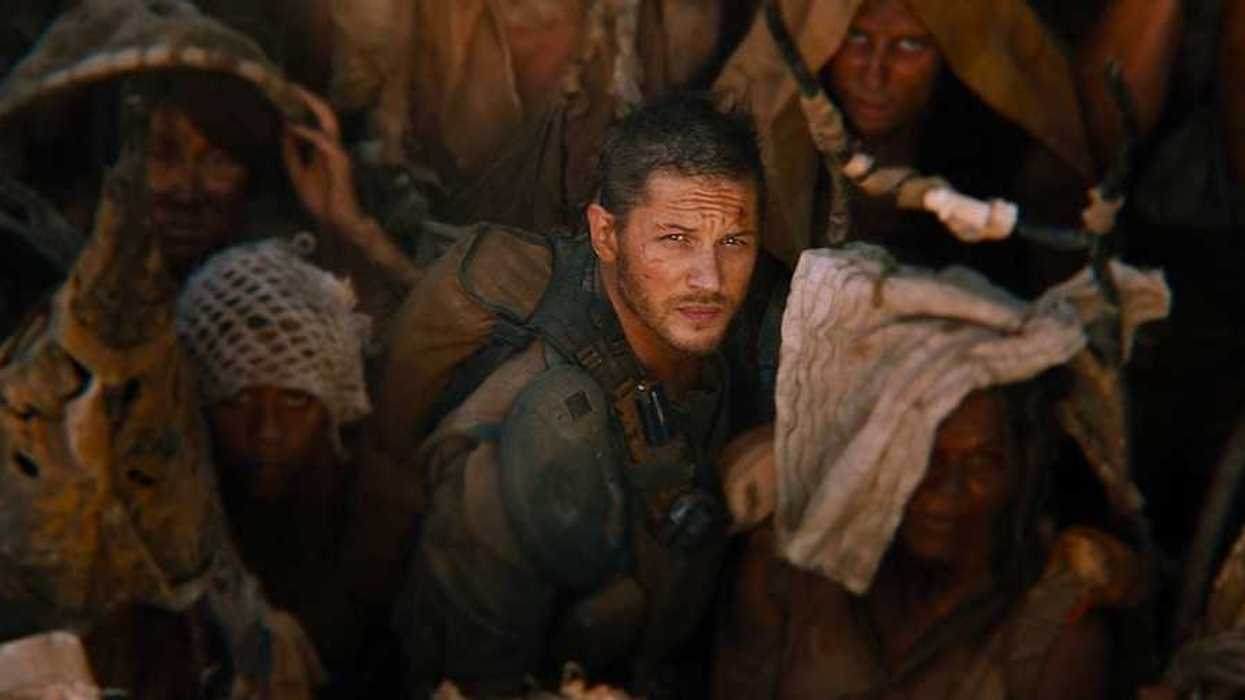
The concept of Mad Max: Fury Road is simple: a hardened survivor tags along with a group of fierce women running from a savage tyrant, and how do we do that? Through a two-hour-long, continuous car chase. Which requires a lot of planning and, well, a script? As a matter of fact, no.
In this post-apocalyptic world created by George Miller, characters spoke only when necessary, and Miller told the story predominantly through action. What made it more special is that it wasn’t shot traditionally with a written script at first, but with lots of action lines and illustrations.
Let’s go behind the scenes of how George Miller flipped the conventional style of shooting for Mad Max: Fury Road.
How Mad Max: Fury Road Started Nearly Two Decades Ago
 'Mad Max: Fury Road'Credit: Warner Bros. Pictures
In 1995, George Miller conceived the idea, and like a classic writer’s trick, he left it floating for a while before revisiting it in the late ‘90s. At that time, Miller met a man named Brendan McCarthy, a British artist, designer, and comic-book maker. He was a megafan of the Mad Max franchise. He even collaborated with Peter Milligan to create a comic heavily influenced by Miller’s Mad Max 2, also known as The Road Warrior.
Moreover, Brendan also wrote and storyboarded an animated Mad Max parody episode in the Reboot animated series and sent it to Miller with a note on top, “Whatever happened to Mad Max?”
Coincidentally, the episode tape caught Miller’s eye, and he watched it. He was impressed by Brendan’s understanding of the character and the world. He straightaway fixed a meeting with him, and the two hit it off.
The Mad Max Room
They both began visualizing the entire movie as a graphic novel at Miller’s office, and named it “The Mad Max Room.”
For the next two years, they both drew approximately 3,500 storyboards, covering all of the office’s walls. These frames had detailed drawings with every action set piece mapped out, along with predecided camera movements and narrative beats. One could have literally seen the entire film, tracing all the storyboard frames in succession.
This storyboard lists the story beats instead of a traditional script that was pitched to studios, actors, and crew.
When the film was finally shot after numerous production hiccups over a decade, more than half of the real product was very close to the storyboards. According to Miller, the film had almost the same number of shots as the storyboards.
Why the Film Required This Approach!
 'Mad Max: Fury Road'Credit: Warner Bros. Pictures
Mad Max’s world has always been known for its beautiful violence and out-of-the-box imagination. Fury Road has over two hours of fast-paced chase scenes and features some of the best explosion scenes.
The grandeur and detailing of each frame are awe-inspiring. The movie imparts a continuous unsettling energy of a post-apocalyptic world. This energy could not have been captured by writing it out, but by visually imagining the action.
George Miller’s approach to going headfirst into drawing out his imagination and designing the movie led him to craft a detailed world-building. Through this process, he was able to crack the sweet spot of visual storytelling.
Every possible imagined shot was constructed by a skilled team of visual artists for over two years. Ultimately, they were successful in conveying story and emotion with less exposition.
Storyboards enabled Miller to direct the action sequences with precision, as the original 140-day shoot was reduced to 100 days by Warner Bros. By figuring out every shot beforehand, Miller and his entire crew had prepared well. All the stunts, explosions, and action choreography were practiced well before, allowing them to shoot some of the most complex action scenes in cinema.
How Filming with No Script Affected Actors
 'Mad Max: Fury Road'Credit: Warner Bros. Pictures
The storyboards with descriptions in place of a good old screenplay significantly challenged actors creatively during filming.
Tom Hardy and Charlize Theron were confused throughout the shooting. They could not understand the narrative direction of the story and their characters’ motivations, and had to dig deep to convey the story through actions, using less to no words.
Tom Hardy, especially, had a difficult time understanding Miller’s vision, for which he later apologized to Miller during a press conference at the 2015 Cannes Film Festival—after seeing the masterpiece edited by Margaret Sixel, who won an Academy Award for Best Editing for it.
Summing Up
Mad Max: Fury Road won six Academy Awards out of eleven nominations in 2016, proving that visual storytelling resonates with audiences more than word-heavy narrative structures and still became a mass blockbuster.
George Miller reminds me of Satyajit Ray, another pioneer of filmmaking who heavily depended on visual storytelling rather than words. George Miller’s ability to envision his movie even before he shoots it makes him one of the great storytellers.
- See All the Crazy Stunts They Pulled Off for 'Mad Max: Fury Road' in This BTS Footage ›
- What Has George Miller Learned After Making 5 'Mad Max' Films? ›
- How the Framing In 'Mad Max: Fury Road' Keeps the Viewer Oriented in a Chaotic World ›
- How George Miller Teaches Us to Watch 'Mad Max: Fury Road' ›
- Behind the Scenes of Conan's Hilarious New 'Mad Max' Parody (Which Was Shot Practically) ›
- Check Out This Massive Oral History of 'Mad Max: Fury Road' ›
- Watch: All of the Incredible Practical Effects in 'Mad Max: Fury Road' ›
- How ‘Duel’ Announced Steven Spielberg To The World ›