How Howard Hawks Pitted John Wayne Against Montgomery Clift to Redefine the Western
Red River (1948) is more than just a movie about a cattle drive.
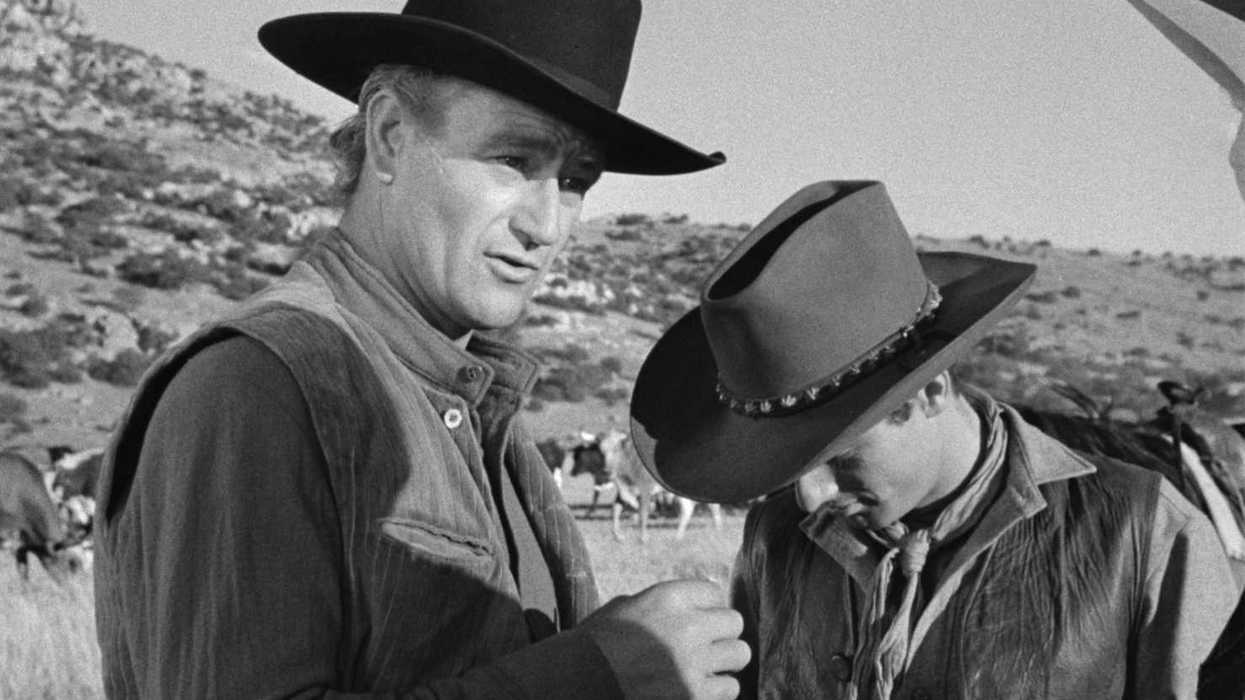
'Red River'
I got this amazing Blu-ray and 4K disc player for my birthday, and I have been renting or buying 4K discs, utterly blowing my mind. One of the discs I snagged this week was the Criterion of Howard Hawks’ Red River (1948).
There is so much to say about this restoration, but today I wanted to focus on how Hawks took a cattle drive and used it as the literal driving force behind a psychological epic that redefined the American Western.
Before Red River, Howard Hawks was already a master of genre storytelling. The guy was sort of a Swiss Army knife of early Hollywood. If you needed a genre movie made, he was the number you dialed.
He had conquered the screwball comedy with Bringing Up Baby, the gangster movie with Scarface, and even film noir with The Big Sleep.
But Hawks had never made a Western, and eventually, the bill came due.
The thing I love about Hawks is that he was always himself behind the camera. So if he was going to do a genre, he wanted to do it his way. Red River is sort of the perfect auteur entry into the Western genre because it has all the Hawks' signature elements while also embracing the tropes that would define the genre going forward.
Let's dive in.
- YouTubewww.youtube.com
A Clash of Generations and Acting Styles
As I said at the start, Hawks was always himself behind the camera. Hawks was obsessed with professionalism and craft.
His films have incredible cinematography, and he was daring with how he moved the camera.
He also loved stories about ensembles and defined his characters by whether they could do their job well.
The movie is about a cattle drive that pulls apart the masculinity of its central characters the further they go, laying them bare before each other in ways they never could have imagined before setting out on the journey.
Our two characters going back and forth are Thomas Dunson (John Wayne) and his adopted son, Matt Garth (Montgomery Clift). Dunson and Matt’s feud isn't just emotional because of who they are; it's a disagreement over the right way to execute the drive, to do the job.
This is that Hawksian element that showcases the auteur's hand.
These two behemoths of the silver screen are clearly trying to one-up each other's acting in the movie, and that gives every scene a little extra mustard and tension.
What's even crazier is that it's one of their first films.
I think you could say John Wayne delivered a career-defining performance as Dunson. He takes the tyrannical cattle baron to new levels as he grows increasingly unhinged.
Wayne had been a star in Hollywood for over a decade and was used to getting his way on set. He was perfect in this role because he could push the other actors around, and that came across as sort of the meta-narrative of this movie.
And who can blame him? The bad luck on the trip is setting him and his business back as his farmhands desert him, his cows fall ill, and the drive to Missouri proves treacherous.
As I mentioned earlier, this is Montgomery Clift's film debut, and he's already going toe-to-toe with the biggest name in Westerns ever.
On set, Clift was a different actor than Wayne. He was quieter, internal, and intense.
This back-and-forth mirrored what Hollywood was facing post-war, as more actors were changing to this new style. Not to be outdone, Wayne uses his bravado to deepen his character and put Clift on edge.
Hawks kind of treats this movie like a war film about a military march, but using cows. We don't have the taming of the West, which came up in a lot of Westerns of the day, but the unraveling of the people, who are becoming less tame themselves.
The film captures the dust, physical exhaustion, and paranoia of months on the trail, climaxing in a famous, thunderous stampede triggered by a dropped sugar bowl.
Summing It All Up
I think Red River elevated the Western, not in a pretentious way, but it kind of showed filmmakers that you could use the genre to explore other realms of possibility. You could have it be a psychological thriller or a more personal story about people.
This ended up in the later decades, using the Old West as a setting and giving us some amazing other movies. And it opened Hawks' signature style of putting his own imprint on different genres as inspiration for filmmakers who followed, too.
Let me know what you think in the comments.