Film Quote of the Day: The 'On the Waterfront' Line That Brought Method Acting to the Masses
"I coulda been a contender. I coulda been somebody, instead of a bum, which is what I am, let's face it."
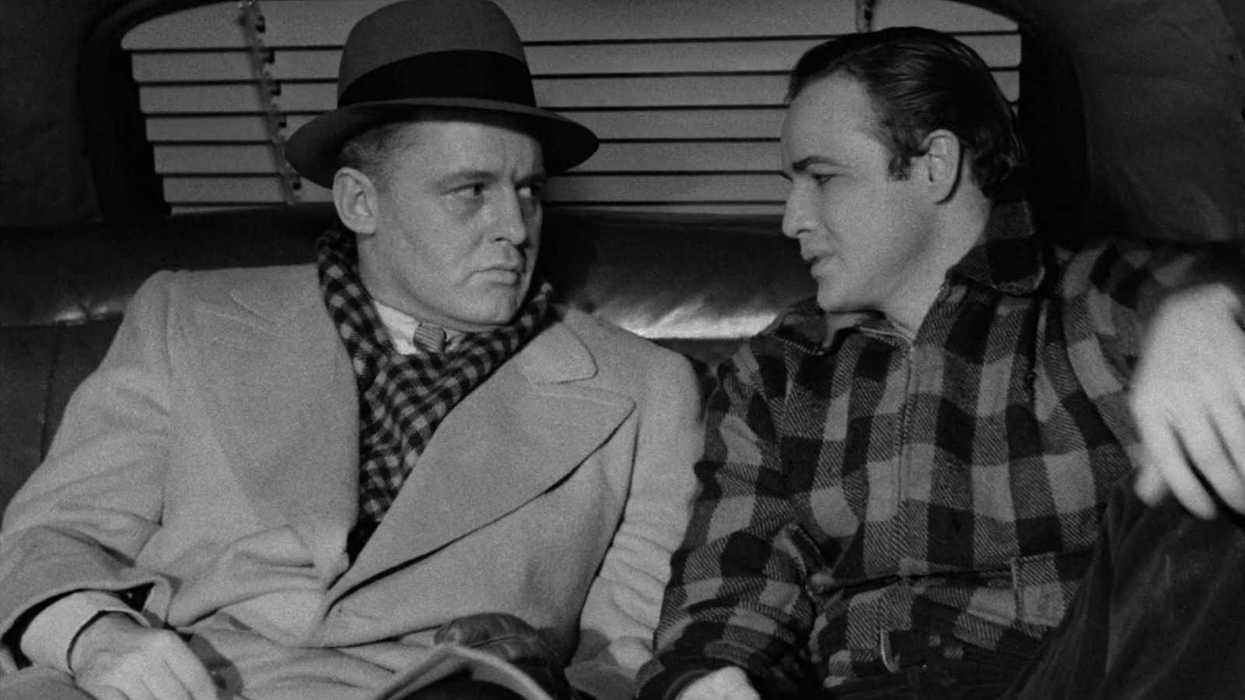
'On the Waterfront'
I truly believe that great dialogue is impossible to teach; you have to just listen intently and see how people talk. And then write them even better than that.
Movies are a visual medium, but the dialogue is pretty important too. It's what made talkies change how we see feature films, and some lines of dialogue have completely shifted the course of Hollywood history as well.
Case in point, this single moment in Elia Kazan’s 1954 masterpiece, On the Waterfront, where we get the rise of method acting all in one raw and powerful piece of dialogue.
Let’s talk about how Budd Schulberg's brilliant script, a legendary backseat improvisational choice, and Marlon Brando brought Method acting to the masses.
Let's dive in.
- YouTubewww.youtube.com
The Backseat Scene In Question
So, fun story: just hours after my son was born, I had to stay awake and chill with him, and this is the movie I put on the iPad. So, technically, this is the first movie he saw as a human being, even though his eyes were closed most of the time.
If you haven't seen the movie, go do it. I think it unlocks so much about character and people and Hollywood and America all in the time period.
On the Waterfront follows Terry Malloy (Marlon Brando), a washed-up prize fighter turned regular dockworker who is stuck under the thumb of a corrupt, mob-connected union boss, Johnny Friendly (Lee J. Cobb). Terry's brother, Charley "the Gent" (Rod Steiger), is Friendly's right-hand man and accountant.
When Terry begins to cooperate with the crime investigators, Friendly sends Charley to straighten him out. They can't have him feeling guilty and talking about shaking down the workers and getting someone killed.
The confrontation between these brothers, which happens in the back seat of a taxi cab, is arguably the most famous dramatic film scene ever shot.
Charley offers his brother Terry a choice: take a cushy, quiet job on the docks, or face the consequences of the mafia.
But Terry feelsl ike his fate had been sealed by his brother a long time ago. He reminds Charley of the night his own brother forced him to throw a fight for mob betting money. That ended his boxing career before it truly began.
And the scene builds from there.
Charley: "Look, kid, I - I how much do you weigh, son? When you weighed one hundred and sixty-eight pounds you were beautiful. You coulda been another Billy Conn, and that skunk we got you for a manager, he brought you along too fast."
Terry: "It wasn't him, Charley, it was you. Remember that night in the Garden you came down to my dressing room and you said, 'Kid, this ain't your night. We're going for the price on Wilson.' You remember that? 'This ain't your night'! My night! I coulda taken Wilson apart! So what happens? He gets the title shot outdoors in the ballpark, and what do I get? A one-way ticket to Palookaville! You was my brother, Charley, you shoulda looked out for me a little bit. You shoulda taken care of me just a little bit so I wouldn't have to take them dives for the short-end money."
Charley: "I had some bets down for the boys that night. Real heavy money."
Terry: "You don't understand. I coulda had class. I coulda been a contender. I coulda been somebody, instead of a bum, which is what I am, let's face it. It was you, Charley."
- YouTubewww.youtube.com
The Line That Changed Acting
Before Marlon Brando broke out in the early 1950s, cinematic acting was theatrical because its roots came directly from the stage. You didn't have generations who were just working on the screen.
But then came the Group Theatre and the Actors Studio, where people like Lee Strasberg and Stella Adler championed The Method.
It was an approach based on Konstantin Stanislavski's system that demanded an actor tap into real, deeply buried personal psychology to find absolute emotional truth.
And that system gave us Marlon Brando.
He brought this interiority to the role, and people were stunned by his performance. In a world of big emotions and music, he was grounded on the screen and made people in the audience feel, too.
From that moment, studios were into the idea of subtle acting on the screen, and method swept up in Hollywood and found other actors, too.
Even people who didn't buy all the way in on this wanted to be a little more subtle and reserved on screen, a little more natural.
And it was all contained in that line, and really, the whole performance on screen.
The Takeaway for Screenwriters and Directors
While On the Waterfront is often studied for its stellar performances, the script provides a clinic on how to construct a scene completely built on subtext, and the performances would not be there without it.
Two things you can learn are...
- Let your characters process pain out loud: Sometimes it's okay to be directly on the nose if you are layering it in a character breaking down. Terry is grieving and finally letting us into his interior. The line "I coulda been a contender" works because it is an indictment of neglect from the one person he thought should protect him. Who is once again threatening him.
- Embrace the poetry of local vernacular: Budd Schulberg didn't write clean, elegant prose for Terry Malloy. He wrote the language of the Hoboken docks. Terms like "Palookaville," "short-end money," and "bum" ground the heightened existential tragedy in a highly specific, working-class reality. Those are colloquialisms that make the scene feel real.
Summing It All Up
More than seventy years after its release, On the Waterfront remains a foundational pillar of American cinema. The movie swept the Academy Awards, including Best Picture, Best Director for Kazan, Best Story and Screenplay for Schulberg, and Best Actor for Brando.
It ushered in the method to Hollywood and proved to the studio system that audiences wanted to see messy emotions and deep characters on the silver screen.
What is your favorite scene from On the Waterfront?
Let us know in the comments below!