Frank Capra’s It’s a Wonderful Life is all about hope, inspiring you to persevere through the darkest of times. The plot of the story was unique and out of the box at the time, and James Stewart’s performance as George Bailey makes you feel his lowest of lows and the gigantic high in the climax. It simply makes you realize that no matter how defeated you are in life, jumping into a deep river is not an option.
However, the movie’s central theme is hidden inside the message Clarence (Henry Travers) leaves for George at the end of the film: ”No man is a failure who has friends.” Let’s understand what Clarence wanted to teach George Bailey with this iconic line.
It’s a Wonderful Life (1946) — Directed by Frank Capra
George Bailey (James Stewart) is a friend to the needy and a mentor to the lost. He does all the great deeds possible and still feels that he is a failure.
One Christmas evening, he decides to end it all by attempting suicide by jumping into a river. Until he sees a world without him, that world is shown to him by Clarence (Henry Travers), his guardian angel.
Clarence helps George understand the nitty-gritty of life, its meaning, and why life not turning out perfectly is not the end of the world. After seeing how his non-existence will affect his family and his community, he races back to his wife and children to cherish them.
The Line and Its Context
The scene unfolds after George’s wish of never being born is granted, and he comes back from the alternate reality, seeing his close ones suffer in his absence.
After realizing the importance he holds in other people’s lives, George runs back to his family to embrace his former life, which pushed him to the verge of suicide once.
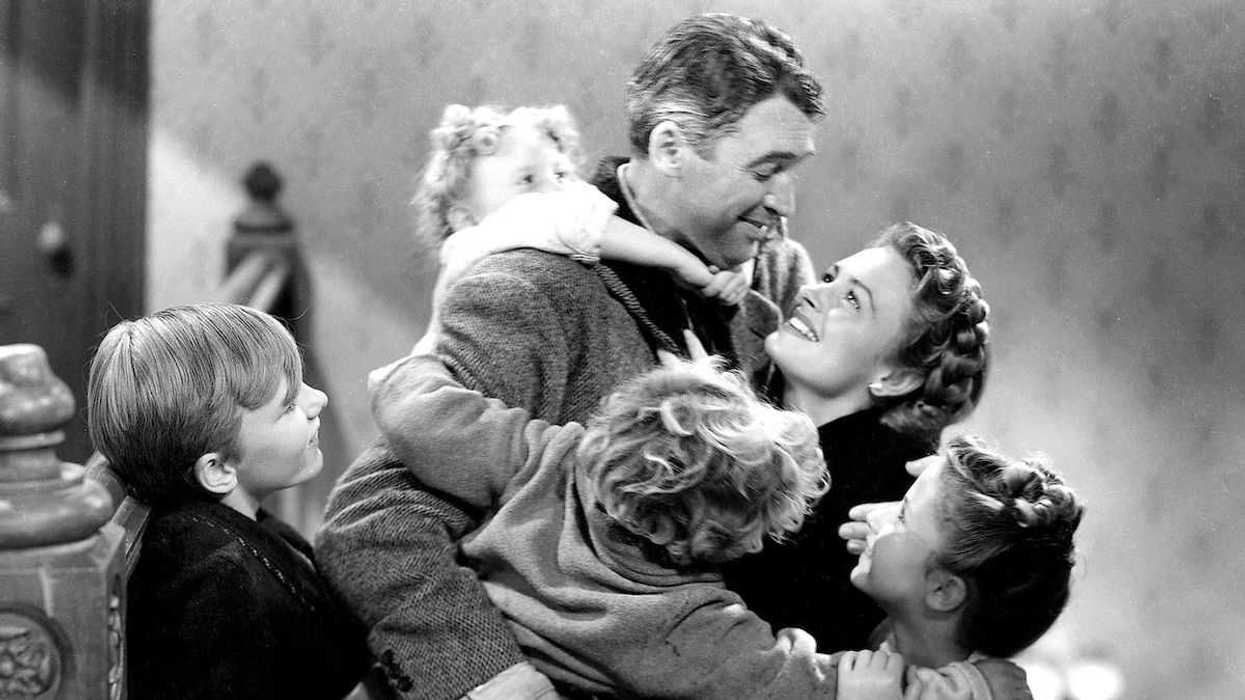
As he returns home on Christmas Eve, George gets a delightful surprise, knowing that his family, friends, and community have come together to rescue him from his financial crisis. Among the donations, gifts, and friends, George finds a book, The Adventures of Tom Sawyer, that he got from Clarence, his guardian angel.
George opens the book and reads Clarence’s message on the first blank page, “Remember, no man is a failure who has friends.”
Right after, a bell on the Christmas tree rings, to which George’s youngest daughter, Zuzu (Karolyn Grimes), excitedly says, “Every time a bell rings, an angel gets his wings.”
George replies, “That’s right. That’s right.” He looks in the direction of the sky and winks, “Attaboy, Clarence.”
Then the crowd gathered in the house starts singing “Auld Lang Syne” together as the movie comes to a close.
What Does Clarence’s Line Really Mean?
George Bailey’s Failed Ambitions
 'It's a Wonderful Life'Credit: RKO Radio Pictures
As a kid, all George Bailey wanted to do was travel around the world and explore life. As he grew older, life happened, and his responsibilities never let him step out and chase his dreams.
He helps people find cheap housing, lends money to those who need it most, and takes care of everyone. Yet, he owns a dilapidated house, has a loan over his head, and guilt for his dead dreams. In traditional measures and society’s perspective, George Bailey is a failure in life.
How the Movie Rejects the Conventional Way
 'It's a Wonderful Life'Credit: RKO Radio Pictures
But the film terms failure as something other than this. The filmmaker argues that a “failure,” to other people’s eyes, hides a quiet advantage invisible to them and us.
Through flashbacks in the film, we see George rescue his brother, Harry (Todd Karns), from drowning. He saves a pharmacist from accidentally poisoning a kid and provides cheap housing to families. But none of these acts brings him wealth or any tangible gain.
But in a world devoid of George Bailey, he sees Harry drown, who never grows up to become a war hero. He witnesses his wife’s living conditions, a town completely corrupted and financially controlled by greedy Mr. Potter (Lionel Barrymore).
What Success and Failure Mean from Frank Capra’s Perspective
 'It's a Wonderful Life'Credit: RKO Radio Pictures
Clarence’s message, “No man is a failure who has friends,” redefines what a failure actually is and what it is not. It is the absence of the company of friends that causes failure in someone’s life, not the material achievements.
It’s because friendship and connection hold an invisible power, which somehow works in the movie too, as the people George has helped over the course of his life are the ones who bail him out of his financial misery in the climax.
People who have friends to back them up never lose in life, as they are the real currency. They are the safety net. And in the movie, George has helped countless people and made friends with them, so he doesn’t need to feel like a failure in life.
The universe has a special way to say thanks to people like George. The condition is that you shouldn’t live life as if it has to be perfect, with all selfish desires to be ticked off before growing old.
Moreover, “No man is a failure who has friends,” resonates even more because the movie had come out in the post-World War II era. So, It’s a Wonderful Life had its fair share of postwar American masculine anxiety, which is asking oneself if their sacrifices even mean anything.