When Officials Talked About Killing Reporters, Ben Klein Made a Movie About It
The director spent months earning a newspaper family's trust, then put the first shoot on credit cards.
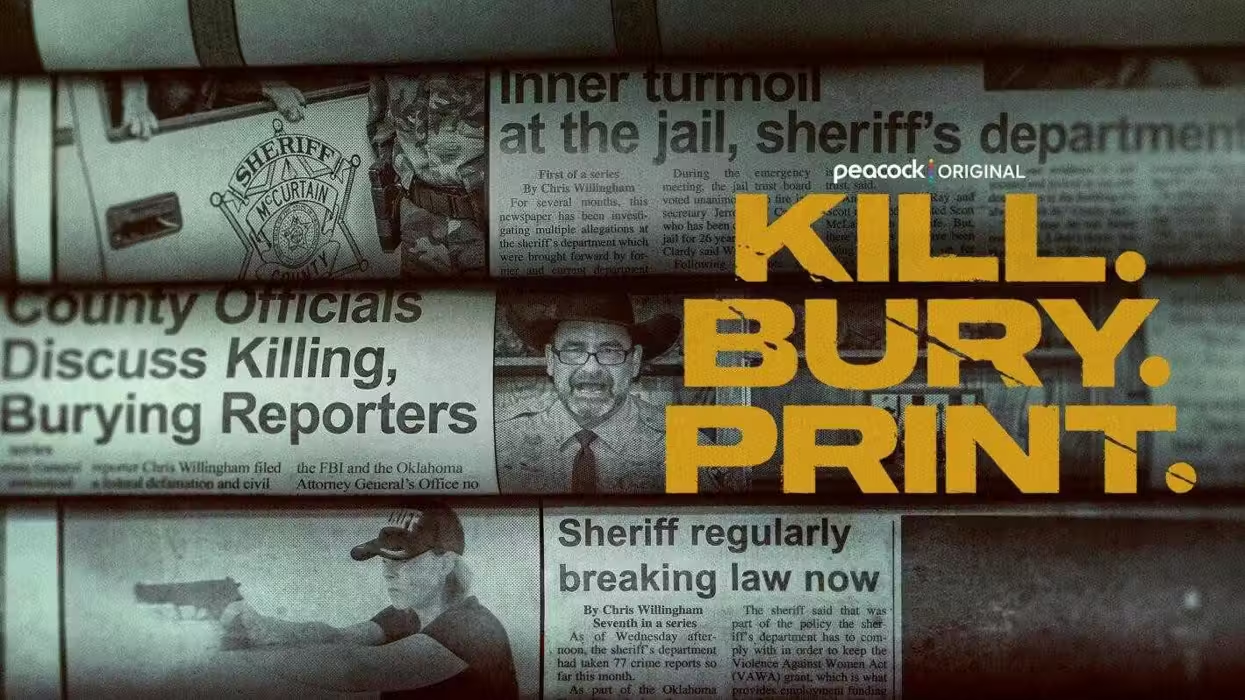
'Kill. Bury. Print.'
In March 2023, the publisher of the McCurtain Gazette in Idabel, Oklahoma, suspected that county officials were conducting business after a public meeting had ended, which would violate the state's Open Meeting Act. So Bruce Willingham left a voice-activated recorder running in a meeting room.
On that recording, the county sheriff and other officials complained about the newspaper's journalists and talked about knowing hit men… and where two holes were already dug. The Gazette published the recording that April, and the story went national.
Director Ben Klein heard about it the way most of us did, through the headlines, and couldn't let it go. He flew down to Oklahoma to make a documentary about it.
Previously, Klein co-directed The Exiles, which won the U.S. Documentary Grand Jury Prize at Sundance in 2022. For his new documentary, he spent months trying to reach the Willinghams, who were buried in media requests. When they finally agreed to speak with him, Klein said he and his producing partners at Number 19 put the first shoot on their credit cards. They had no network, no funding, and no sizzle reel.
That bet became Kill. Bury. Print., produced with Rachel Maddow and now streaming on Peacock. In addition, The Montclair Film Festival will honor Klein and Maddow with its David Carr Award for Truth in Non-Fiction Filmmaking at a screening on Oct. 17.
We spoke with Klein about chasing access, keeping a lean crew, and vetting claims in a town where everyone knows everyone, and they all have their own version of the story.
- YouTube www.youtube.com
Editor’s note: The following conversation has been edited for length and clarity.
No Film School: You came in, I think roughly around a year after that recording went public. So as you approach this story, how do you find your focus?
Ben Klein: That's a big question. That's a tough one. I think to me, the focus of this story was so central from the beginning, and that's something that really appealed to me about it is that it spoke to a lot of these larger themes: the death of journalism, corruption in America, the allegations being thrown around willy-nilly.
It seemed that there was a lot that spoke to larger themes in the country, but through a very specific and personal story. It had this amazing family at the center of it, this family unit that ran the newspaper. And especially, I reached out to them almost immediately after I heard about this story, and they were getting so much media attention at the time, and it's this little small family paper, and they were entirely unprepared for being the center of a huge national news story.
So, understandably, they were inundated with a lot of requests and a lot of new experiences, but I was so obsessed with the story, so I kept trying and kept trying to speak with them. And it was almost maybe six to eight months after I first reached out that I was able to make contact. And we spoke, and it took a lot of back-and-forth, but eventually they agreed to let us come down and meet them and start filming.
So that was, I think it was May or June. It was May of 2024 was the first time my crew and I went down there, and we interviewed the Willingham family and some other citizens. The first time I stepped inside the Gazette office, it was just this unbelievable time capsule. All the technology’s straight out of 1991. It's just this incredible place with so much life and people insanely devoted to what they do and focused on local news. And it just felt like this is the access, this is the story, this small family unit up against so much pressure.
I just felt like right away that there was something really important going on here, and it only deepened from there. We were down in McCurtain County quite a bit and spoke to all sorts of people involved, different sides of the equation, and so many people had been affected by it as well.
As you see in the film, there are all these different stories and tangents we go on because the sheriff's department down there, so many different people were affected by what was happening and had their own spin on it, own view on it.
So yeah, there were certainly a lot of challenges that came up along the way, but in terms of how to begin approaching the story, it didn't feel that challenging from the outset because it just had this amazing family at the center of it, so we knew that's where it had to start.
NFS: So did you know from the beginning, “I want to make a documentary about this situation”?
BK: Yeah, definitely. I started hearing the story when it broke nationally and just kept tabs on it. And especially after meeting the Willinghams, I knew this film could work. And after spending time inside the Gazette and just in McCurtain County in general. The people down there are amazing. They're so passionate and protective, and they have an amazing way of speaking. It just became clearer and clearer that a feature could work.
The first time I heard about this story, I thought that there was a film there for sure. I think that's often how it works, or at least for me, has been my experience: you think of all sorts of different topics or things that could maybe be a documentary film, but when I hear about something that strikes me in this way, I know almost instantly there's something here; this could definitely work. It's like that magic feeling that you're chasing all the time.
I think that's why we fought so hard for it. The first time we went down there, this project was not funded. We were not working with Peacock. We had not sold anything. We hadn't made a sizzle. My producing partners and Number 19 and I, we literally put that first shoot on our credit cards, and flew down there and filmed this with no promise of it working out. We felt so strongly that this was a story that needed to be told, and we wanted to be the people to tell it.
NFS: What does your crew typically look like on a shoot like this?
BK: It depends. I think for the most part we had a pretty lean and tight crew. It was me, a producer, cinematographer, AC, and sound typically while we were down there.
For the election scene in the film, the primary election, that was just me and my close collaborator, Connor Smith, who also cut the film. It was just the two of us down there. I was doing sound; he was shooting.
It depends, but I really like to work with a lean crew. I like to be mobile. I like to be reactive. I like to stay on our toes, keep a light footprint, and try to fade into the background as much as possible. Certain things obviously require more manpower, but yeah, on this one we kept it light, and I felt like that approach wound up working out.
NFS: How do you as a documentarian build a relationship and trust with the people that you're talking to?
BK: I think it's just about having conversations, talking a lot about what inspired me about the story, why I was interested in telling it, talking with them about their experience and the realities of documentary, what it's going to take, how much time. The Willinghams and everyone else we spoke to down there could not have been more generous and open with their time and their stories, and by providing supplemental documents and archival. I was really blown away by the hospitality from everyone we spoke to.
And I tell everyone about our team and who's involved and what they're bringing to this. I'm very lucky to work with an amazing crew. I think just meeting them and having that mutual trust, mutual respect, and honesty is always the first approach.
NFS: You deal with a lot in this story that has to do with rumors and explosive claims. How do you approach verifying what you're going to put in?
BK: Well, we always want multiple sources on anything. We had an extensive, extensive legal review on this film. Obviously, with explosive claims, especially. Everything has been vetted down to a T. Our producers are all over it. And my editor and I spent so much time going through any piece of evidence we can find.
There are a lot of contentious things going on in this. And so we tried to speak to anyone who was willing to talk to us. We reached out to the sheriff and [investigator] Alicia Manning multiple times, trying to do interviews.
There's an active lawsuit going on right now, so it made some people less willing to speak with us, but we cast a very wide net and made sure we did diligence on every single thing that wound up in the film.
NFS: Is there anything in particular that you learned making this project?
BK: Oh, God, so much. I don't even know where to start. Filmmaking-wise, I think on the edit side of things, it was simultaneously a new experience and a comfortable one. I think this was the first film that I've made for a larger network like NBC, and so working with executives and taking notes, and these kinds of things were somewhat new to me. I had previously done some TV work and had a bit of that experience, but on a film, this was the first time.
And NBC was great, and all the executives we were lucky to work with were awesome. But on the flip side of that, my editor and I, Connor Smith, who I've worked with in the past, we cut this film in his bedroom studio, and it felt like an indie in a lot of ways. It was an interesting mix between the two.
So I think I learned a bit about how to work on a slightly bigger level, more formal level, but trying to keep our independent spirit while doing so.
NFS: Is there any advice you would give a new documentary filmmaker working on a divisive story?
BK: I would just encourage them to speak to both sides as much as possible and to try to verify information and ultimately just to try and treat everyone with respect because it's a very difficult job. It's tough to parse through some of these things, especially when it's real people, and it's affected their lives. So I think as long as you're trying to hold yourself to a very high standard and trying to make sure that you're approaching the story with respect and honesty and trying to do your job.
I think my advice on the non-divisive issue, in regard to the film, would be similarly just if you have that feeling that this is a story worth telling, a story you have to tell, then just going for it. We took a real risk in just starting this film, but I knew that ultimately it would work out because it's just struck me as a really vital story, a really important story and one worth taking a bet on.
NFS: Is there anything you want to add about the film?
BK: I think it's really crazy timing that the film has come out at the same time as we're dealing with this White House press ban, and freedom of speech is just under attack nationwide. The film has been very relevant to me since we started shooting it, but has only grown more and more so since it's come out, even.
I just think it's such a great example for why we need a free press in this country, and not just a free press because the way we get information, the way we share information, has changed and is changing so drastically. And I do think, very sadly, newspapers are going out of business, especially local newspapers, and there are a ton of news deserts in the U.S., and that's only likely to increase. And I hope when people see this film, they think about their local newspaper and how important it is and where they would be without it.
Because as the film shows, without the McCurtain Gazette, that sheriff's office might still be running the same way, and all these people's lives would be affected, and no one would know about it.
Journalism might not always be the most popular thing. It's very hard to be a small-town paper ... You're living right next to people you're writing about. You're at the grocery store with someone who you just wrote about the worst day of their life.
It's very tough business, and it makes people mad, but it is a vitally important part of our society and our democracy, and it's what keeps things level, and it keeps powerful people accountable. And I just hope that the film reminds people of that and reminds us what we stand to lose.