Why Luke Skywalker Throwing His Lightsaber Was the Most Powerful ‘Return of the Jedi’ Moment
The saga’s moral peak hinged on a critical Skywalker decision.
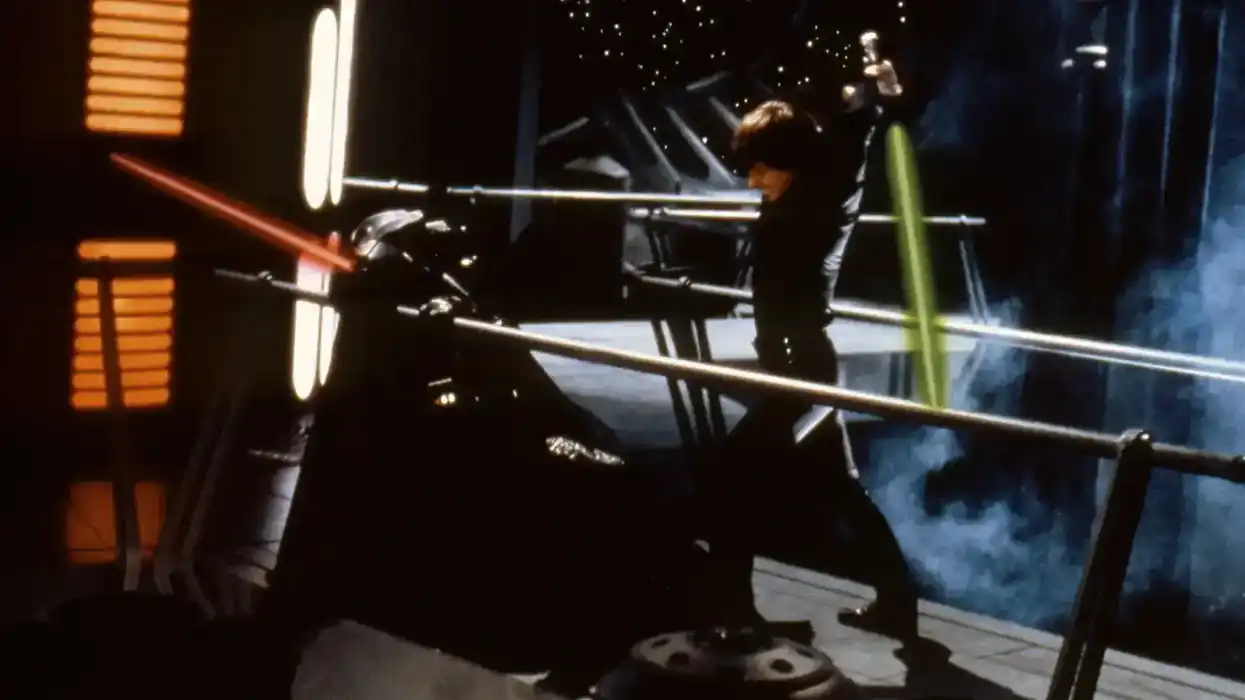
'Star Wars: Episode VI - The Return of the Jedi' (1983)
Towards the end of Star Wars: Episode VI - Return of the Jedi (1983), directed by Richard Marquand, an epic climax unfolds in the throne room of the second Death Star. Luke Skywalker confronts Darth Vader while Emperor Palpatine watches.
Palpatine wishes to provoke Luke into killing Vader out of anger and then claim him as the new Sith apprentice. What is considered one of the most iconic moments in the saga’s history, this battle is most spoken about for Luke Skywalker’s pivotal decision: to throw his lightsaber away.
Luke’s hesitation and eventual decision not to strike a killing blow is a perfect example of what makes Star Wars an epic that never loses sight of delivering crucial moral messages. For the legendary series, it was never about simple victory or defeat but about how decisions are influenced by deeper, more spiritual choices about the kind of warrior one chooses to be.
What can this iconic scene teach us about character values and the dramatic power of choosing not to act?
Let’s jump right in and explore.
Why Luke Chose To Stop Fighting
After Luke Skywalker’s (Mark Hamill) epic clash with Darth Vader (David Prowse, voiced by James Earl Jones), absolute victory, at least in the physical sense, is entirely within Luke’s reach. As soon as Darth Vader loses his mechanical hand, thanks to Luke's lethal blow, Vader is down and, in action-movie terms, “there for the taking.”
Luke takes a moment to gather himself when Emperor Palpatine urges him to strike the final blow, kill Darth Vader, and embrace the dark side. He says, “Your hate has made you powerful. Now, fulfill your destiny and take your father’s place at my side.”
Skywalker hesitates, glances at his own arm and the severed arm of Darth Vader. He throws his lightsaber away and says, “Never. I’ll never turn to the dark side. You’ve failed, your Highness. I am a Jedi, like my father before me.”
Luke’s decision stems from absolute clarity that hits him the moment he destroys Darth Vader’s hand. Mirroring the loss Luke himself suffered in The Empire Strikes Back, he sees his own anger reflected back at him. Luke realizes that killing Vader would mean giving in to the very anger Palpatine encouraged, eventually culminating in his move to the dark side.
By throwing away his weapon, Luke makes a critical decision of tremendous moral weight. He rejects the very idea of unrelenting aggression and chooses the path of peace. Some consider this to be surrender, but that is not what Luke’s action actually symbolizes. Instead, it is a profound example of Luke preserving his integrity and identity and choosing compassion over giving in to the rage of the moment.
How Character Values Can Resolve Conflict
It’s a lot easier for a character to speak about their values than to actually show them through their actions, especially in critical situations. In the case of Star Wars, this wasn’t just a critical moment for the movie it is part of, but for the entire saga.
While physical victory might have been the most obvious resolution to Luke Skywalker and Darth Vader’s conflict, the path Luke takes elevates the scene to an entirely different level. Throughout the original trilogy, Luke believes that there is still some good left in his father. An absolute act of killing would negate this notion.
By choosing compassion over murder, Luke Skywalker remains true to his belief system, not only towards Darth Vader but also toward his own life philosophy and the Jedi way of thinking. In this iconic scene, Luke chooses kindness and compassion over anger and violence.
Luke Skywalker’s values are visible through his actions, not just his words. His confrontation with Darth Vader, to this day, is considered one of the most epic moments in film history, and perhaps, if he had chosen to give in to his anger, it might not have been held in the same regard.
The Dramatic Power Of Choosing Not To Act
Not acting upon something can also be a powerful cinematic tool, not just a representation of character values. Luke Skywalker “acted” with profound wisdom by simply choosing not to act. Think about it. Would this scene be talked about as much as it is today if Luke simply chose to kill? Maybe not.
The moral dilemma that Luke faces culminates in his choice of peace over death and destruction, which is what makes it noble and memorable.
In most cinematic duels, the hero proves his worthiness by defeating the enemy. In fact, in many cases, this is considered the most obvious outcome, especially when the ending we are talking about is a crucial moment in a widely popular saga.
Luke’s act of throwing away the lightsaber is simple, from a physical point of view, but it carries tremendous emotional weight. His decision crystallizes his identity as a Jedi who prides himself on every decision he makes, not just the battles he physically wins. While the latter would be more about typical heroic dominance, the former is a fascinating example of moral clarity and wisdom.
Summing It Up
Luke Skywalker’s decision to throw away his lightsaber is one of the most defining moments in the Star Wars saga. In a trilogy that does not shy away from action, its greatest, most poignant moment essentially hinges on a decision not to act.
Which is your favorite quote from this duel between Luke Skywalker and Darth Vader? Tell us in the comments below.