Many great actors have been attracted to the magnetism and aura of the director’s chair. After years of being in front of the camera, some actors felt the need to either go behind it or, as in the case of Marlon Brando in One-Eyed Jacks, do both simultaneously.
Brando never took up directing as a career. But he did make this movie, the only directorial venture in his filmography, a genre-bending Western experience.
I find it particularly interesting when actors take up the role of a director, but even more interesting when they do it once and never again. So what was this movie about? And how is it different from a traditional Western?
Let’s jump right in.
What Is One-Eyed Jacks About?
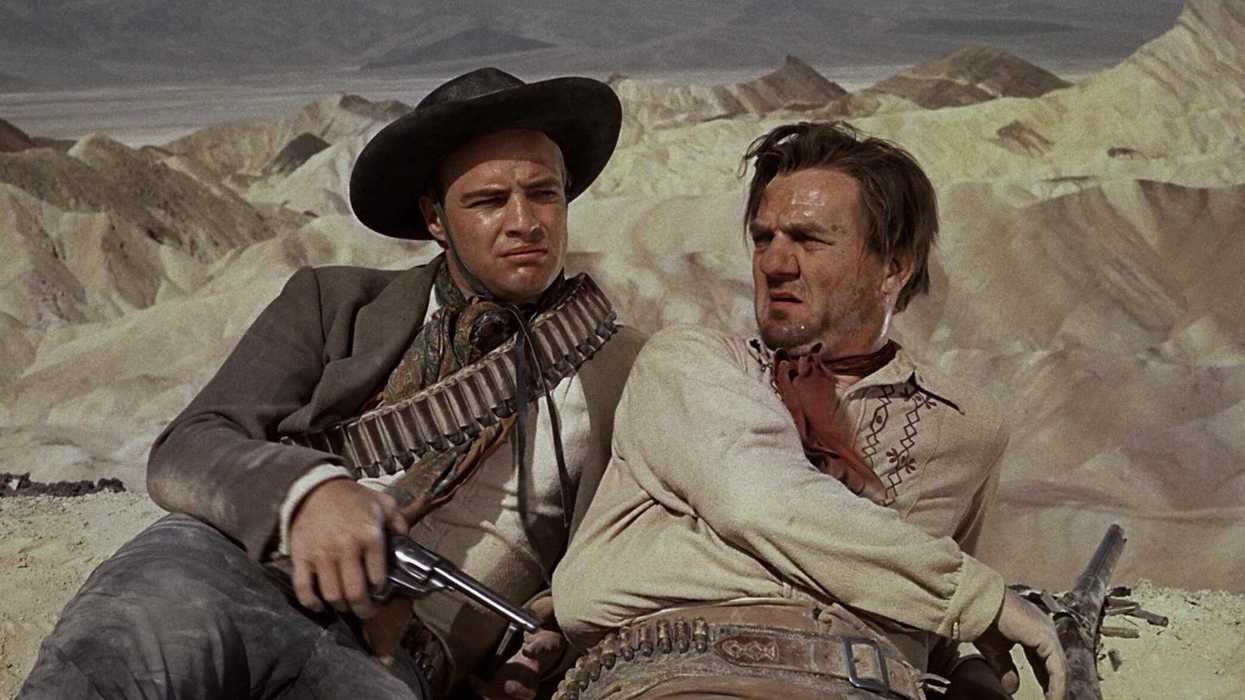
One-Eyed Jacks follows a bank robber, Rio, played by Marlon Brando, and his partner, Dad Longworth (Karl Malden), as they pull off a heist in Mexico. When they come under threat, Dad Longworth betrays Rio. Rio gets captured, and Longworth escapes with the gold.
Years later, Rio escapes prison and hunts for Longworth, only to find him settled down as a respectable small-town sheriff. Rio, who has obviously not forgotten their shared past, chooses a measured approach to revenge instead of a quick one. At this time, Longworth has already married Maria (Katy Jurado) and has a stepdaughter, Louisa (Pina Pellicer).
Rio infiltrates the town and becomes involved with Louisa, partly as a means to get back at Longworth. Over time, genuine feelings emerge between the two of them, and a romance begins to bloom. Rio continues to be driven by the idea of vengeance, but is met with brutal confrontations that leave him physically damaged.
The film builds towards a tense showdown, driven by primary themes of betrayal, vengeance, and complications arising from emotional connections between people. Unlike typical Westerns, Brando’s film looks inward rather than outward. Vengeance isn’t achieved easily, and characters evolve as human beings, as do the relationships between them.
How One-Eyed Jacks Breaks Away From The Traditional Western
Unlike most Westerns from its era, One-Eyed Jacks is more focused on the “how” than the “what”. I mean, the film prioritizes morality over simplistic resolutions, even though the genre is famous for such resolutions, often as a basis for action sequences.
Don’t get me wrong, we love Westerns for exactly these reasons. More often than not, we aren’t as concerned about a character’s inner conflict as we are about how they could teach someone else a lesson or seek vengeance. However, Brando created a new language within a beloved genre, and I think that’s admirable.
In Western films, we are used to a meandering plot; we want to be surprised by how the lead character outsmarts the people around them. Many great Westerns are a collection of fantastic action pieces stitched together by a story that simply takes you from one to the next. Brando’s film slows down this process. It focuses on Rio’s struggle and the effects of Longworth’s betrayal weighing down on him.
If you think about it, betrayal isn’t an uncommon trope in Westerns. In fact, it’s almost a staple or fuel for a character to do something about. But Brando uses betrayal as a basis to study Rio’s character as a human being. It isn’t just about Longworth running away with the gold; it’s about how doing so ruined Rio’s fate.
Brando pulls the audience's attention towards Rio’s conflicting emotions. When he meets Louisa and a real connection ensues, he tries to establish how torn Rio is, with vengeance still on his mind. In many ways, One-Eyed Jacks can be considered a Western with the soul of a psychological drama. The film uses the foundations of a Western to focus on character, a man’s inner complications that may or may not dent his ultimate purpose.
In this Western, violence feels more like a ‘price’ than a ‘prize’. It isn’t an opportunity the characters earn; it is the price they pay for the world they live in and the situations they find themselves in. This is, perhaps, the single most important differentiating factor between One-Eyed Jacks and a traditional Western film.
 'One-Eyed Jacks' (1961)Credit: Paramount Pictures
Marlon Brando As A Director
It makes sense to me that a film like One-Eyed Jacks came from an actor like Marlon Brando. The internal nature of its focus, the philosophical undercurrents to its central conflict, the film’s emphasis on relationships and their complexities over action sequences and quintessential Western mayhem, all amount to the same belief.
What’s difficult for me to comment on is why another film did not follow up on this one, and I don’t like to speculate based on an actor’s reported personality or what his working relationships “might have been” with studio heads.
I’m always excited to watch a film when it is directed by an actor I admire. It makes me significantly more curious to see why they decided to make this film in particular and what they, as actors, would bring to the subject as directors. In One-Eyed Jacks, Marlon Brando brings his wealth of acting experience and leverages his philosophical curiosities into his filmmaking. Unlike a typical Western or an action film, Brando is not afraid of silences and slow moments. Both these aspects bring a freshness to the Western genre, which I often feel, references itself rather than reinventing and breaking away from typicality.
Reshaping a genre as remarkably well-defined as the Western is no easy task. I don’t think it is a coincidence that the man who ended up doing it, even if he did it only once, was Marlon Brando.
Final Thoughts
One-Eyed Jacks may not be a Western that is remembered as much as other popular films in the genre, but whoever watches it will admire it for its refreshingly different approach. Good films become part of human history, and history will be kind to those who made an effort to do something different and throw light where there had not been light before, whether it's about this particular film or another.
Why do you think Marlon Brando never directed a second film? Tell us in the comments below.
- What Are the Best Marlon Brando Movies? ›
- Did Marlon Brando Really Refuse to Learn His Lines? The Hollywood Myth Explained ›
- How Did Marlon Brando Change Acting Forever? ›
- Make Your Directorial Debut with These Tips From Phoebe Nir | No ... ›
- 12 Tips for Working with Non-Professional Teenage Actors | No Film ... ›
- Getting Better as a Director: Learning How to Talk to Actors | No Film ... ›
- Words of a Legend: 9 Iconic Movie Quotes From Marlon Brando ›