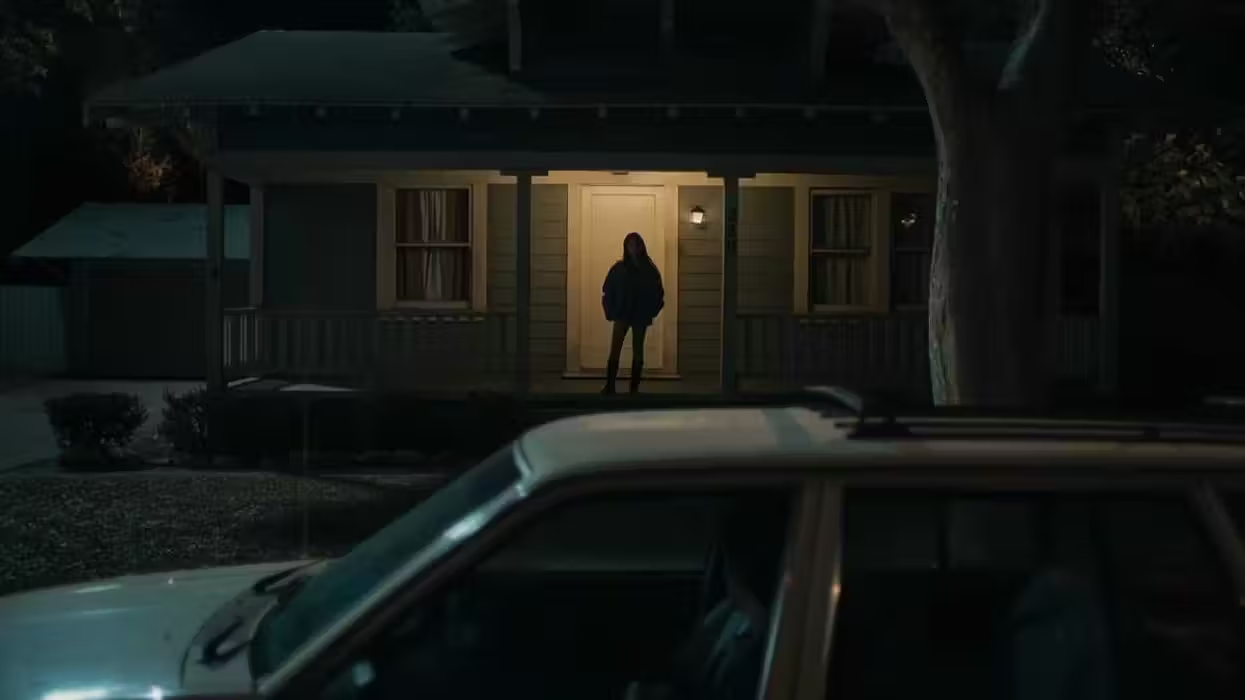
Obsession has grossed over $290 million worldwide on a budget somewhere between $750,000 and $1 million. Its driving scenes look like something shot on a major studio stage.
They weren't! They were lit inside an LED volume by a small crew doing a lot with very little.
The film follows Bear, a character obsessed with Nikki, who just likes him as a friend. But after he makes a wish on a One Wish Willow, Nikki's feelings suddenly change. Even though the wish goes sour fairly quickly, Bear keeps moving forward, trying to make things work.
I saw this a second time with a DP friend who clocked it immediately because he's worked on a lot of LED walls. I'm typically not paying attention to things like that in an early viewing, so I'll admit I hadn't even noticed until he pointed it out.
Gaffer Christopher Oh and lighting programmer Bicher Barmada, working under DP Taylor Clemons, broke down exactly how they did it in a recent video, walking through every scene they shot at the volume.
We've already covered what Curry Barker learned making the film. This is the lighting side of that story. Let's dive in.
- YouTube www.youtube.com
They Previs'd the Entire Film in 3D
Clemons uses a video game-style software to 3D-scan locations and build walkable environments for pre-visualization. And on Obsession, that meant the entire film, not just the volume sequences.
In a tight-crew environment where every hour costs money, being able to walk through a virtual version of the set and start placing lights before anyone touches any hardware changes the math significantly.
"It's not going to be super accurate," Oh said, "but you get kind of an idea."
On a production where the camera rig, the volume panels, and all the practicals are sharing extremely limited real estate, walking in with a plan is super important.
The previs was especially helpful for figuring out how much of the physical space the camera rig would actually consume. On a larger production, that logistics problem gets solved by dedicated departments with days to sort it out. Here, as Barmada noted, they "had very little crew" and "a lot of work to do."
Knowing the spatial constraints ahead of time meant they could design the lighting package before getting on set.
The Single Biggest Rule on Any Volume Shoot
"The biggest thing coming in," Oh said, "was we knew the second we had lights spilling on the video wall ... you're kind of cooked."
Every lighting decision on the Obsession volume days was made in relation to that constraint. The LED wall only functions as a believable background when its surface stays clean. The moment a key, a bounce, or anything else bleeds onto the screen, the image on the wall degrades and the illusion collapses.
We've covered this in our guide to lighting LED stages. It's the fundamental problem of volume work, and it has to be designed around from the beginning.
How They Lit the Driving Scenes
An early driving scene featuring Nikki and Bear heading home was built around a rig designed for controlled, consistent movement simulation. Five SkyPanel S60s on a truss handled the moving exterior environment.
Five SkyPanel S60s on a truss handled the moving exterior environment. A CreamSource SpaceX served as the key, replacing the SkyPanel from their exterior location.
Two Vortex8 lights handled moonlight fill through a 12x muslin. Two Aputure 600Cs alternated as street lights and brake lights, with a DMG DASH mounted on top of the camera.
The street light simulation is where Barmada's approach diverges from the usual volume playbook. Rather than using media server interpolation or Unreal Engine integration to match the Atlanta driving plates, he busked it all by hand from his lighting console, watching ahead of the car in the plates, anticipating what was coming, and calling his own cues.
"Blue, long, slow, go," he demonstrates in the video.
Stacking layers of color, intensity, speed, and effect length in real time, he built the impression of passing streetlights manually for every take.
 Obsession Credit: Focus Features
How Production Design Sold the Background
Production designer Vivian Gray applied a consistent layer of glaze and haze to the car windows, and it ended up being one of the more important visual decisions of the shoot. On set, Oh's first instinct was that it telegraphed the absence of a real backdrop.
"I thought it looked great on the big screen," Barmada said. "It added so much texture."
For coverage, the team physically rotated the car between setups since the LED wall stays fixed, which means maintaining both sides of the lighting world simultaneously. Barmada had both presets saved in his console. Switching was mostly a flip with minor adjustments per shot.
The Big Scream and the Red Light
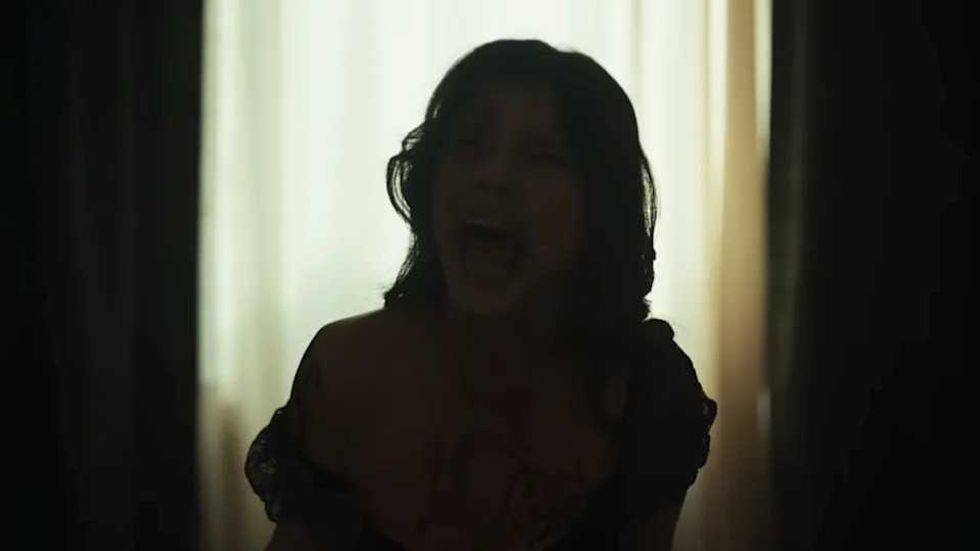
During Bear's big, emotional car scene (reading the acceptance letter before a huge scream), Barker called an audible. While Michael Johnston's character screamed, Barmada dialed the entire lighting environment from blue to red.
"It breaks the entire color science of the film," Barmada said. "It breaks every established look for the entire rest of the film."
Yeah, they knew, but they did it anyway. Barmada didn't even have a red preset in his console. The film's palette had no use for one. So he built it from scratch on Barker's instruction, in the moment.
It got cut. But the speed of the response, a director calling for something completely outside the established system and the crew executing it within seconds, is an argument for the whole console-driven workflow.
Barmada's closing advice for anyone heading into a volume shoot is to get a programmer and bring them into pre-production.
"Volume and console integration makes all of this so much easier," he said.
The Obsession car/driving scenes worked so well (and were so seamless to eyes like mine) because the prep was done, the presets were built, and when something changed (be it coverage direction, a spontaneous color idea, a last-minute reshoot), the team could respond without rebuilding from scratch.
- What Are The Lessons Hollywood Should Learn From The Success of 'Backrooms' and 'Obsession'? ›
- From $800 Film to Hollywood Deal: What You Can Learn From Curry Barker’s Rise ›
- 'Obsession' Ending Explained: Who Got What They Wished For? ›
- The 'Obsession' Effect: How a YouTuber-Turned-Filmmaker Just Bagged an 8-Figure Studio Offer ›
- Decoding ‘Obsession’: When Was the Real Nikki Actually in Control? ›
- Designing Indie Horror: The Production Design of 'Obsession' ›
- How 'The Isolate Thief' DP Lit a Whole Movie in Prep ›