This DP Solved a 6-Page Dinner Scene with One Light
Complicated lighting set-ups on a budget.
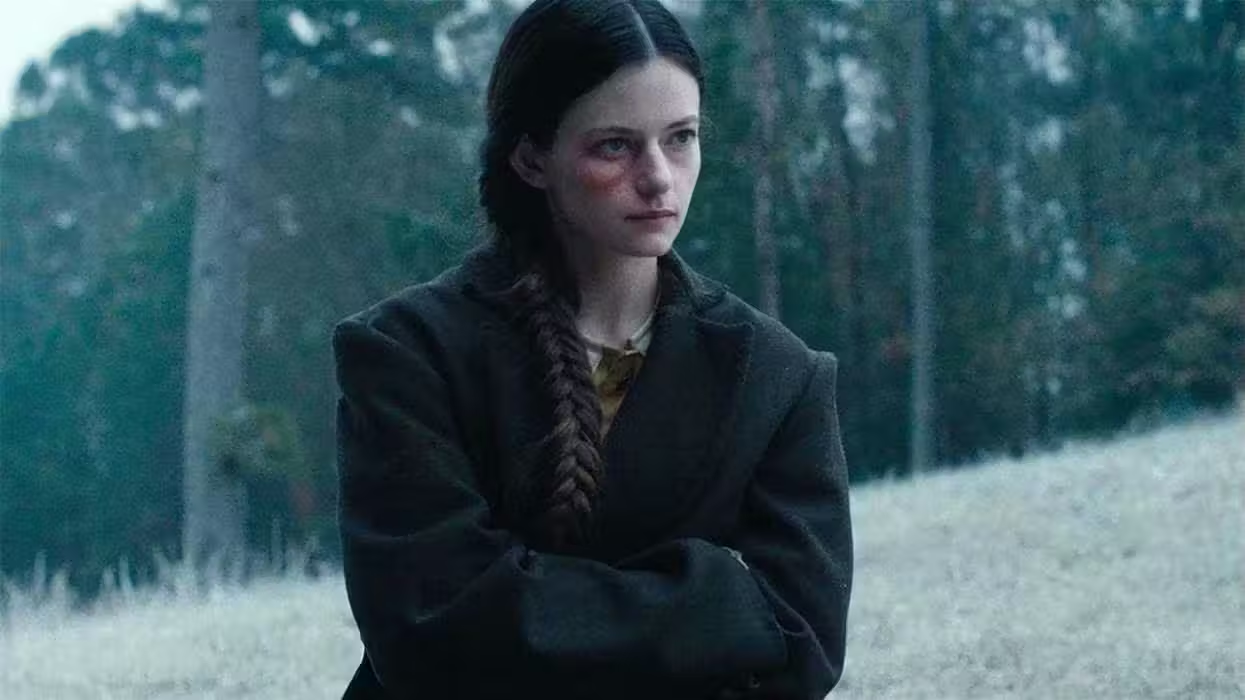
'The Isolate Thief'
In The Isolate Thief, Ada Horn (Mackenzie Foy) is stranded at a snowbound Union Army outpost in Oregon after her father dies. She stumbles on a stash of stolen gold and decides to hide it. Cue a gang of outlaws led by Sean Bean, who show up and take over her cabin. Now it's Ada versus the bad guys. It's directed by John Suits and written by Kevin Lefler.
Cinematographer Will Stone recently broke the film down for DP Camp. He said the film had a $3 million budget and about four weeks of prep, roughly two of which went to shot listing. What he built in those four weeks is what let him shoot it effectively. Let's learn from his experience.
- YouTubewww.youtube.com
Prep Is Where the Schedule Is Won
Stone's framing of the budget is pretty unromantic and straightforward, which we like around here.
"Generally, the budget does determine the amount of days you have. It determines the size of the crew you can have. And then you do have to take those constraints and try to find a creative way to still give everything you can to the best creative vision that the script calls for," he said.
So he front-loaded in prep in order to preserve the indie filmmaker's most important asset—time. Line diagrams, shooting rules, reference films, prep documents. The lens decision came out of the same thinking. Stone said the film was contained and the main character isolated, so big vistas were off the table, which pushed him away from the Sergio Leone anamorphic tradition.
"So our approach was to go spherical in order to be able to get intimate with the character within the cabin, but also to be able to show space when needed and not have technical limitations as well with the lensing," he said.
If you're weighing the same call, our breakdown of anamorphic versus spherical covers what each choice costs you.
Blocking the Sun Was the Lighting Plan
The production built the cabin itself, but not on a stage. A local landowner gave them a deal on a practical location. Stone said that even though it was built for them, it wasn't a set and behaved pretty much like an actual house. And what does that mean? Uncontrolled daylight everywhere.
The fix went into his plan.
"So we had to control a lot of direct sunlight coming in. So [I] built into my lighting plan, along with my gaffer—we decided to create shelves above the windows to block more direct sunlight that's coming in toppy. And we bounced 18Ks into ultra bounce under the shelves, and that created this nice natural light pushing in through the windows and helped us maintain levels outside," Stone said.
Direct sun through a window is the least cooperative light source on any set. It's hard, it's hot, and it moves around on you, coming in at a different angle and a different intensity and a different color at different times. On a contained film shooting in one room for days, that isn't an aesthetic problem so much as a continuity issue.
"Toppy" is also a specific complaint. When the sun comes in high and steep, it rakes straight down. Eye sockets go dark, noses throw shadows onto lips, and everyone reads like they're standing under a bright parking garage fixture. It also reads unmistakably as midday, a problem for a movie set in the winter of 1865 that Stone said was shot in early to mid-fall.
Outside, he said it was 12-by-20s and a lot of subtraction. If that's unfamiliar territory, start with our primer on negative fill.
- YouTubewww.youtube.com
One Top Light, Six People, Six Pages
Imagine you're facing a table scene. Lots of pages. You have a day to shoot it. It's tough for a ton of reasons, mostly coverage and sound. And that number of pages could be shot over several days, not just one. Stone identified the enemy immediately.
"Whenever you have six people sitting around a table, then eyelines become a big concern. One way that I wanted to do this is I didn't want to have to be relighting for every eyline and I wanted to try to be able to light everyone pretty similarly so that we can pop around and get the angles that we need quickly and efficiently," he said.
The answer was one soft top light, an 8-foot pipe light, double-diffused with muslin and skirted. Everyone sat in the same quality of light, so when the camera moved, nothing needed to be relit. Stone credits grip and electric, plus a gaffer and key grip who delegated well.
For thinking about your own day in these terms, see our piece on shots, takes, and pages.
The Moonbox and Options
Night exteriors had action running in every direction and no time for precision. Stone's answer was to stop chasing the light.
"I wanted the moonbox to be as versatile as possible. So, instead of trying to dial it into hitting a certain stop from a certain distance, we weren't able to be that precise. So, what we did is we maxed out the amount of light that we could get out of the moonbox, also based off of budget and weight and things like that," he said.
He also placed the fixture roughly 25 feet away from Bean rather than overhead.
"Instead of putting your subject directly under it, [I] like having the top light away from your subject, and then the falloff is a lot more pleasing," he said.
Let the Image Be Imperfect
Working on a budget and tight schedule, a DP has to be willing to let some things slide. Stone kept the windows hot without letting them clip, retaining information so he could push to just short of blown in the grade. He also refused to nail his white balance. There are pools of light for actors to walk in and out of. Bean silhouetted just outside the light until his gun goes off and briefly lights the room.
"It's okay to not have somebody lit perfectly all the time," Stone said. "Allow for the imperfections and embrace whenever you find something that's more than what you planned, or maybe it's what you planned but looks even cooler than you imagined."