In his new movie, Bitter Christmas (Amarga Navidad), iconic Spanish director Pedro Almodóvar uses autofiction (a style of storytelling that involves weaving autobiographical elements with fiction) to weave a complicated tale about filmmaking, his own life, and even the creation of the very movie you're watching. It can be difficult to understand if you haven't literally seen his entire filmography. But guess who has two thumbs and has done exactly that? This guy!
Let me walk you through what you can glean from the movie and what remains mysterious.
- YouTube www.youtube.com
Peeling Back the Layers of Autofiction in Bitter Christmas
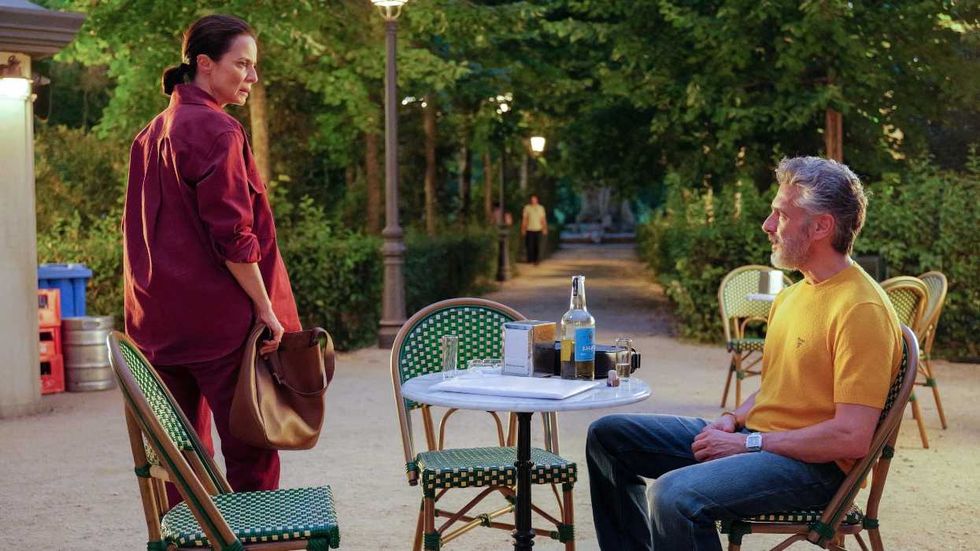
Bitter Christmas is a movie that is quite literally about autofiction, with multiple Inception-esque layers therein. The outer layer, which takes place in 2026, follows Madrid-based filmmaker Raúl (Leonardo Sbaraglia) pulling in elements from his own life while writing a script for his first movie in five years, which is also titled Bitter Christmas. While he is mostly detailing the physical and mental struggles he had during a challenging Christmas season in 2004, he pulls in details from the complicated life of his newly retired assistant, Mónica (Aitana Sánchez-Gijón), as well as biographical details from his live-in ex-partner Santi/Santiago (Quim Gutiérrez).
The in-universe Bitter Christmas, where we spend the majority of our time, follows Raúl's stand-in, Elsa (Bárbara Lennie). Her partner, firefighter and stripper Beau/Bonifacio (Patrick Criado), is a clear stand-in for Santi. Over the course of the movie, Elsa deals with her own physical and emotional pain and how she has drowned herself in her work as a commercial director in order to try to escape the pain of mourning her mother, who died a year ago. Over the course of the story, she finds her spark and begins writing her first screenplay in a long time. While this mimics the arc of the 2026 story, the film that she is writing is actually a stand-in for Almodóvar's own 2019 film Pain and Glory (Dolor y gloria).
That film was also autofiction, following filmmaker Salvador Mallo (Antonio Banderas) dealing with back pain and headaches while reuniting with a former collaborator, Alberto (Asier Etxeandia), and reminiscing about his childhood with his mother (Penélope Cruz), all of which ultimately gets turned into its own movie.
Back in 2026, Mónica objects to Raúl pilfering details from her life, leading to a new rift between the filmmaker and a collaborator, just like the one between Salvador and Alberto in Pain and Glory.
 'Bitter Christmas' (2026)Credit: Sony Pictures Classics
In addition to Bitter Christmas seemingly seeing Almodóvar reckoning with his own selfishness and his almost vampiric willingness to turn people from his life into characters, there are many details from the film and the film-within-a-film and the script-within-a-film-within-a-film that reflect elements from his own life.
For one thing, Almodóvar has written extensively about his own painful experience with migraines and photosensitivity, which he has dealt with since at least the mid-2000s. A spell of migraines is what inspired the storyline for 2009's Broken Embraces (Los abrazos rotos), which itself autofictionally depicts the making of his 1988 film Women on the Verge of a Nervous Breakdown (Mujeres al borde de un ataque de nervios). The feverish intensity with which Raúl and Elsa have both dedicated themselves to cinema is likely drawn from Almodóvar's own compulsion to keep creating, considering the fact that he has helmed seven features and two short films since 2009 in spite of these health issues.
Additionally, Almodóvar's own mother died in 1999, which is a factor that colors the stories being told in both Pain and Glory and Bitter Christmas, as well as many of the filmmaker's other movies since that time.
The filmmaker has also had a major rift between himself and a former muse. While the details of this conflict remain unknown, Carmen Maura, who starred six of the first seven Almodóvar films through Women on the Verge of a Nervous Breakdown, and the pair had a falling out and didn't work together again for 18 years. She finally returned to the fold in 2006's Volver (which, appropriately and intentionally, means "return" in Spanish).
All of Almodóvar's Favorite Themes Are Present and Accounted For
Almodóvar is well-prepared to handle such a complex form of autofiction in Bitter Christmas because he has been writing and directing it essentially since the beginning of his career. In addition to the examples cited above, this includes the fact that complicated filmmaker characters appear in 1987's Law of Desire (La ley del deseo) and 2004's Bad Education (La mala educación), both of which also feature scenes that allude to a bad experience that Almodóvar had as a child in a Catholic boarding school.
By virtue of providing his most elaborate autofictional story yet, Bitter Christmas also acts as something of a victory lap for some of Almodóvar's other favorite themes and filmmaking trademarks. In a way, it's a kaleidoscope of every movie he's ever made.
 'Bitter Christmas' (2026)Credit: Sony Pictures Classics
On a story level, on top of the themes about his mother, his migraines, his obsession with filmmaking, and his rifts with creative partners, he brings in two other common themes from throughout his work.
One is characters contemplating death in the form of suicide, which is a throughline that connects Women on the Verge of a Nervous Breakdown to his only English-language feature, The Room Next Door, to Bitter Christmas.
He also uses the story of Bitter Christmas (both the real movie and the in-universe movie) to express his love of recording artist Chavela Vargas in the most focused and potent manner yet, after featuring her music in multiple movies and appearing as a talking head in the 2017 documentary Chavela.
Bitter Christmas also acts as a celebration of the way that he creates movies on top of the stories that he tells. Almodóvar is known for using bright colors and meticulous, stylized costume and production design, and his new movie pulls those elements to the fore. Almost every frame has something to gawp at, whether it's a miraculous bird's-eye view of a beach blanket or a simple moment where a character takes off a bright red coat to reveal a bright blue sweater underneath.
 'Bitter Christmas' (2026)Credit: Sony Pictures Classics
Almodóvar also indulges in his habit of pulling from the same stable of actors time and again. While none of his usual muses (Carmen Maura, Victoria Abril, Penélope Cruz, and the like) are present, he finds roles for plenty of recurring stars including Rossy de Palma (who has held key supporting roles in nine Almodóvar films, including Julieta and Women on the Verge of a Nervous Breakdown), Milena Smit (Parallel Mothers), Bárbara Lennie (The Skin I Live In), Leonardo Sbaraglia (Pain and Glory), Aitana Sánchez-Gijón (Parallel Mothers), and Carmen Machi (The Skin I Live In, Broken Embraces, Talk to Her, I'm So Excited!).
There's also a cheeky moment where a group photo is being taken at a party. The group is mostly comprised of Spanish notables, many of whom are part of the cast and crew of La bola negra, a buzzy movie from this year's awards season on which Almodóvar was an associate producer. The presence of La bola negra directors Javier Calvo and Javier Ambrossi, songwriter Lucas Durán, and stars Guitarricadelafuente, Lola Rodríguez, Teo Lucadamo, Sabina Urraca, Custodio Pastor, and Alana S. Portero is just one more way that the filmmaker has honored his on-screen career in Bitter Christmas.
So have you had the chance to see Bitter Christmas yet, and if you haven't, are you looking forward to seeing the new Pedro Almodóvar movie? Share your thoughts in the comments below!
- 5 Filmmaking Lessons to Learn From Pedro Almodóvar | No Film School ›
- 13 Films That Inspired Pedro Almodóvar to Push Boundaries | No Film School ›
- Pedro Almodóvar Takes on Masculinity and the Studio System With His New Western | No Film School ›
- Pedro Almodóvar’s Top 13 Films, Ranked | No Film School ›