How Sam Elliott Used a Handful of Scenes to Deliver the Most Important Lines in 'The Big Lebowski'
What 'The Stranger' teaches filmmakers about thematic anchors, economic writing, and building a cinematic icon in under five minutes.
'The Big Lebowski'
When you need to relax and take something off your mind, or maybe you want to ponder the ways of the universe, then it might be time to put on The Big Lebowski.
This is a movie that is steeped in many different ways of thinking. And we're guided the whole time by one of the most iconic voices in film history, playing The Stranger.
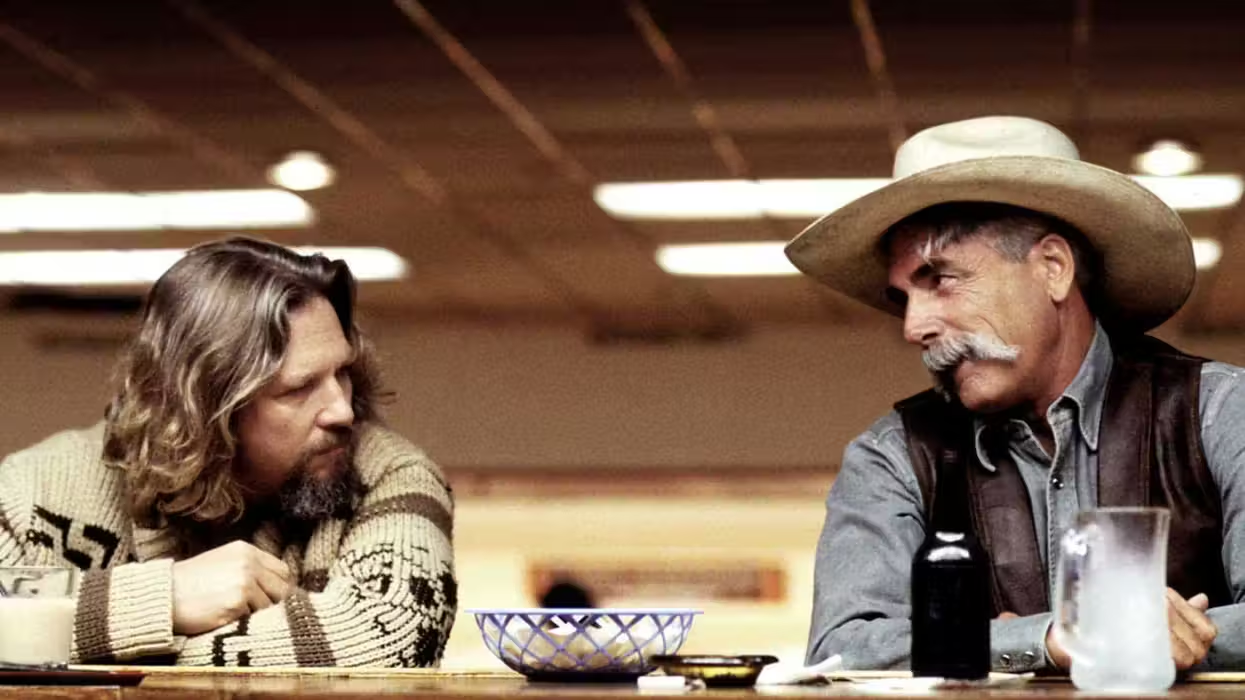
Sam Elliott's gravelly voice narrates The Big Lebowski (1998) and is the maestro of our journey. When he finally appears on screen, it's for less than five minutes, and yet his appearance helps us understand all the philosophies swirling around our heads, and also helps the Dude understand his role in the whole thing.
So, how did the Coens and Elliott pull this off? More importantly, what can it teach us about the art of subverting the traditional three-act structure to craft characters that completely transcend their screen time?
Let's dive in.
- YouTubewww.youtube.com
The Power of Genre Disruption
Great character introductions state the intent behind why that character is in the movie and usually hint at the arc they'll follow. But what happens when your character exists as an outsider?
Well, in The Big Lebowski, we get a scene toward the end of the movie where The Coens hijack a genre and use a scene and that aforementioned character to say something completely new.
Okay, so let's cover something right away: The Big Lebowski is a modern-day Los Angeles noir. Think Sunset Blvd and Double Indemnity, but with a lot of weed.
These are movies that usually have a very specific kind of narrator, one who has been broken by the city and is world-weary.
Instead, we get a somewhat happy Sam Elliott.
He's playing a cowboy all the way down to his Stetson, and he's in a bowling alley in Los Angeles. We get this mythical old-school Western archetype that kind of creates a weird new set of rules within the genre.
Was this actually a noir, or was this movie a Western with a showdown at the corral?
Can it be both?
The Coens use The Stranger to frame The Dude’s total lack of ambition as a form of Zen heroism. He's the real-life cowboy in this bar, saying that The Dude is "the man for his time and place."
It's a classic fourth-wall break that assures us that no matter what philosophy we buy into, the world will keep spinning.
- YouTubewww.youtube.com
The Philosophy Of the Dude
Like I said above, The Stranger is the thematic anchor of the entire film. While the Dude is busy running around in circles trying to solve a mystery that doesn't actually exist, The Stranger steps in to interpret the madness and to bring peace to the chaos.
I mean, if you look at The Stranger's most famous lines, they all point to order in the cosmos.
"Sometimes you eat the bear, and sometimes, well, he eats you."
When he sits next to a beaten-down, exhausted Dude at the bar, he drops this classic cowboy idiom about the ups and downs of life that the Dude has seen firsthand. He rolls with the wisdom, and as an audience, we have to take that into account as we try to analyze it.
We're reminded that fighting the "bear" of a chaotic universe is futile. Sometimes, you just have to take the loss and order another White Russian.
"I second that emotion."
When the Dude casually tells him, "Yeah, well, the Dude abides," The Stranger looks genuinely comforted, responding with a quiet, heartfelt, "I second that emotion."
It’s one of the few moments of pure, unironic warmth in a movie otherwise fueled by nihilism. In fact, it's a total refusal to be nihilistic; it's basically imploring you to love and enjoy the little things while they're still available to you, in the same way The Dude loved his rug.
But when they're taken from you, you can try as much as you can to get them back; they may never be th e same again.
As the movie ends, we get The Stranger leaving us with some parting thoughts.
"The Dude abides. I don't know about you, but I take comfort in that. It's good knowin' he's out there."
This is a summation of the core of the movie. In a hyper-capitalist, aggressive world populated by insane people who just want to take and take, the Dude is a monument to peace.
And it's great to have those peaceful people out there.
The more people on that path, the better.
Summing It All Up
Next time you’re working on a script and feel like a minor character is a bit flat, ask yourself how you can disrupt your own genre to deliver the exact perspective that's at the heart of your story.
And if that doesn't work, just have a White Russian.
Let me know what you think in the comments.
- “The Dude Abides”: What It Really Means in the Coen Brothers’ Universe ›
- Top 11 Character Archetypes in Comedy ›
- The 5 Best Sam Elliot Performances ›
- The Sam Elliott Line From the 1989 Cult Classic - "I'll get all the sleep I need when I'm dead." ›
- Sam Elliott's 'Lifeguard' at 50: The Role That Made an Icon ›