Film Quote of the Day: The Sam Elliott Line From the 1989 Cult Classic That Still Resonates Today
"I'll get all the sleep I need when I'm dead."
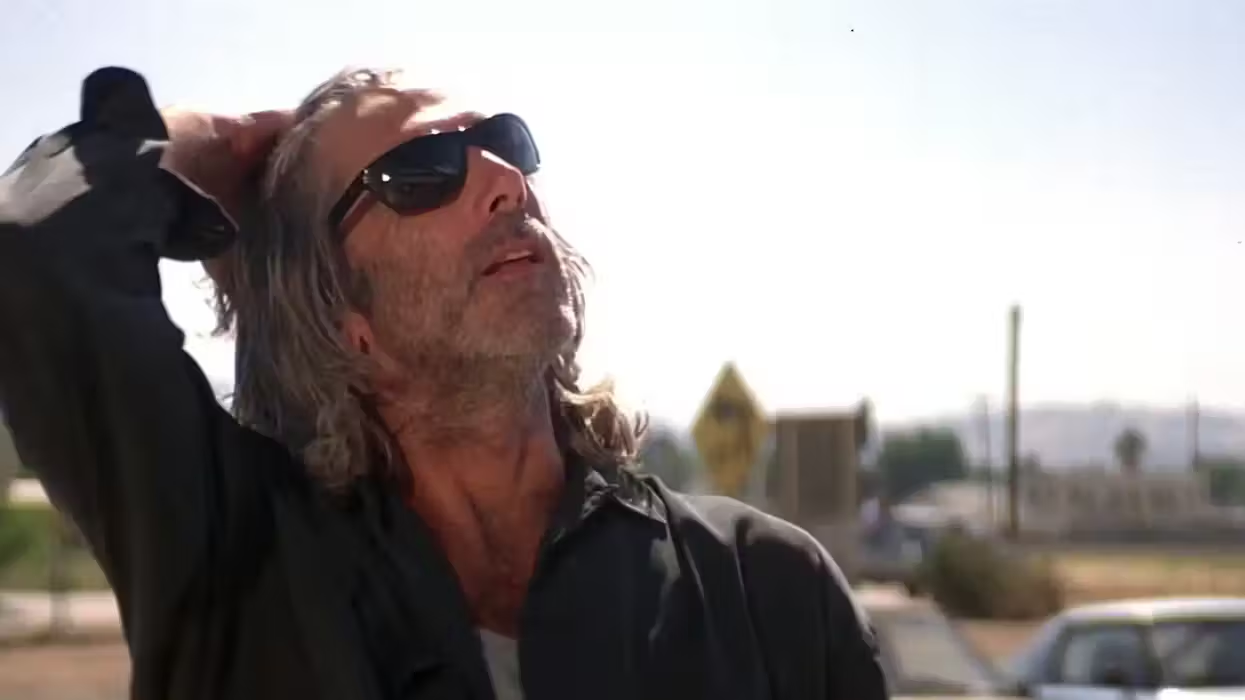
'Roadhouse'
Sometimes, you just need a little '80s action to settle you in for the night. So, when the mood strikes me right, I fire up Road House and crack my knuckles.
When you look back at Rowdy Herrington's 1989 ode to manliness and throat rips, it's easy to get lost in the gravity of Patrick Swayze's zen-infused performance as Dalton.
I mean, this is undoubtedly his movie.
But there's just something about Hilary Henkin and David Lee Henry's dialogue that gets us leaning into a story about a world where bouncers bring justice and wisdom, sometimes with the same punch.
Today, I want to talk about a line that dictates the movie's worldview and its characters. It's one that added a lot of sauce to the story and contributed to its cult status.
Let's dive in.
- YouTubewww.youtube.com
The Scene in Question
Road House is a study in heightened genre action. And it's so much fun. From the brawls to the zingers, this is always a great movie to revisit.
We're always trying to unpack the lad character, Dalton (Swayze). He's got a mystery surrounding him about possibly killing a guy by ripping out his throat. There's this shroud around him we want to pick away and see him arc.
Well, later in the movie, he gets a visit from his legendary mentor and fellow "cooler," Wade Garrett (played with magnificent, silver-maned swagger by Sam Elliott).
Now, Sam Elliott knows how to play it cool, and we suddenly understand him as a father figure and professional cam guy that Dalton wants to be, if he can live long enough to be him.
Dalton wants to clean up the joint without letting the local corporate bully, Brad Wesley, completely consume him.
On the other hand, Wade Garrett is a veteran who has survived the absolute worst of the neon trenches and knows Dalton's about to get into trouble bigger than a bar fight.
During a quiet, late-night breather, Dalton notes just how exhausted his old friend looks. Wade delivers philosophy on life and the job:
"I'll get all the sleep I need when I'm dead."
- YouTubewww.youtube.com
The Illusion of a Guaranteed Tomorrow
In a world built on fighting, where knives and guns frequently come up, these guys know there's a good chance they won't wake up in the morning. This is a film about living on the edge and walking that line, testing how much you can give and take.
But what happens when your mileage finally runs out?
By the time we get to Elliott's line, it introduces the narrative's primary thematic conflict, and they disguise it as a casual quip between two buddies.
We kinda feel that this is going to be a story about both of them finding the limits of their legendary status, and then pushing past them so that the town can survive.
Sam Elliott is amazing in this movie, and he treats the smoky bars like they're a stage on which he's performing. We can see that he's probably the same way when the cameras aren't rolling, fully embodying the iconic archetype he helped define.
The Takeaway for Screenwriters
This is a great movie to watch for writers. You can look at the structure of 80s action cinema and see what a noisy, highly commercial spec script can get you in Hollywood.
Dalton is an obvious role for a star, and this is a world that feels actualized and one we don't get to frequent often.
He's also a guy with a philosophy degree, one that will allow him and us to parse out Sam Elliott's words in the scenes that follow.
As screenwriters, we often get caught up trying to make our characters tell us their code, but this is a movie that shows us a guy living by a code, and then tracks where it came from, too.
Here are a few other things I wanted to highlight for my writer pals.
- Weaponize Worldviews: Your mentors and supporting characters should have a philosophy that feels lived-in and earned. This will do a bunch of worldbuilding on its own. Wade's line hurts because, on a structural level, he isn't entirely wrong about the cost of their lifestyle. We know the stakes, and so do they.
- Establish the Thesis: Use early conversational banter to introduce your script's core philosophical argument. This is a movie about living life one day at a time, and how that can mean both freedom and danger.
- Subvert Genre Tropes: Dalton spends the rest of the movie realizing that his zen philosophy has a breaking point and that he has to draw on Wade's absolute, uncompromising commitment to the present moment to survive. That's a totally interesting way to deconstruct an action hero we have never seen before.
Summing It All Up
Road House is like one part film theory, two parts action movie. It punches above its weight class because it has something to say and characters who believe it.
When you're building your next script, ask yourself what your characters believe and how that can be tested within the plot.
The more depth you can add to a casual line of dialogue, the better your story will be.
Let me know your thoughts in the comments below.
- The 5 Best Sam Elliot Performances ›
- How Sam Elliott Used a Handful of Scenes to Deliver the Most Important Lines in 'The Big Lebowski' ›
- Film Quote of the Day: The Sam Elliott Line From 'The Quick and the Dead' That Asked a Dark Question ›
- Patrick Swayze's Monologue in 'Point Break' is Way More Poignant Than You Remember ›
- Sam Elliott's 'Lifeguard' at 50: The Role That Made an Icon ›