How 'Saving Private Ryan' Changed War Movies Forever
Steven Spielberg's masterpiece altered how Hollywood looked at war.
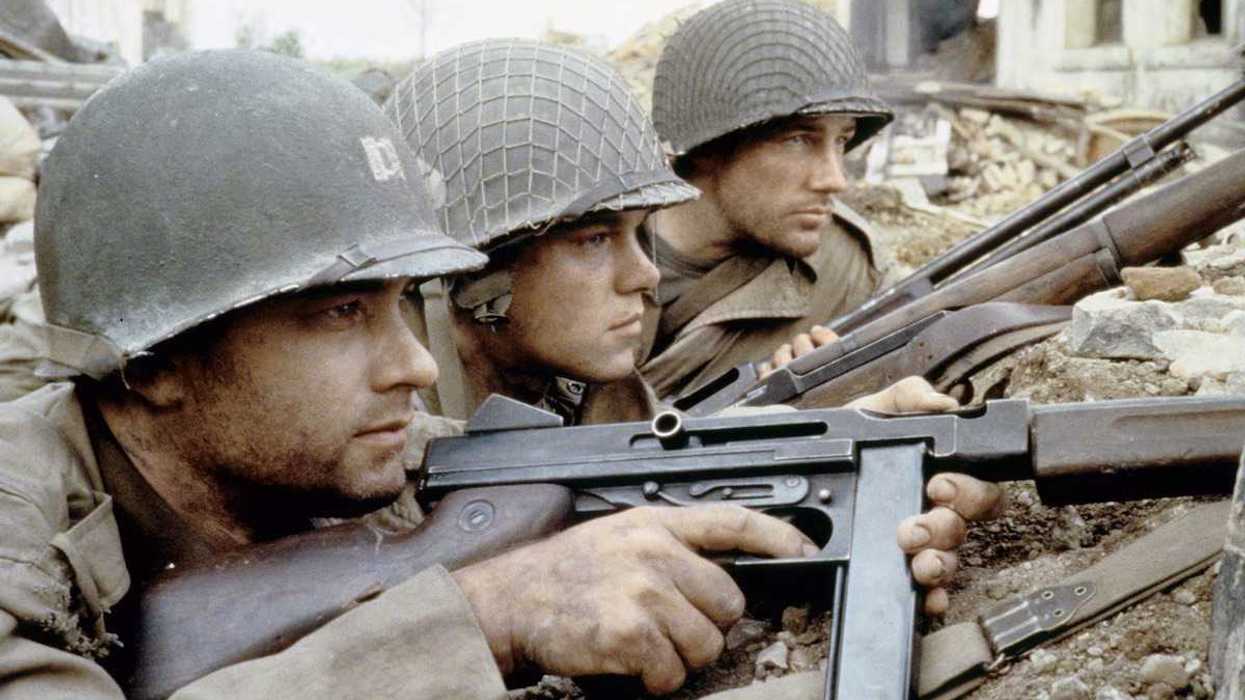
'Saving Private Ryan'
I think that Saving Private Ryan is one of those formative movies that people eventually sit down to watch, and then have to reconcile that, after you see it, filmmaking feels different.
And it's not just us who saw it on home video in college who feel that way. If you go back to its release, they viewed it as the audience in theaters as well.
When Steven Spielberg’s Saving Private Ryan hit theaters in 1998, everyone noticed. You had the director at the height of his fame making a personal movie that echoes with tens of thousands of veterans who had felt forgotten.
Before Ryan, Hollywood WWII combat was shot wide and clean. The camera was on sticks or on a comfortable dolly, moving with people and presenting a glistening sheen that did not resemble war.
You had this divide: WWII was a clean war, Vietnam was the dirty one, and never the two should meet. But Saving Private Ryan came in and was disorienting and visceral. It took the notion of there being any kind of clean war and tossed it out the window.
DP Janusz Kamiński and Spielberg’s technical innovations on Omaha Beach and throughout the campaign dictated in the movie left an indelible mark on every war movie that has followed.
And today, I want to look at several tangible things that you can emulate, too.
Let's dive in.
- YouTubewww.youtube.com
1. The 45-Degree Shutter Angle
This is the big one that I think everyone takes a stab at when shooting a war film. This is the sharp motion and hyper-realistic stuff that is all done with shutter angle manipulation.
So, standard motion picture shooting uses a 180-degree shutter angle (which equates to a shutter speed of 1/48 sec at 24fps). We do this because it mostly mimics natural eyesight and makes things feel "real."
But what if you want reality to be more heightened and frenetic?
Kamiński used a 45-degree or 90-degree shutter angle (a fast shutter speed of roughly 1/192 or 1/96 sec) that eliminates motion blur. That way, flying dirt, water droplets, and shell casings stand out as distinct, sharp particles rather than faint streaks of light on the screen.
You have a stroboscopic feeling that adds tension to each situation.
So, how can you access these tools?
Takeaway for Filmmakers: If you want an action scene, foot chase, or fight sequence to feel violent and immediate without changing your edit pace, drop your camera’s shutter angle below 90 degrees (or raise shutter speed to 1/120s or higher).
- YouTubewww.youtube.com
2. Stripping Lens Coatings for Flare and Contrast
There are a few more camera tricks that Kamiński used to pull the audience in. First, he worked to replicate the feel of 1940s combat newsreels. So he worked with Panavision to strip the protective anti-reflective coatings off vintage lenses.
That's kind of a wild task, but you definitely see it on screen.
Modern lenses are engineered to reduce lens flare and maximize internal contrast. He wanted the opposite.
Without the protective layers, light hit the glass and scattered freely, causing washed-out contrast, blown-out highlights, and lens flares whenever a gun flashed, or bright sunlight broke through smoke.
That became the signature look of this movie.
The Color Bleach Bypass
Beyond the lenses, the film stock itself underwent a Bleach Bypass (ENR process) during development. This process leaves the silver in the film emulsion, so you get desaturated colors, high-contrast blacks, and intense grain.
Even if you're shooting on digital and not on film, you can work in post to put LUTs or other tools on your footage to make it look this way.
3. The Handheld Camera
I feel like Paul Greengrass gets a lot of credit for this from his movies, but Saving Private Ryan put it in the mainstream.
Like I said in the opening, prior to 1998, high-budget Hollywood war movies relied heavily on smooth dolly moves or floating Steadicam shots to maintain scale and a consistency of the visuals.
They wanted things to look locked off and in control.
But war is ceding control.
And Spielberg wanted the audience to feel like they were on the front lines. He and Kamiński had operators run through the surf with handheld cameras at eye level or low angles, matching the movement of the soldiers taking cover.
They scaled hills and crouched in bunkers.
To create the organic ground-shaking effect during explosions, the best boy, Bob Anderson, attached an electric drill to the pan handle. They used that to shake the camera slightly to make things even more visceral.
“It’s a great effect,” said Kamiński to ASC, “but you certainly can’t handhold the camera with a drill attached to it. Plus, your eye is constantly bopping against the viewfinder. So for handheld work, we used Clairmont Camera’s Image Shaker, which is an ingenious device. You can dial in the degree of vibration you want with vertical and horizontal settings, and mount it to a handheld camera, a crane, whatever. It’s heavy, but my camera operator, Mitch Dubin, did some amazing handheld work with it. At first we used it very conservatively, like when there was an explosion or a tank rolling by, but after seeing dailies, we just dialed it in and out as Mitch ran with the camera."
This outside-the-box thinking contributed to an unsettling nature and a fear you had as soon as shit hit the fan. You were in the middle of it with everyone, and it stressed you out.
4. The Subjective POV
We talk about point of view in writing, but to substantiate what's on the page, and on the screen, one unsung hero is the sound.
Gary Rydstrom’s sound design on this movie changed how directors treat audio perspective.
During the Omaha Beach sequence, when Captain Miller (Tom Hanks) is shell-shocked, the audio cuts from a chaotic wall of sound to a low, muffled ringing tone mixed with underwater-like sound design.
This is maybe the most memorable moment in the entire movie, and it's sold through a new sound we had no experience with before.
This subjective audio transition forces the audience directly into Miller’s psychological state. We are solely in his point of view, and it makes us empathize all the more with what's happening.
- YouTubewww.youtube.com
The Legacy Of Saving Private Ryan
Aside from being one of, if not the greatest, war movies ever made, the impact of Saving Private Ryan is that you can trace its direct visual DNA through two decades of film and television.
Think about movies like Black Hawk Down (2001), Gladiator (2000), 28 Days Later (2002), and 1917 (2019); do they not all have a similar look and feel? Do we not see echoes in the action, the desaturation, the subjective POV, and the use of sound?
You had Band of Brothers (2001) and The Pacific (2010) carry that entire aesthetic over to the small screen as well.
And games like the Call of Duty and Medal of Honor franchises reshaped their visual presentation to emulate Kamiński’s handheld, narrow-shutter style.
Saving Private Ryan proved that breaking technical norms is often the exact key to creating timeless visual storytelling.
You have to shake things up and take chances.
Summing It All Up
I love this movie because it was Steven Spielberg finally achieving a childhood dream and making a war movie that showed the general public what these heroes actually felt and what they were going through while they were over there.
It was so important, and it was a landmark movie that opened the imaginations of everyone who saw it and changed movies forever.
Let me know what you think in the comments.