If you're an aspiring filmmaker, you probably have a short film planned on your slate. It could be a proof of concept or something you'd like to do to test the extent of your skills or tools. It's a more accessible way into filmmaking circles and festivals. But they're also notoriously difficult to make for reasons of their own.
Writing instructor John Matthew Fox (who runs Bookfox, a resource for fiction writers) recently shared advice about crafting short stories that we can use over in the film community, too. If you're writing a short story or a short film, the challenges will be surprisingly similar. You've got limited time for complete narratives, and every element has to earn its place.
Watch his video and then see how we can adapt these tips to your short film.
- YouTube www.youtube.com
Your Film Should Start in the First Frame
Fox says that short stories must begin immediately, in the first line. You don't have space to waste.
The same applies to short films. While features have some time for set-up and backstory, short filmmakers need to grab attention even faster. That means hooking the audience from the moment you cut in from black.
According to Fox, your opening would benefit from movement, tension, or mystery (or some combination of all of them). That could be a character already in motion, a problem already unfolding, and we aren't sure what it is.
As someone who has screened short films for festivals, I beg of you—you don't need an opening credit sequence. You are wasting valuable time when we could be into the thick of your story already.
Think of immediate engagement. Consider in medias res options, like characters hurrying somewhere frantically or in the middle of a tense discussion.
Scene First, Context Second
One of Fox's tips involves structure. Begin with action, then fill in backstory. He calls this "first equals scene, second equals backstory," and describes it as so common in short fiction it's almost cliché.
Many emerging directors open with exposition, even in short films, when you don't need to. We get voiceover explaining things we haven't seen yet, or montages, or slow, everyday conversations.
Show us people doing something interesting first. Once we're hooked, reveal who they are. Trust your audience to go along for the ride.
I'd suggest looking at filmmakers like Kelly Reichardt for this. She is famous for not overwriting dialogue and for throwing characters into situations without explanation. She makes the audience lean in. Her action then shows the audience, usually seconds later, what's going on.
Include Four Essential Elements
Fox describes what he calls "the quadrangle of story"—four elements that every narrative needs. These are character, setting, situation, and emotion. Drawing from Damon Knight's work on short fiction, Fox says you can start with any of these (though setting proves trickiest), then expand into the others.
For filmmakers, this framework applies because cinema can deliver multiple elements at the same time. A well-composed shot can establish character through costume and body language, setting through location and production design, situation through what's happening in frame, and emotion through performance and lighting.
You need all four to work together. Check your short film against these criteria. Are any missing or underdeveloped?
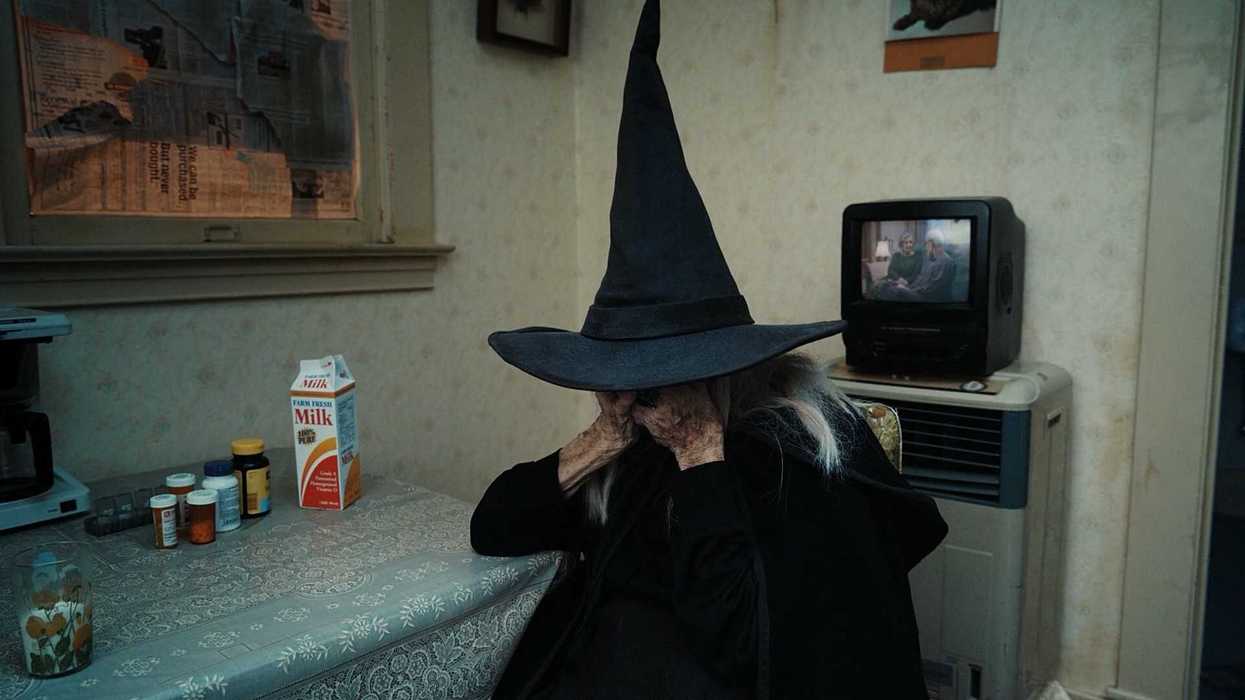
Even advertising, in some more creative cases, contains these elements. I'm including a quirky Skittles spot as an example. You have two characters in conflict—a young victim who wants to be in the witch's odd little apartment to eat candy, and the witch who wants him gone. The emotion on her part is frustration. What results is a short, comedic story.
 Skittles—WitchCredit: DDB Chicago/Chicago/Skittles
The Right Pace for Short Form
It's obvious, but you have so much less space in a short film or story. Fox compares it to running a marathon versus a 5K. You must compress, compress, compress, and think of a short as a sprint.
Challenging yourself to economy of storytelling is one reason shorts are so hard. Simpler stories work best, although you're not limited to straightforward narratives.
One of my favorite recent shorts is called Réel, directed by Rodrigue Huart. It's four minutes long. It's 1857, and two French farmgirls find a modern smartphone and fight over it from the opening moments. There's no explanation or backstory or even subtitles. It's a simple but unexplained conflict, and it works so well.
Every scene must move the story forward and reveal character or story. There's no room for atmospheric wandering, unless the atmosphere itself is the point (like in the case of more artistic, poetic shorts with no clear plot to follow).
Make choices about what to include and what to cut. Tighten your pace where you can.
Every Image Matters
Fox says the most important unit of a novel is the scene, but the most important unit of a short story is the sentence. In novels, weak sentences get buried among stronger ones. In short stories, every sentence stands exposed. A single clumsy line can ruin the entire experience.
For filmmakers, the equivalent unit is the shot. In a feature film, a poorly composed or awkwardly executed shot might slip past. In a short film, every shot matters. If something bumps, it's going to feel more like veering totally off-road instead of just hitting a little pothole.
This should inform your shot list, your coverage, and your editing. If something isn't working, you can't leave it in, hoping something else will compensate for any errors.
Be Realistic About Scope
Fox discusses how most creative minds have been trained on expansive narratives. Novels, TV series, three-hour films. When newbie creators try short form, they naturally think big, like a 20-person cast and a story that requires 10 locations and a dozen VFX shots.
It's admirable, but often unrealistic.
What can you actually achieve? Do you have one location you can use for free and a couple of friendly actors? Write to that.
Fox contrasts Gabriel García Márquez's century-spanning novel with Hemingway's short "Hills Like White Elephants," which unfolds in one location over forty minutes.
Consider your budget and what you can actually do with resources on hand. You don't have to create the opening act of a feature. Maybe just do the first scene or two. If your aspirations are larger, write a day-in-the-life of one of your characters that could be expanded later.
Keep It Short
When Fox analyzed word counts from famous short story writers, he found an average of around 4,000 to 5,000 words, though first drafts often run 7,000 to 8,000 words before editing shortens them. He says that literary magazines strongly prefer shorter submissions.
Short films face similar realities. Film festivals receive far more submissions in the 10- to 15-minute range than longer shorts. Programmers can fit more films in their blocks with shorter pieces. Audiences stay engaged more easily with tighter runtimes.
I have gone on record saying as a screener that I prefer a short film to be short, so I'll repeat it here, not to discourage but to challenge. It will be a matter of preference to screeners and fests, and maybe your short is just so amazing that it warrants a 30-minute runtime. But there's a much slimmer chance it will get a slot, especially if you're a first-time filmmaker. Charlie Kaufman can get away with 27 minutes because he's Charlie Kaufman. But you aren't Charlie Kaufman.
Your first cut might run 25 minutes. Can you get it down to 12 or 15? Shorter?
You have to learn to edit ruthlessly. Again, this is a unique challenge of short filmmaking.
Ending Your Film
Fox identifies four effective ways to end short stories. They are revelation endings (like Shirley Jackson's "The Lottery"), resonant image endings (Raymond Carver's "Cathedral"), ambiguous endings (Hemingway's "Hills Like White Elephants"), and middle-of-the-action endings (Joyce Carol Oates' "Where Are You Going? Where Have You Been?").
In film, the revelation ending provides a final twist. The resonant image ending gives audiences a powerful visual to carry with them. The ambiguous ending leaves questions unanswered. The middle-of-the-action ending cuts off before full resolution.
That last one can be great for a proof of concept to make audiences want to see more of the same universe.
Short stories (and short films) can afford to be elusive. Your audience doesn't need everything wrapped up tidily.
Let us know your tips for short filmmaking.
- To Short or Not To Short: 3 Things to Think About Before You Make ... ›
- This Shorts Filmmaker Gives You a Full Budget Breakdown, Tips for ... ›
- How to Keep Your Short Film Small (But Make it Play Big) | No Film ... ›
- How I Made My Short Film Go Viral | No Film School ›
- 11 Rules for Making a Short Film Worth Finishing ›
- How to Make a Short with No Script, No Shot List, No Actors ›
- What Making 70 Short Films Taught This Filmmaker ›