Film Quote of the Day: The 'Star Trek' Line That Changed How Sci-Fi Looked at Life and Death
"How we deal with death is at least as important as how we deal with life."
'Star Trek II: The Wrath of Khan'
Star Trek was one of those wild, philosophical shows that I wish we still greenlit. I guess now we do, but they're all kind of twisted lessons, where Star Trek really was earnest and about a hopeful future.
Anyway, the show was so successful that it spawned many movies, which I do think honor the heart of the original series and inspired hope amongst viewers.
That kind of philosophy and heart led to some great dialogue and lines across the series. And some real deep examinations of what makes us humans as well.
Maybe the most famous of the movies is Star Trek II: The Wrath of Khan, where we got a famous villain and Captain Kirk screaming. But the reason it became such a big hit was that it was a mature look at a space adventure between aging friends.
Today, I want to talk about a line in the movie that sets up the thematic foundation for the entire third act, and arguably everything that followed in the franchise.
Let's dive in.
- YouTubewww.youtube.com
The Scene In Question
If you only ever watch one Star Trek movie, this is probably the one I would recommend. It's got such a good story that sucks in people who are not fans of the series, and a lot of memorable moments have seeped into popular culture.
The Wrath of Khan is al just a great watch for its cinematic pacing and structure.
It’s arguably the best film in the franchise because it anchors its massive space battles in deeply personal stakes that tear characters apart and give us the line we're about to pull apart.
Okay, so early in the film, we learn about the Kobayashi Maru. Maybe you've heard people reference it before, but it's an unwinnable training simulation designed to test Starfleet cadets on how they face a no-win scenario.
Saavik (Kirstie Alley) fails the test and later asks Admiral James T. Kirk (William Shatner) how he would beat it. Kirk casually admits that he reprogrammed the simulator because he "doesn't like to lose."
This is a plant. We now understand that Kirk cheated his way out of facing mortality. It's a weakness that has been exposed to the audience.
Later, while trapped deep inside an asteroid, Saavik confronts Kirk again about his attitude toward the test, and we get the payoff.
Kirk decides to tell the Vulcan the truth, and drops a bombshell:
"How we deal with death is at least as important as how we deal with life."
- YouTubewww.youtube.com
The Contrast of Youth and Aging
What makes this line hit so hard is how it reframes Kirk's entire identity. In this movie, Captain Kirk is now an Admiral. His career has advanced, along wth his age, and he's having trouble relating to some of the new, younger recruits who have questions for him and maybe don't identify with his bravado.
But the bill has come due in this movie; his escapades and shooting from the hip have come home to roost. He's now older, did he get wiser? Well, this is a movie that writer-director Nicholas Meyer opens with Kirk getting a pair of reading glasses for his birthday.
It's a sign that maybe he's not seeing the world as clear as he once did, which gets reinforced by the younger recruits as we go. And then again, as he finds the rules of the world he once believed have changed drastically.
The idea of "How we deal with death is at least as important as how we deal with life" is at the very core of this film.
How has Kirk dealt with life? Will it affect him later?
When we get to the climax of this movie, the Enterprise is crippled, and the engines are failing. This situation they're in is a no-win. Justl ike the Maru. And this time, you can't reprogram it to get out of it.
Kirk looks for ways to do it, and cannot face the reality that this world will not be manipulated by him anymore.
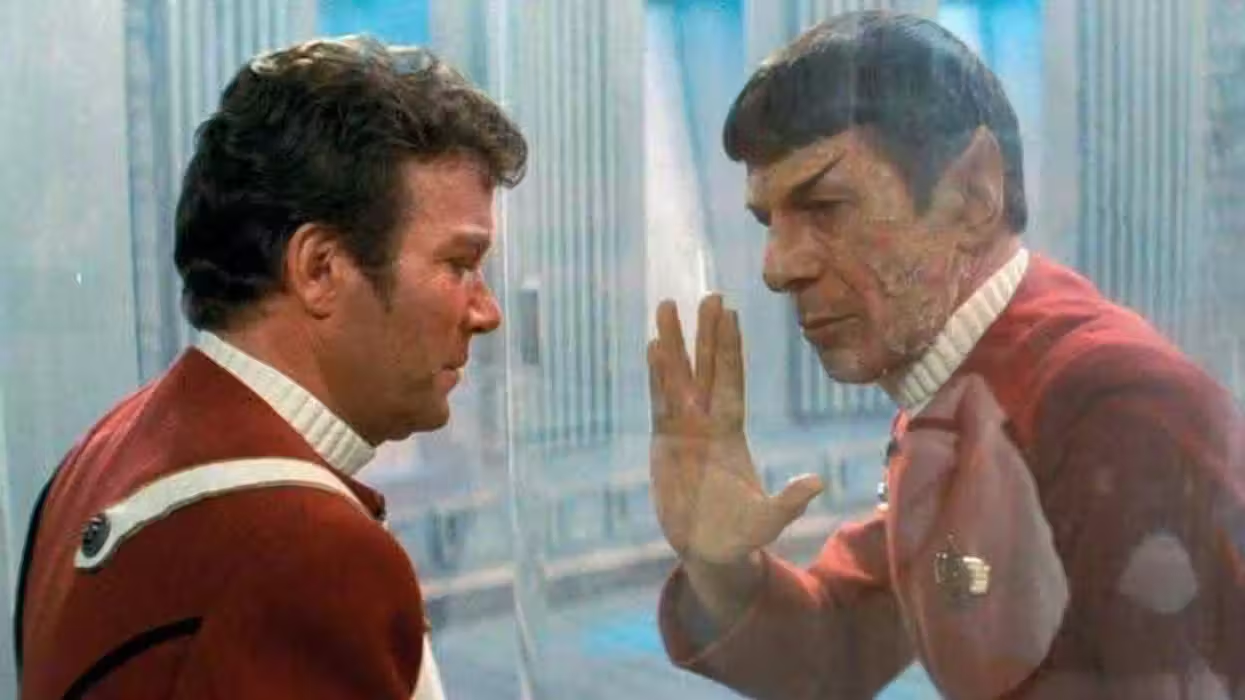
That leaves Spock (Leonard Nimoy) to use all the logic he has left to find a way out for his friends. He steps into the radiation-filled engine room to sacrifice himself for the crew.
Kirk now has to stand behind a glass partition, helpless, finally learning the exact lesson he preached to Saavik when he delivered that line. He is forced to figure out how to deal with death in real-time.
And to lose the Maru and move on.
- YouTubewww.youtube.com
The Takeaway for Screenwriters
Great scripts align their external plot with an internal, thematic arc. It's a way to make the intangible suddenly tangible, allowing the audience to feel and experience it along with the characters on screen.
For this movie, Nicholas Meyer took a massive sci-fi franchise and turned it into an intimate character study about accepting life's limitations and dealing with the consequences.
At the time, that was a complete subversion of what people had come to expect from Star Trek, and it added some depth to the characters we had grown to love over the years.
There are a few lessons here we can apply to all our writing going forward.
- Plant your theme early: Kirk’s line isn’t just a cool piece of dialogue; it’s a thesis statement for the entire film that we see play out in both action and emotion. If you establish the thematic argument in act one, your third-act climax will carry double the emotional weight because it's paying it all off.
- Attack your character’s core flaw: Kirk’s flaw was his refusal to accept loss. So every beat of this movie is pushing him toward losing and seeing how he comes out the other side. By forcing him into a scenario where the only way to save his crew is to lose his best friend, the narrative forces genuine character growth and subverts what we have come to expect from him.
- Let dialogue evolve: The meaning of Kirk's line changes over the course of two hours. When he says it in the cave, it sounds like abstract advice. When he speaks at Spock's funeral, the words carry the weight of lived experience.
- YouTubewww.youtube.com
Summing It All Up
There’s a reason The Wrath of Khan rescued Star Trek from filmic obscurity and brought audiences back to the Starship Enterprise.
It is understood that spaceships are only interesting if the people inside them have some stakes in the story.
That line carries the movie and also echoes in the next film, The Search For Spock, as Kirk tries to right his wrongs to find his lost friend. Honestly, every core of Star Trek itself is about that search for what makes us human out there,e and the carpe diem of a life well lived, exploring to make things better for people across the galaxy.
It's what makes the show stand the test of time.
Let me know your favorite Star Trek line in the comments below.
- What Are the Most Misquoted Movie Lines Of All Time? ›
- 10 Hidden Details in 'Project Hail Mary' You Notice Upon Second Viewing ›
- Why Spock’s Epic ‘Star Trek’ Line is One of Sci-Fi’s Most Powerful Quotes ›
- Film Quote of the Day: William Shatner's Captain Kirk Monologue That Defines What 'Star Trek' is All About | No Film School ›