What is The First Christmas Movie Ever Made?
Over 100 years ago, people started making Christmas movies.
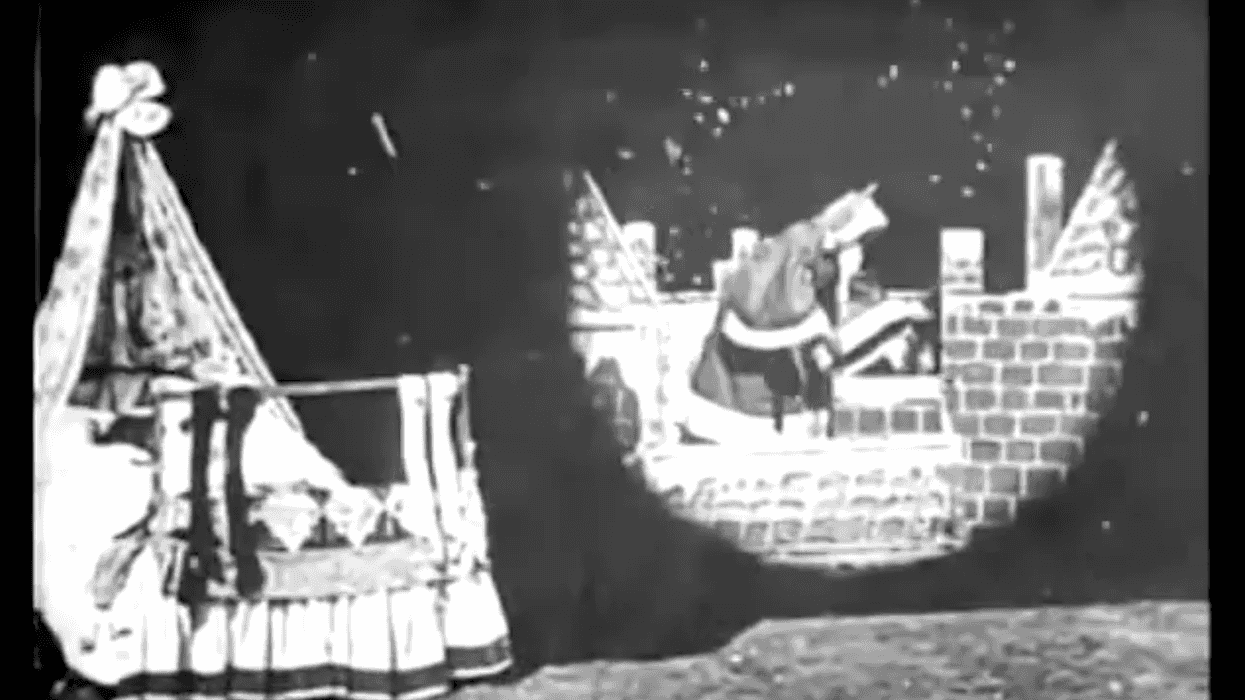
'Santa Claus'
The Christmas movie genre has become a juggernaut for streamers and theatricals alike. These kinds of movies bring in the big bucks and have a massive audience.
It may feel like this is a new part of culture, but what if I told you we were making Christmas movies way back in 1898?
There's a famous film titled Santa Claus that was directed by British pioneer George Albert Smith and was actually the first Christmas movie ever made.
And while it might look quaint to modern eyes, for filmmakers, this 79-second clip is a masterclass in early innovations like parallel action and double-exposure masking.
Let's dive in.
The First Christmas Movie Ever Made
The movie was produced in England by G.A. Smith, a key figure in the "Brighton School" of cinema pioneers.
The plot of this first Christmas movie was pretty simple.
We follow a nanny who puts two children to bed. The lights go out. Suddenly, a circular vignette appears in the corner of the room, showing Santa Claus arriving on the roof. He climbs down the chimney, emerges from the fireplace in the nursery, fills the stockings, and vanishes just as the children wake up.
- YouTube www.youtube.com
Why It Was Revolutionary
Okay, so this is like a 79-second movie, but in 1898, it was pretty revolutionary. At this time, cinema was dominated by the Lumière brothers, who were just shooting real things happening, like trains arriving and people in gardens.
Narrative editing as we know it (cutting from Scene A to Scene B to tell a story) didn’t exist.
So Smith, a former stage hypnotist and psychic, decided to bend reality in order to connect these images with the audience.
And he did so with techniques that are still around today.
1. The Matte Shot (Double Exposure)
Smith utilized a technique called "masking." He filmed the nursery scene first, but he placed a black mask over the top right corner of the lens, leaving that part of the film unexposed (black). He then rewound the film inside the camera.
Then he placed a new mask over the nursery part of the lens (the part he just filmed), leaving only the previously black corner open.
Finally, he filmed the "Roof" set against a black velvet background, positioning the image perfectly into that corner.
Basically, this allowed him to create a green-screen effect in which two separate images, filmed at different times, appear in the same frame.
2. Parallel Action
What is common today was groundbreaking in 1898. At the time, if you wanted to show Santa on the roof, you would typically stop the camera, move the set, and film a second shot. Smith realized he could show simultaneous action.
He showed us the "inside" (the sleeping kids) and the "outside" (Santa on the roof) happening at the exact same moment.
This concept of parallel action is the foundational grammar of modern editing, eventually evolved by filmmakers like Edwin S. Porter and D.W. Griffith.
3. The Legacy
George Albert Smith eventually left the film industry, but his contributions to the "grammar" of film are undeniable.
Every time you see a split-screen phone call in a rom-com or a complex composite shot in a Marvel movie, you are seeing the DNA of the first Christmas movie ever.
Summing It All Up
Christmas movies are big business now, but the holiday has always meant a lot to people, and is the perfect setting for any story you want to tell.
So, as you watch Elf or Gremlins for the hundredth time this year, pour one out for G.A. Smith—the man who first realized that movies were the perfect medium for making us believe in Santa Claus.
And who gave us a lot of contributions to film language as well.
Let me know what you think in the comments.
- 20+ Writing Prompts for Winter Holiday Movies ›
- What Are Some Storytelling Lessons from Popular Christmas Movies? ›
- Watch: Why Are Christmas Films So Sad? ›
- Insane Christmas Movies: They're Non-Union and Lazy, So Why Do We Love Them? ›
- 11 Classic Claymation Christmas Movies to Watch in 2024 ›
- 10 Best Christmas Movies For Adults ›