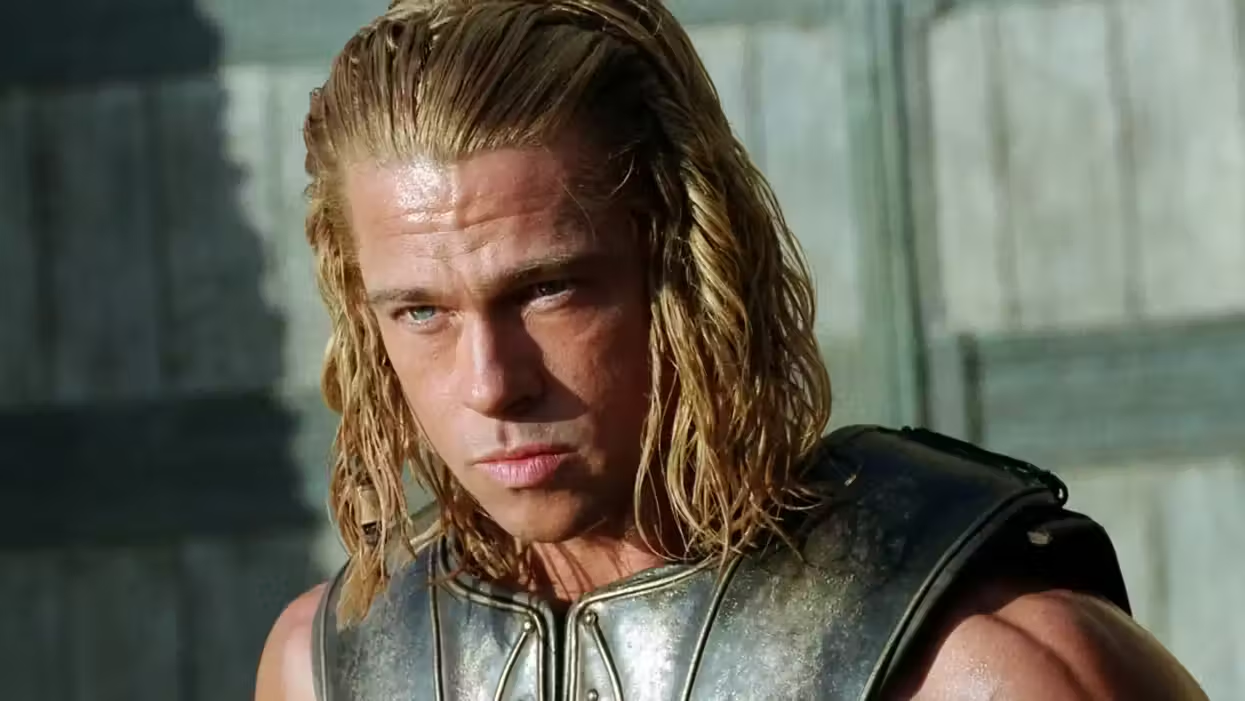
"Everything's more beautiful because we're doomed."
This is a line that has outgrown its source material so much that it's basically become its own thing. Search it on Google, and you'll find it on Goodreads, on grief forums, on the inside of a few forearms as tattoos, or floating over a picture of a sunset with no attribution at all. Most people who like to recite it have never seen Wolfgang Petersen's Troy, and a fair number would be surprised to learn it came from a Brad Pitt sword epic that Roger Ebert did not care for. It travels the internet as a tidy piece of philosophy floating in the ether now.
Troy, written by David Benioff, gives the line to Achilles, and the character isn't consoling anybody. He's trying to win a debate with a woman he's holding prisoner.
With The Odyssey's release, a lot of us are returning to the story of the Trojan War, so it seems like the perfect time to dissect this one. (Jason Hellerman would like me to remind everyone, if you do rewatch Troy, watch the director's cut.)
Let's look at the scene and what we can learn from the line.
- YouTubewww.youtube.com
The Scene
Briseis (Rose Byrne) is a battered priestess of Apollo taken during a raid. She sits across from Achilles in his tent. There's food and wine in front of her, and she won't touch it. She goes first.
"I've known men like you my whole life," she says.
"No, you haven't," Achilles says.
They circle each other and verbally spar during this tense conversation. She serves the gods. He claims to know them even better. She asks why he chose this life, and he brushes the question off. "I chose nothing. I was born, and this is what I am."
When he needles her about devoting herself to a god who won't love her back, a god who is violent, she asks if he enjoys provoking her. He doesn't answer. He goes somewhere else instead.
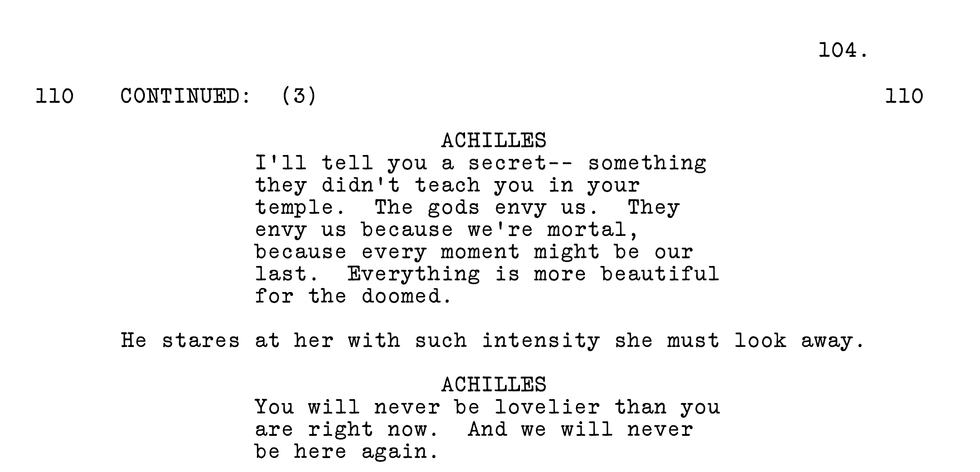
"I'll tell you a secret. Something they don't teach you in your temple," Achilles says. "The gods envy us. They envy us because we're mortal, because any moment might be our last. Everything's more beautiful because we're doomed. You will never be lovelier than you are now. We will never be here again."
"I thought you a dumb brute," she says. "I could have forgiven a dumb brute."
Achilles Is Trying to Get Somewhere
Every character in every scene should have a goal. It's a simple thing, but easy to forget in a mess of plot and dialogue. It's a good reminder to think about this first as you start writing. What does this character want? If you're hitting a wall, chances are you haven't considered this element.
Strip away the context, and this scene is just a meditation on impermanence. Put the context back, and it's about seduction. It's a captor talking to his captive, in a tent she can't leave, trying to know her.
"You will never be lovelier than you are now" is doing double duty, and both duties are for him (in service of his argument as well as a compliment).
That's exactly why it plays. If Benioff had given this speech to Achilles on a hilltop, alone, staring out at the sea, we'd feel the sermon coming and check out, because—bleh. Instead, it has weight. Briseis lends the scene direction. Without her pressing, the speech doesn't exist.
Notice he opens with "I'll tell you a secret." He's framing it as intimacy or something he's giving her that her temple never did. It's a move. The philosophy underlying it is sincere, which gives it weight and keeps it from feeling like a cheap line.
A couple of scenes later, the sexual tension does indeed pay off.
 'Troy' Credit: Warner Bros. Pictures
He's Arguing Against His Own Life
Achilles tells Briseis that mortality is the gift, that being doomed is the whole reason anything is beautiful. However, he has organized his entire existence around escaping that condition.
This is a man who told his Myrmidons that immortality awaited them. His own mother warned him: if he went to Troy, the world would remember his name forever, but he'd never come home. He picks the name and the glory. Being remembered is more important than being alive.
So when he tells a captive priestess that the gods envy us for our ending, he's arguing for the one thing he's spent his life trying to trade away. He wants what the gods have. He's telling her the gods want what he has. The irony is in the fact that he can't hear it.
What Writers Can Take from It
Philosophical dialogue has a bad reputation. Rightly so. You can usually feel when the writer is putting something in that they believe, and they just want a mouthpiece (sidebar: please don't get me started on any of Damien Chezelle's characters when they start to preach about dang jazz).
But this dialogue feels like it comes from Achilles, not Benioff. The tension with Briseis provokes every line. She calls him typical and questions his choices. The speech is a reaction. Reactions feel involuntary in a way that pronouncements never do.
Then make the idea cost the speaker, due to dramatic irony or another tool. The audience gets to be smarter than the hero for a moment.
Benioff would go on to build a career on characters who say true things for self-serving reasons, and we've covered how he and D.B. Weiss learned to run that machine at a large scale.
The Last Sentence Is Important Too
The scale of the speech collapses as it goes. It starts with gods. It narrows to mortals. It narrows again to this one woman, right now.
"We will never be here again."
It's the only sentence in the speech with no philosophy in it. Just a fact.
Whatever your version of this scene is, see if you can mimic the pattern. The cosmology is what can get the audience's attention, and the specific, intangible, transient thing in front of the characters is what breaks our hearts.