Film Quote of the Day: The John Wayne Line from 'Hondo' That Still Defines the Western Hero
How a throwaway line about a dog became the blueprint for the laconic gunslinger.
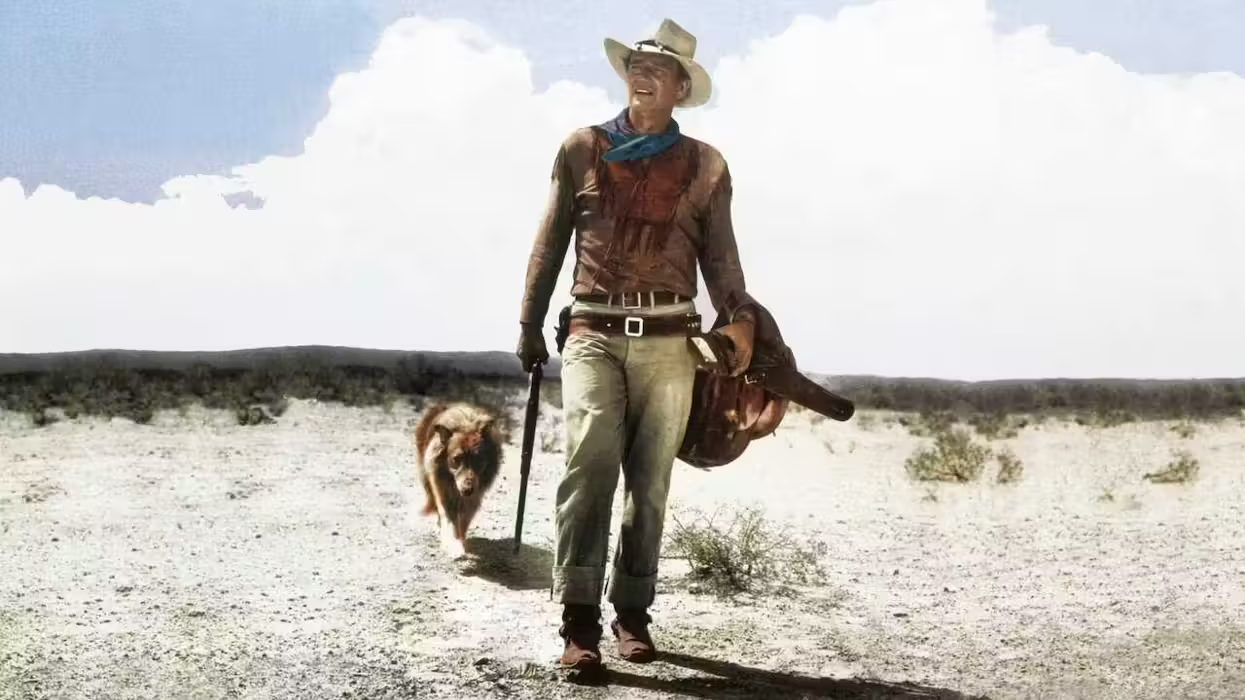
'Hondo'
I love my dog. I remember when I saw the video of the woman punching a bear to save her dog, and I thought, I would do the same thing. I would run into a burning building to save my dog.
So all that to say, today's film quote of the day resonated with me immediately.
It's a John Wayne line, delivered over the head of a dog, and it's all it takes for Wayne to lay out a whole code of the West. "A man ought to do what he thinks is best" sounds like a shrug, but with Wayne slowly lifting a rifle as he says it, it's closer to a loaded warning.
In Hondo, the 1953 Western that Wayne produced and starred in, the line does what great Western dialogue always does. It's full of subtext and deceptively simple. Let's walk through it.
- YouTube www.youtube.com
The Scene
In this film, Hondo Lane rides out of the desert as a cavalry dispatch scout, and he's rarely alone. His dog, Sam, trots at his side. He's a lean, half-wild mongrel who won't be babied, won't be fed by strangers, and answers to no one, including Hondo. The two of them are cut from the same cloth. When they turn up at an Army camp, Sam plants himself in a tent doorway, blocking the path.
Another man wants through and isn't inclined to detour around a dog. The man calls Sam a "cur" and tells Hondo to move him. Hondo doesn't move.
"Walk around him," he says.
The man bristles. He'll be hanged, he says, before he goes out of his way for a mangy dog.
And here Hondo, calm as ever, lifts his rifle as he answers.
"A man ought to do what he thinks is best," he says.
The words sound like permission. But with the rifle, it's a dare. The man weighs the dog against the barrel, swallows his pride, and detours around Sam, stalking off the other way. Only then does Hondo watch him go and lower the rifle.
What the Line Reveals About Hondo
Hondo's line grants the man total freedom to do as he pleases, while reserving the same freedom for Hondo to answer however he pleases.
That's it.
That's the frontier bargain. Everyone does as they see fit, and everyone has to reap what they sow.
It's the same ethic Hondo extends to Sam. He refuses to pamper the dog and won't let anyone feed him, because a creature that can't look after itself won't last out here. Wayne's Western hero runs on that kind of hard self-sufficiency. It's all about competence, independence, and no explanations or apologies.
I think the restraint is what makes it feel even more dangerous. Hondo gives the man every chance to choose well. The menace is real, but it's held in reserve. There's a lethal capability paired with an honest wish not to use it, and for me, that's the appeal of this archetype.
The Dog Makes the Same Point
Hondo's dog, Sam, is not so much a pet as he is proof of Hondo's theology. When Angie (Geraldine Page) offers to feed the animal, Hondo turns her down, and as MUBI points out, the dog has to fend for himself because Hondo admires that self-sufficiency and means to protect it. Sam, like his owner, shouldn't need anybody.
The movie casts the part with a wink. Sam was played by Pal, the original screen Lassie, turned hard against type into a mangy, ill-tempered animal instead of a family sweetheart.
Angie tells Hondo everyone needs someone; he agrees. "Yes, ma'am, most everyone. Too bad, isn't it?" he says.
Late in the story, Sam is killed by an Apache character, and the film barely pauses to grieve him. In a world where a man does what he thinks is best and asks nothing of anyone, even loss gets no ceremony.
- YouTube www.youtube.com
How the Line Works
There's a screenwriting lesson buried in how little the line does on the page. These are plain words, with no threat stated out loud. The menace comes entirely from context and delivery. It's the rifle rising, Wayne's unhurried cadence, the dog nearby.
On paper, it's almost nothing. But that's often how Wayne did it.
His toughest characters say more by explaining less. When you're writing a character meant to dominate a room, the instinct to let them justify themselves is usually the wrong one. They don't have to be big. They don't have to orate. Say the small thing plainly and let the subtext do the lifting.
The delivery handles the other half of the story. What is the character doing with their voice and stance and blocking? The same words could read as a friendly maxim or a death sentence, depending on what's happening around them, which is why the meaning of a line lives underneath it as much as in it.
Here, of course, Hondo means the deadly version, and we know it, though he never raises his voice to make it obvious.
The Line That Still Defines the Western Hero
That flat little sentence is the blueprint for a specific kind of hero, mostly one we see in Westerns but has seeped into other big characters across action and dramas.
Hondo is a loner who lets his actions and his weapon do the talking. You can see the same tropes from this character through the Man with No Name, through countless quiet gunfighters, and into every modern tough guy who says one thing and means something more dangerous.
Wayne spent his whole career turning spare, philosophical lines into a whole mythology, and this is one of the best examples.
It endures because the code underneath it is so appealing. Hondo is about self-reliance and standing up for his beliefs, and offering mercy up until the moment it's refused. But the same line carries an edge we shouldn't skip past.
"A man ought to do what he thinks is best" is also the logic of a man who answers to nobody. Later Westerns spent decades pulling that hero apart. He got older, more morally murky, harder to root for because of the darkness underneath.
This line still defines the Western hero, but in both senses. It's the myth we love, with that murkiness hiding inside it.
- John Wayne’s Most Human Quote From the 1965 War Classic 'In Harm's Way', Explained ›
- Kirk Douglas Had One Rule for Working with John Wayne ›
- The John Wayne Quote From a 1976 Western That Still Resonates Today ›
- The John Wayne Quote From a 1968 War Movie Classic That Redefined the War Genre (In a Bad Way) ›