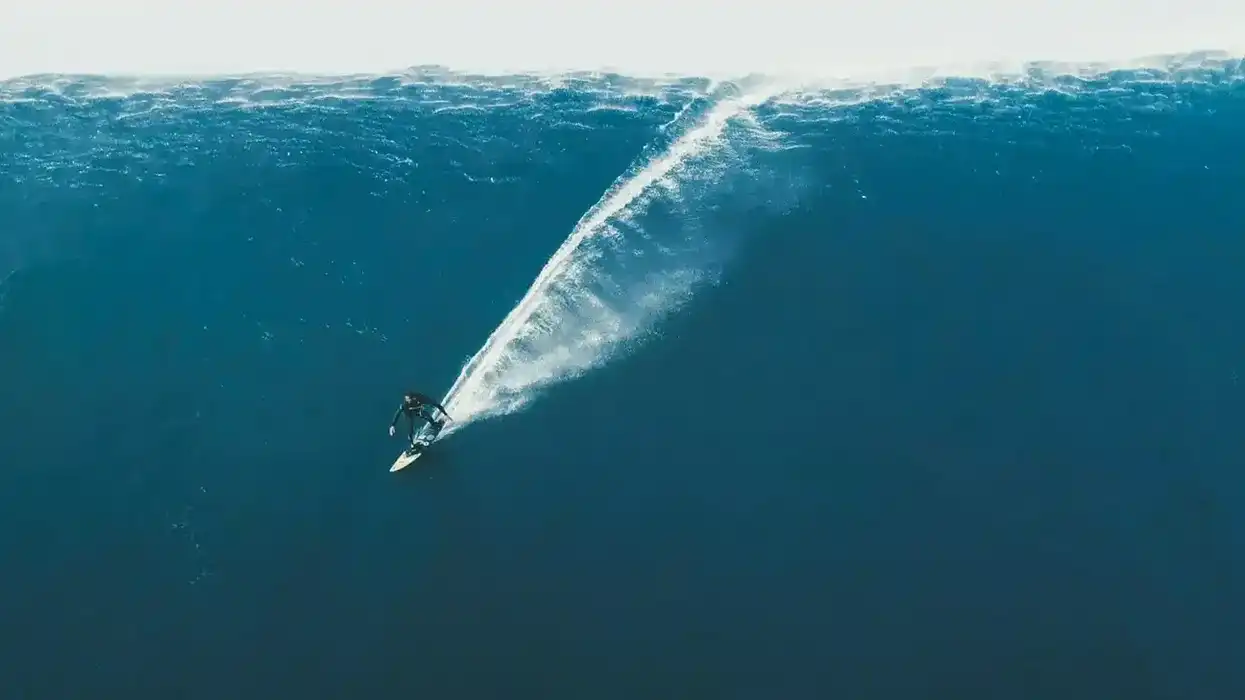
Capturing the raw power of the ocean is difficult enough. Doing it while managing a massive production budget, coordinating a team of cinematographers, and dodging 100-foot walls of water seems nearly impossible. Yet, that is exactly what Vincent Kardasik does.
Kardasik recently took home an Emmy for Outstanding Cinematography for a Nonfiction Program for his work on HBO’s hit series 100 Foot Wave. But perhaps even more impressive is that he also walked away with a win for Best Documentary—this time, accepting the award as a producer.
For many filmmakers, the choice between "below the line" craft and "above the line" management is a hard boundary. For Kardasik, erasing that boundary was the key to his success. By embracing the role of a "Swiss Army Knife," he was able to merge the technical demands of shooting in extreme conditions with the logistical foresight required to run a show.
We sat down with Kardasik to discuss his recent Emmy wins and his philosophy on versatility in the film industry. He opens up about creating a "White Paper" to unify the visual language of his camera team, the terrifying logistics of protecting gear (and lives) in Nazaré, and how his time on the show prepared him to direct his intimate new documentary, Dos Au Mur.
Let's dive into the interview below.
- YouTubewww.youtube.com
No Film School: Hi Vincent! Congratulations on your recent wins at the Creative Arts Emmys. What does it mean to you to receive such industry recognition for your work on 100 Foot Wave?
Vincent Kardasik: Thank you so much! It still feels a little surreal. On the morning of the ceremony, I crossed paths with someone checking out of our hotel carrying two Emmys. I remember thinking: “Wow, winning twice in one night must feel incredible!” A few hours later, that ended up being my exact situation.
Winning the Emmy for Outstanding Cinematography for a Nonfiction Program already had me over the moon. But when 100 Foot Wave won Best Documentary and I walked on stage as a producer, it felt almost out-of-body. I couldn’t stop thinking back to that person in the lobby…like the universe had given me a little wink earlier that day.
Coming from France, this recognition carries an extra layer of meaning. The industry at home can be quite rigid: you’re often expected to choose one lane and stay in it. When I began directing and producing while also building my career as a cinematographer, I was repeatedly told to pick a specialty. Some producers and agents even told me, “We don’t need Swiss Army knives in this industry.” It was frustrating because my curiosity naturally pulls me toward multiple aspects of filmmaking.
In the U.S., the mindset is very different. Versatility is valued, so being recognized by the Television Academy feels like validation that I wasn’t wrong to follow my instincts, even if my path didn’t fit the standard mold. More than anything, it’s a huge boost of energy. It motivates me to keep leveling up, technically, creatively, and as a producer, so I can take on bigger and continually more ambitious projects.
NFS: How does working as a producer impact or change your role as a cinematographer as well?
VK: Well, it definitely made my days longer and my nights shorter!
But honestly, it was a massive learning curve.
100 Foot Wave is the biggest show I’ve worked on so far, and stepping into the producer role meant I was involved in pretty much everything: hiring and leading the camera team, dealing with budgets, assessing forecasts, and even helping shape the narrative. It was a constant challenge but also incredibly rewarding.
I learned a lot from Joe Lewis, our executive producer, from Stacy Smith, our line producer, and from Chris Smith, the director. They all have such deep experience that nothing seems to throw them off. Where I’d sometimes panic over a last-minute decision or a trip across the Atlantic where the swell never showed up, they’d immediately shift into solution mode. They knew how to turn every high and low of the shoot into part of the story. Watching that taught me a lot about staying adaptable.
Producing definitely pushed me out of my comfort zone, and oddly enough, it made the cinematography side even more enjoyable. After spending hours planning a trip, fighting with the budget, and analyzing the forecast, the moment we finally got to shoot felt like a release: “Okay, this is my part. Let’s enjoy it.”
I was also lucky to have a great crew. When producing tasks overlapped with my camera responsibilities, I could count on the team, our other DPs, and my production coordinator to keep everything on track while I focused on filming.
On a show that runs from October to April, efficiency becomes essential. You know how much a production day costs, you see how hard the editors and Chris are working, and you want to deliver gold. There is extra pressure, but it’s the kind that pushes you to be better.
NFS: When shooting a show alongside a team of cinematographers, how do you collaborate with your fellow DPs to achieve a cohesive and consistent look for the series?
VK: Within our team, everyone brings something different to the table. Some DPs come from the surf world, some have deep relationships with our athletes, others contribute strong technical or aesthetic expertise. But once we’re on the ground, we all operate on the same level: we work hard, adapt to whatever the ocean throws at us, and support each other completely.
After watching Season 1, I felt we could push the visual identity of the show even further. Chris Smith, our director and also a fantastic cinematographer, originally crafted the look of 100 Foot Wave, and I knew he’d support any effort to refine and systematize our visual language.
So for Season 2, I created what we now call our “White Paper”: a 20-page production guide focused heavily on cinematography, especially our cinéma vérité approach, which is the backbone of the series. I compiled reference frames, both strong examples and weaker ones, and explained why certain choices worked or didn’t. I added technical guidelines, preferred focal lengths, aperture ranges for consistency, how we move and stabilize the camera, how we light and frame our master interviews, etc. Then I pushed the team to read it, question it, and use it as a reference throughout production.
Chris loved the process, so for Season 3, we expanded it. With the editors, we added tutorials and specs for every camera, including GoPros. Whenever possible, we shot with global-shutter cameras to keep motion natural. We captured RAW or flat LOG and monitored with custom LUTs from Parker Jarvie at Company 3. My partner, Julie Kardasik, worked as both production coordinator and DIT. She handled an enormous amount of footage (Season 3 alone totaled roughly 3,500 hours), processing material almost daily. Thanks to her workflow, Chris and I were able to regularly review what the team was shooting and keep everyone aligned with the visual style. Sometimes Chris would flag a sequence: “Great content, but here’s how we could have framed it better.” He’d send me examples, and the next morning I’d debrief with the crew. That constant loop kept everyone aligned and made the show visually cohesive despite the number of DPs involved.
NFS: What technical considerations go into operating or protecting the camera while filming amidst the massive waves of Nazaré?
VK: In Nazaré or anywhere you shoot surfing, you have to be incredibly reactive. No two waves are the same, and if you miss an action, you often lose the ability to properly capture the story that unfolds from it. That pressure means your camera package must be light, efficient, and ready for anything.
In a single day, you might follow an athlete from their home to the warehouse where they prep, into the water, and then end up somewhere completely unexpected: on the beach at night with a flipped jet ski, at the hospital, or even in another country. (Yes, that really happened.)
Each DP also runs their own audio, so the setup must handle: 4K minimum, RAW recording, 4-channel monitoring, a versatile lens range, and enough media and batteries for day-to-night shoots.
For water work, we used custom housings, compact, with access to nearly all controls, but heavy. In Nazaré, you don’t swim; you sit on a jet ski dodging mountains of water all day. After a decade of shooting this way, I know how demanding it is physically, especially for our water unit. Laurent Pujol, who’s been with the show since day one, knows better than anyone how intense the job can be: the hours, the tension, the weight. It pushes your body to its limits.
You’re constantly thinking about keeping your gear safe because if you fall in those conditions, your camera is gone. But you’re also monitoring your framing, your exposure, and your body mechanics. Protecting your back becomes as essential as protecting the camera.
Our vérité DPs face the same thing: six months of handheld work, often for hours a day. By the end of the season, everyone is physically exhausted.
No matter how careful we are, the ocean always wins at some point. We’ve pushed drone cinematography to its limits, and we’ve lost a few drones…those aren’t cheap. I stopped counting how many GoPros disappeared underwater. And even when gear survives, the salt corrosion in Nazaré is brutal. After months on the cliffs or the beach, we usually have to replace a lot: audio equipment, accessories, and sometimes the cameras themselves. It’s an extreme environment, but that’s also what makes the images so unique.
 '100 Foot Wave'Credit: HBO
NFS: How do you promote safety on a show like 100 Foot Wave?
VK: It may sound cliché, but safety really does come first both for our crew and for the athletes we follow. These surfers are incredibly trained professionals, always pushing their limits, but accidents can still happen, and we’ve seen how serious the consequences can be. So our first rule is simple: whether we’re shooting on land, in the air, or in the water, the camera team never interferes with any safety protocol. We’re there to document big-wave performance, but if a situation becomes too tense or risky, we step back and let the safety teams do their job. Their priority is saving lives, and nothing we film is more important than that.
Spending time with the best big-wave surfers in the world can give you wings. When you see them pushing their craft, you also want to push yours: getting closer, finding new angles, working longer hours...but whether you’re in Nazaré or on a boat 100 miles off San Diego, you have to stay aware of the risks. You need to remain focused, grounded, and honest with yourself about your limits. Whenever I feel one of our operators is getting close to burning out, I insist they take a break. Fatigue is dangerous in this line of work.
On the production side, Stacy Smith makes sure every season that our insurance coverage is rock-solid, no matter where we are in the world. But even with the best protections in place, we’re still working in extreme environments. Staying safe requires constant awareness, communication, and respect for the ocean…and for each other.
NFS: Can you tell us more about your own film, Dos Au Mur? How did your experience on 100 Foot Wave prepare you to direct your own documentary?
VK: Every project you direct feels special, but Dos Au Mur was truly unique. With my partner Julie, we followed Jérémy Florès, arguably the most talented and decorated surfer Europe has ever produced, after he was diagnosed with a serious brain tumor just months after retiring from the professional tour.
Even though it’s “just surfing,” 100 Foot Wave exposed us to incredibly intense, emotional moments. Moments that force you to question where you’re supposed to be and why. That experience prepared me for the more fragile sequences in Dos Au Mur…except this time, the subject wasn’t just an athlete; it was a close friend I have known for more than twenty years. Filming him as he received devastating news or struggled through the reality of daily life could feel overwhelming. When those moments happened, I fell back on what 100 Foot Wave taught me: if you stay respectful, transparent in your intentions, and fully present, you can capture what needs to be captured. The real challenge becomes managing your own emotions.
Technically, we worked with a minimal crew, partly for budget reasons but mostly because I didn’t want to overwhelm Jérémy with five people hovering around him all day. It was refreshing to focus primarily on my own camera work rather than coordinating multiple angles. I even shot some interviews alone, running two cameras while Julie led the conversation.
My five years working with Chris Smith on 100 Foot Wave were basically a masterclass in how to build a documentary. He’s the one who made cinéma vérité shine again for me. When Julie and I were writing Dos Au Mur, we decided early on: no voiceover. The narrative would be driven entirely by our master interviews. We put a huge amount of time and effort into those sessions. Jérémy was unbelievably patient: we recorded more than seven hours of conversation with him alone. We kept the framing and lighting consistent, knowing the interviews would be the backbone of the film, and avoided unnecessary lighting or rigging. We wanted the audience to feel like they were sitting across from him, face to face.
A lot of the techniques and instincts I used on Dos Au Mur were things I learned from Chris over the years. That vérité approach, honest, stripped-down, intimate, was exactly what the film needed.
NFS: Is there anything else you would like to share about yourself or your career?
VK: Over the years shooting in Nazaré, I started noticing something fascinating: from the water, we’re still filming surfing almost exactly the way the pioneers did. People like Jack McCoy and Sonny Miller defined the language of water cinematography decades ago, swimming into the lineup with heavy housings or shooting handheld from jet skis, and in many ways, we’re still doing the same today. The cameras and housings have evolved, but the fundamentals haven’t changed much.
I’ve always dreamed of capturing long-lens, stable, truly cinematic shots from within the water, something that could support a stronger narrative and bring a fresh visual grammar to surf filmmaking. During 100 Foot Wave, we never quite managed to make that vision a reality. So recently, with a couple of partners, we began developing a new system, essentially combining several existing technologies, to finally make those shots possible. I’m excited about what this could bring to the genre.
More broadly, I’ve been doing this job for over two decades, and I’m incredibly grateful for where it has taken me. Surfing brought me around the world and even twice to the Emmys. It taught me resilience, speed, adaptability, and how to work with constantly changing elements.
But alongside surf, I’ve also worked on feature films, commercials, and other documentaries. And while I’ll always have a strong connection to the ocean, I’m eager to bring what I’ve learned into new environments and new stories. Sports, cultures, travel…those passions still drive me. I’m excited for what comes next, for new collaborations and high-end projects beyond surfing.
I feel ready to take everything I’ve learned and push it further.
- 'Nebraska' Cinematographer Phedon Papamichael Talks ALEXA in Black & White ›
- Vincent De Paula, CSC Cinematographer on Shooting Peacock's 'The Irrational' ›
- How 'Mudbound' DP Rachel Morrison Created 'Natural Light' By Lighting Heavily ›
- Cinematographer Wolfgang Held Explores the Ethics of Vérité: 'The Camera is a Catalyst' ›