What Is a Catalyst in Storytelling? One Moment That Changes Everything (5 Iconic Film & TV Examples)
Discover the spark that sets the story on fire.
Game of Thrones (2011-2019)
We all recall a moment in a story when everything suddenly shifts, and even though it has only just begun, our protagonist reaches a point of no return.
This single, irreversible moment is called the catalyst. It doesn’t just “happen”. It is engineered into the story to set the main plot points into motion. The catalyst drags the protagonist into the story and takes us on the narrative ride we signed up for.
Most stories, if not all, have a single defining moment that can be considered the catalyst. Before we look at examples in film and television, let’s try to understand what a catalyst is a little better.
What Is A Story Catalyst?
A story catalyst is a single, irreversible event that pulls a protagonist out of regular life and forces them to take the story forward. A catalyst makes the film’s plot a certainty.
To recognize it accurately, we need to understand that merely a strong opening scene or an early chaotic action sequence wouldn’t qualify as a catalyst. A catalyst moment can be soft, but it has to be defining. It does not have to be glorious in scale. It has to be integral to the story in a manner that ensures that the protagonist cannot return to ordinary life by avoiding it.
Everything before this moment is a setup for what will come after. A catalyst must force the protagonist into a crucial decision, a decision that will have consequences that define the entire story as we know it.
Most of these moments take place in the early stages of a story. However, there isn’t a hard and fast rule about this. A catalyst moment can happen at any point; it’s just more common early on in the story.
As they say, there’s no smoke without fire. Just like that, it’s hard to find a good story without a solid catalyst. Now, let’s look at some of the greatest catalyst moments in film and television.
5 Iconic Examples Of The Catalyst In Film & TV
Like we’ve discussed, the catalyst is a common tool that is clearly visible in most stories. I’ve tried to pick five moments that I think are fascinating uses of this storytelling element in both films and television.
The Lion King (1994)
Directed by Roger Allers & Rob Minkoff
In the Pride Lands of Africa, Simba is born as heir to King Mufasa’s throne. Scar, Mufasa’s evil brother, plots to seize the throne from him and have the Kingdom to himself.
The catalyst in the film is Mufasa’s tragic death in a stampede created by Scar. Simba watches his father die, considers himself responsible, and leaves the Pride Lands. Scar takes over the kingdom, and darkness descends all over. Simba completes his time in exile, grows up from a cub into a lion, and returns home to win back the throne that is rightfully his. All of this stems from Mufasa’s death, the irreversible moment that puts the story in motion. The catalyst is tragic, iconic, and defining. It creates an overwhelming orchestra of human emotions amongst the audience for an animated character, eventually leading to a stellar, unforgettable finale.
Jaws (1975)
Directed by Steven Spielberg
On Amity Island, new police chief Martin Brody (Roy Scheider) is still getting accustomed to his surroundings when a young woman is killed by a shark. The Mayor and bureaucrats refuse to shut the beach in light of the Fourth of July weekend.
In this Spielberg classic, the catalyst in the story is the brutal shark attack on the young Alex Kintner in front of a beach packed with beach-goers. Until the child’s scream is heard, the town continued to pretend that the deaths before his were due to “boating accidents”. Alex’s death moves the story forward, and the hunt for the murderous shark begins, eventually becoming Martin’s sole purpose, or one he simply cannot walk out on.
The fact that this death is that of a child makes this a shocking, brutal, and traumatic catalyst point. It fuels Martin Brody to risk his own life, kill the shark, and make Amity Island safe once again.
The Godfather (1972)
Directed by Francis Ford Coppola
In 1940s New York, aging don Vito Corleone (Marlon Brando) wishes to keep his family out of the drug trade. After he refuses a deal with a rival, a war breaks out amongst the five families of New York.
The catalyst in the film is the Christmas Day assassination attempt on Vito that nearly kills him. Vito is rushed to the hospital, where he fights for his life. Until this point, his son Michael Corleone (Al Pacino), proudly distanced himself from the mafia business. However, witnessing the assassination attempt on his father and realising that a lot of dangerous people were in on the crime, Michael crosses the line he once promised never to cross.
This moment isn’t merely a turning point; it represents the phasing out of an old don and the making of a new one. The need to protect his family and the desire to avenge the attempts on his father’s life all take off from a singular point, making Michael one of the most iconic characters in film history, whose genesis came through this very catalyst moment.
The Sopranos (1999-2007)
Created by David Chase
Tony Soprano (James Gandolfini) is a New Jersey mob boss juggling his family on one hand and the underworld on the other. He has always managed to keep his stress under control. Until one day, when he can’t.
The catalyst in the story is Tony’s first full-blown panic attack. An experience the mob boss never had. It makes him question his health, of course, but also the state of his mind, eventually landing him in front of a therapist (Lorraine Bracco). The entire series follows Tony navigating life with his difficult work, the complexities of the gangster world, and growing troubles at home, all while visiting a therapist.
This moment is unthinkable for a mob lord and defines everything we know about The Sopranos today. It creates a tremendous sense of irony while also humanizing Tony and making him a lot more relatable than a typical gangster in any other story.
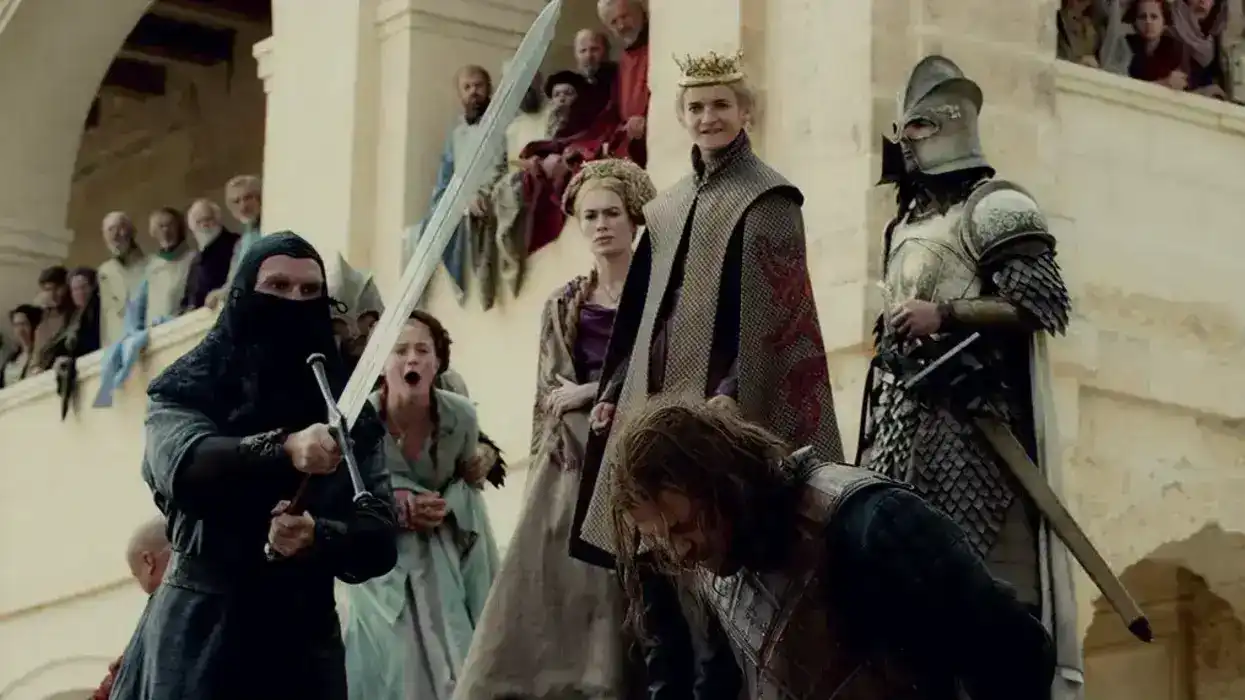
Game of Thrones (2011-2019)
Created by David Benioff & D.B. Weiss
In the land of Westeros, honorable lord Ned Stark (Sean Bean) raises his family in the North when King Robert asks him to become the Hand of the King.
The catalyst is the moment Jamie Lannister (Nikolaj Coster-Waldau) pushes Bran Stark (Isaac Hempstead Wright) from a tower window afterBran catches Jamie and his sister, Queen Cersei, in an incestuous sexual moment.
His fall, which ends up crippling him, sets off a chain of events that define the series as we know it. This is a seismic moment as Bran’s knowledge of the incestuous affair between the King’s wife and his sister is also our knowledge of the affair.
The moment raises an incredible number of questions and heavy intrigue as the story unfolds. Not only does this moment set the stage for the rest of the show, but it also counts as one of the most, if not the most, shocking revelations in the entire series, which is actually full of such moments.
Final Thoughts
These five catalyst moments share one common theme: some of the finest stories don’t lean into their conflict; they push the audience into it. A singular moment defines a film or multiple seasons of a television series.
What are some of your favorite catalyst moments? Tell us in the comments below.