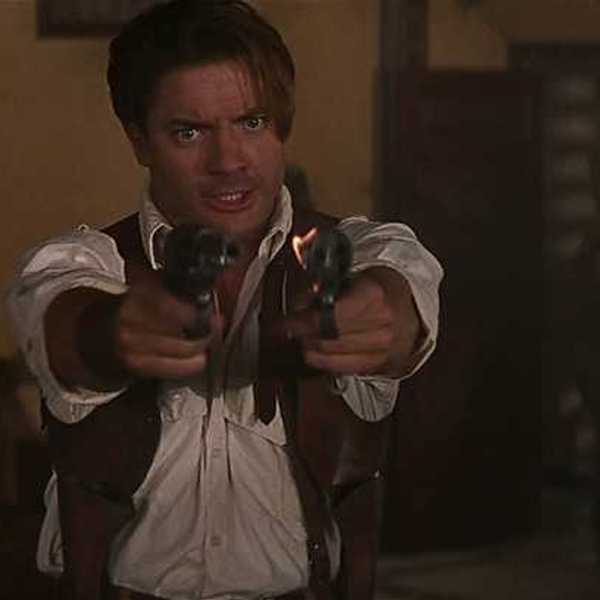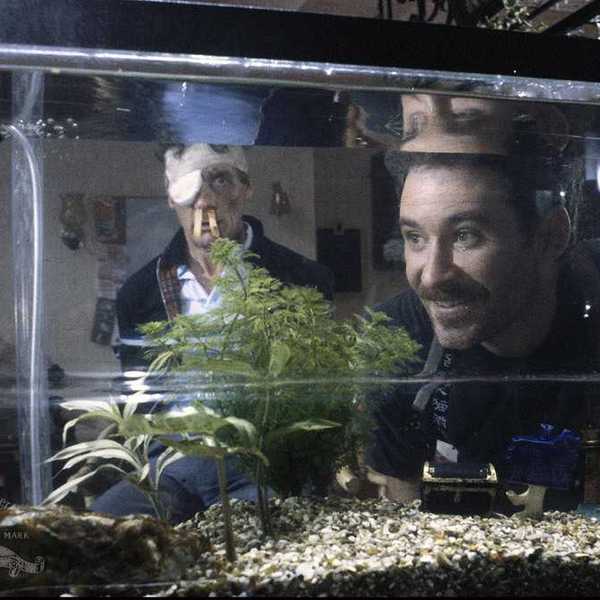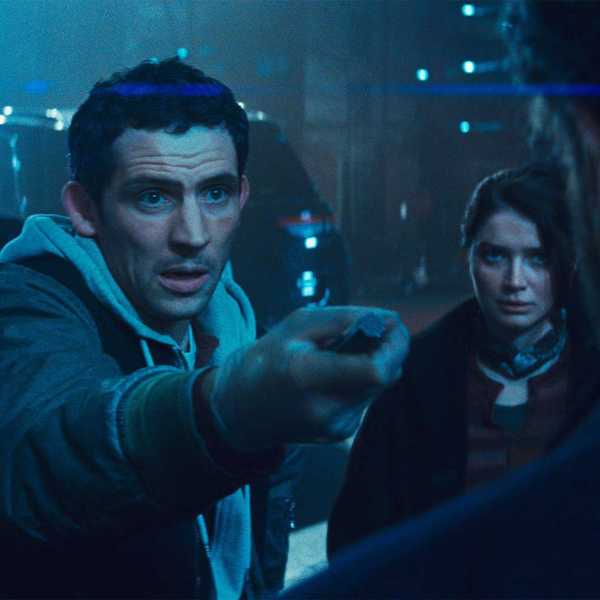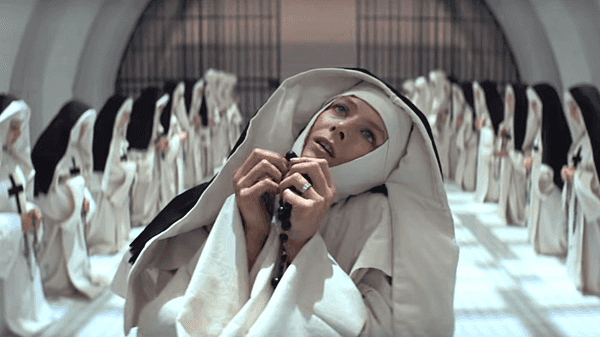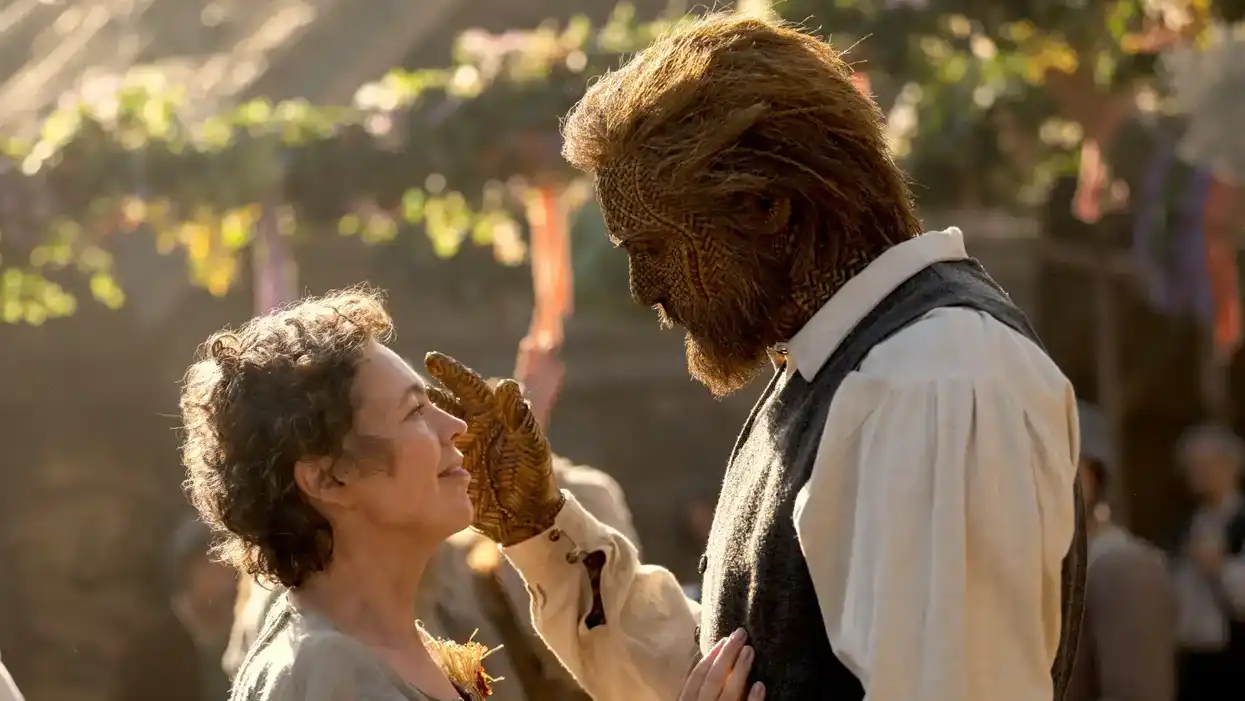
Wicker has two directors and a fairly large cast of villagers, which includes a romantic lead... made of wicker.
The film comes from married writer/directors Alex Huston Fischer and Eleanor Wilson, whose first feature, Save Yourselves!, premiered at Sundance in 2020.
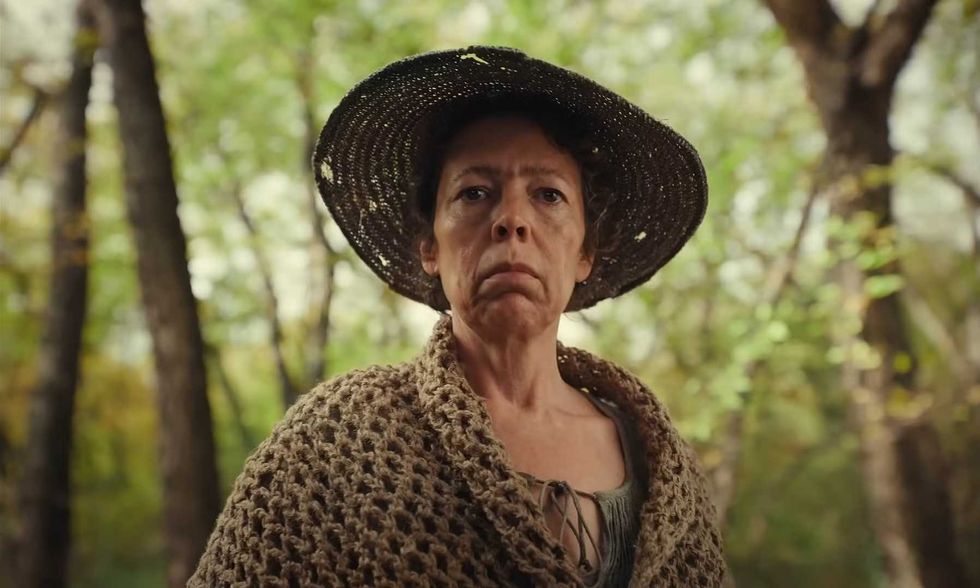
Their second follows a smelly, lonely fisherwoman (Olivia Colman) who commissions the village basketmaker (Peter Dinklage) to weave her a husband. Alexander Skarsgård plays the handsome result. Elizabeth Debicki is the Tailor's Wife, the Fisherwoman's chief rival in the village.
We've been following the film since its first trailer. And so has the rest of the internet.
I caught Wicker at its Sundance premiere in January, and it was a blast. It opens in select theaters Oct. 23. Ahead of the release, I talked with Fischer and Wilson about how two people direct one movie and other challenges they faced during production.
- YouTube www.youtube.com
Two Brains, One Direction
Some directing teams split the job down the middle, with one person on actors and the other on camera. Fischer and Wilson mostly don't.
Fischer said they stay side by side as much as possible, and they don't sit down. Wilson said the reality is far from glamorous, involving muddy boots, and a set that's always either too hot or too cold. Married directing teams have to decide early how much of the job to share. For these two, it's nearly all of it.
Wilson said, "We like to stick together. I think that's the strength of our partnership is that there's two of us, that there's two people to stick up for a thing or recognize that that's something that we can let go."
"And we have the same taste,” Fischer said. “So if there's something happening or it's a prop or how someone's doing a scene, whatever it is, we'll have the same reaction, which is like, 'I think it needs to be more like this.' And then we get to chat about how best to get in there. So that's nice."
Fischer said they call cut, whisper it through with each other, and then one of them goes to the actor. Wilson said they don't formally divide duties.
On days with three cameras rolling, she might spend more time among the villagers while Fischer watched the cameras, but they worked that out moment to moment.
You Can Direct Differently
Talking to actors is its own challenge. Who talked to which actor often came down to chemistry. Fischer's lane was often comedy.
"I come from the more comedy background. I always attached myself to the funniest people and made their videos or whatever."
So he would sit beside Colman and pitch her alternate jokes. Wilson took the dramatic, heartfelt scenes, where she said Colman barely needs direction.
“Olivia's pretty amazing like that, that you don't have to say much to her. You just go up and have a little heartfelt look.”
Fischer said, "The way they worked together was very nonverbal. Where the way I worked with Olivia was very like, 'What about this?'"
 'Wicker' Credit: Black Bear
When Your DP Says You Need Three Cameras
Fischer and Wilson are planners, but their cinematographer still changed the plan.
"We had 30 days to shoot, and Lol Crawley, the cinematographer, he's made a lot more movies than we have,” Fischer said. “So he was the cinematographer and a mentor at the same time. And we got to these village scenes with these big crowds and a lot of story beats happening. It's not just capturing naturalism. It's like this is happening for this couple. This is happening for this couple. We need eye lines. There's a lot going on."
Fischer said that after one day of crowd work, Crawley told them they wouldn't get through those scenes without three cameras. The village sequences went multicam, and Wilson said the dialogue-heavy scenes mostly stayed single-camera.
More cameras can mean challenges. But a second or third camera can also save you time on a tight schedule. Here, it also changed the energy on set. Wilson said shooting the crowd scenes that way felt more like staging a play. With three cameras rolling, nobody in the background stops acting.
"We had all this incredible ensemble in this movie, and they all get to perform in these scenes. They're maybe peripheral to the moment of the scene, but they're doing something great, and we catch it, and then it gets in the movie. So there's discovery in that," Fischer said.
That's a departure from how they usually work, Wilson said.
"Yeah, that was really fun actually, because when it's a sit-down dialogue scene, we don't really do improvisation. We mostly stick to the script—maybe at the end of the scene or something. But in these big group scenes, everybody has to improvise because they've got one line in seven pages of action, but they have to be there for the rest of it."
Wilson said almost every member of the supporting cast has an improvised line in the final cut. Most of them are writers, too, and she said some of the film's best lines were discovered on the day.
 'Wicker' Credit: Black Bear
Test, Again and Again
The biggest lesson they're carrying forward also came from Crawley.
Wilson said, "We are very prep-heavy ourselves. We like to heavily shot list. We like to come in with a very clear plan. We're not fly-by-the-seat-of-our-pants directors."
Even so, Wilson said, they were a little timid about asking for what they needed. Crawley taught them to keep pushing for tests during prep, and when something failed on a test day, to test it again.
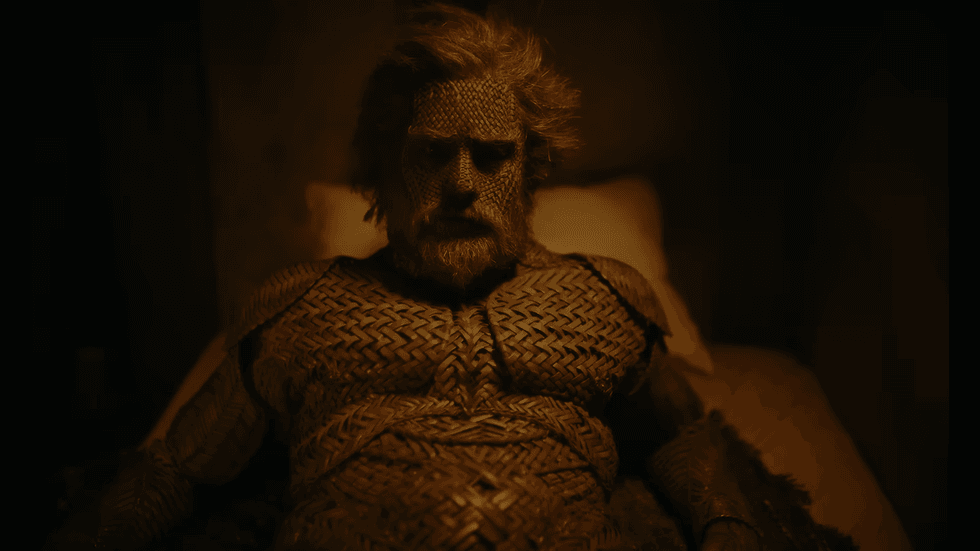
That mattered on a film built on practical effects. The title character is a physical creation. Wētā Workshop designed the husband's suit and makeup around Skarsgård's own facial expressions. Practical effects give actors something real to play against, but they need rehearsal like anything else.
Fischer said every test day comes out of the budget, and nobody likes spending money. They both said it still beats getting it wrong on the day.
"If you get to the shoot when everybody's there and you're spending real money and you're not getting it and it's taking a couple hours, then you're really wasting everybody's time,” Fischer said. “So we have a lot of practical effects in this movie, and we tested them all a lot, and there's a lot that you learn through testing. Things get improved, you'll come up with things that you never would've come up with, and you never want to be rushed trying to do something like that."
Indie productions skip camera and effects tests all the time because they see them as a luxury. Wilson said the real cost shows up on set. When you're rushing an effect, you're spending less time on the performance.