If there's any lesson to take from the partnership between Alec Goldberg and Camille Wormser, it's that you don't know what's possible unless you ask.
That's not the only thing we learned from the duo, of course, but when we heard that they were mutual filmmakers who saw each other's work at a festival, and became creative partners months later after a cold DM, we were definitely inspired.
Goldberg comes from the world of documentary filmmaking, and Wormser is a comedian who made a comedy short of her own. Both of their films centered empathy and human struggle, which caught each filmmaker's attention.Their Sundance project, Soft Boil, just premiered in the episodic pilot block.
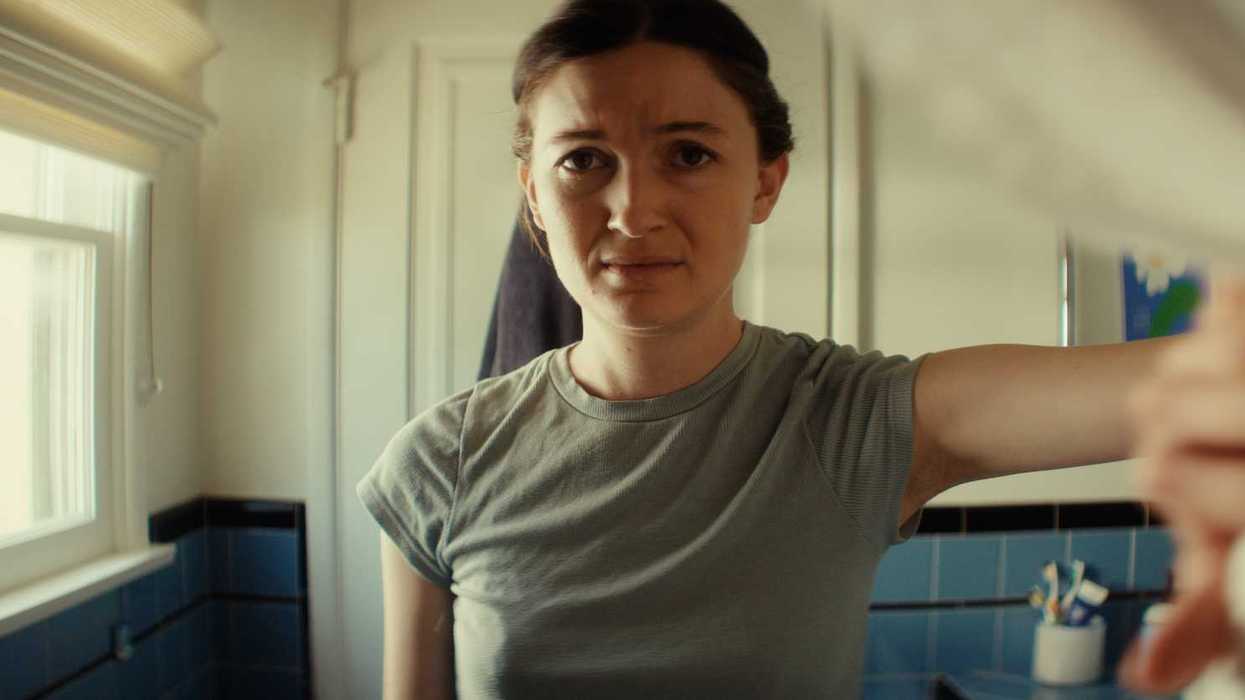
The comedy follows Lulu (Wormser), an aspiring actor who is desperate enough for a job to try nannying, a position for which she is both woefully underqualified and emotionally unprepared, especially after she catches her boyfriend cheating in their shower. As she tries to pick up the pieces, she makes a series of questionable choices. The pilot was directed by Goldberg and co-written by the pair.
We talked to Wormser and Goldberg during the festival to learn about their approach to comedy and how they shot a pilot in a little over two days.
- YouTube www.youtube.com
Editor's note: The following conversation has been edited for length and clarity.
No Film School: So if I remember correctly, you all met at a festival. I would love to hear a little bit about that and how you made that connection.
Alec Goldberg: I had a mini doc called What Happened to You in the same block as her short, Just Right, that she starred in, wrote, and directed. And I just thought she was brilliant and started working on this, DM'd her, and then we started developing it together. We were really lucky that she brought on—half of our crew is her friends, half the crew is my friends, and it worked out really nicely.
NFS: How fast was that timeline?
Camille Wormser: So the festival was in May, and I remember your short being—I was like, "F*ck, that's good." And then you thought the same thing. ... Six months, I would say it was actually a huge gap between the festival. You didn't message me until December. I remember.
AG: Yeah. I had to have something ready.
CW: Yeah, you were stewing. Then you were like, "Hey, I think we should make something together. This is my idea." So it was six months after that. Then we wrote it in a month, and then shot in March of the following year.
NFS: How did you know that partnership was going to work?
AG: She has such a unique style of comedy that I was just very moved by it.
Wormser: You were intrigued.
CW: I also just could tell you were a good person. I feel like you can tell when someone's scary. Well, actually, not always, but you just didn't seem like you were trying to—sorry—you weren't trying to grope me. Just seemed like a normal, nice—
AG: Pretty low bar for—
CW: And also, your film had so much heart in it, and I could tell that you cared about humans on a level that you weren't going to make fun of me. Well, you were, but with my consent. So I think it was festivals, meeting people at festivals is the only reason I have any sort of career. It's trusting there's a genuine connection. And just being able to use your gut, I guess, even though I hate when people say that because sometimes my gut's so wrong.
AG: I think it was interesting. I came mainly from a documentary background. I just feel like it's a different vibe. Not more empathetic necessarily, but there were human elements of what I was doing that I think she connected to.
CW: Yeah. The film that you made was so caring about humans who have a hard time, which I have.
NFS: How did you decide it was going to be a pilot episode? What did your story development look like?
AG: Yeah, we were writing it as a short originally, and then—not to give away any beats, but the ending seemed to fit a pilot really well. And I think once we were at over 15 minutes, we're like, "At this point, we should probably just go for the pilot." It wasn't really going to be much bigger of a production to do that. So then I think we just went for it.
CW: I think as a short, it wouldn't have a true ending. We always wanted this open-ended situation at the end. And I do think even the way the family dynamics work, it's like, this is something you should see over time. I don't think it would be; it makes sense in just a single form.
NFS: Shorts are so hard, too.
AG: So hard. I'm terrible at writing shorts. I think this was much easier. To your point, we just didn't need a super clear ending.
 Soft Boil Courtesy of Sundance Institute
NFS: One thing I loved was the character voices, particularly Lulu's. I think that that is such a unique character, and the way that she talks is so fun. So I want to hear about how you develop character voices.
CW: The character, Lulu, is such an anxious, strange lady, but I am an anxious, strange lady. But it's on crack, on steroids. I have been, at times in my life, where I've been, my life is falling apart more so than it is now. And I think it was easy to go into, "What is someone whose anxiety is all over their skin, all over them, but also has a unique point of view on the world and doesn't feel like anyone understands it?"
I just relate. Sometimes it's hard when your brain is moving a mile a minute ... basically, I could connect to her, but also I just heightened certain things.
I just can picture being in the interview scene. That's tough. This woman clearly hates my guts. I've been in a situation where I do more to compensate for someone hating me. You know what I mean? I am kind of exploding in front of them. And that sh*t's funny to watch because I'm deteriorating in front of them anyway.
NFS: And you're so aware of it too, in the moment, you're like, why am I even talking?
CW: Yes. And I keep going, I keep going. I'm like, "Oh my God, I just talked about Marissa Tome. What the f*ck?" Which I've done.
NFS: So when you have a big character like that, how do you calibrate the secondary character voices?
AG: Yeah, I think Vivian [Kerr]'s character, for example, is pretty much the polar opposite of Lulu. And I think putting Lulu in these situations where there are people who are not understanding of her allows that character to come to the forefront more, I think.
CW: Yeah, and I think Vivian did a great job with Christy being, she probably, there are parts that they can connect on, but Christy spent her whole life probably suppressing anything that shows her anxiety and has just decided to be very stick-up-the-butt. You know what I mean?
AG: So John [Gemberling], who we knew from Broad City, who I would say actually in Broad City is probably much closer to Lulu than he is in this. And I don't know, I think we were just really intrigued by the idea of putting John in a more serious role.
CW: Like a goofy dad role.
AG: And then Madison [Shamoun], who plays Jess in this, Camille and her have been friends for a very long time. And I think she and [Patrick Tabari], who plays her boyfriend Eric, are the two characters who really do understand her. So we could feel the contrast between when she's with them versus when she's with the family.
NFS: Alec, this was the first scripted comedy that you've done. What's different about shooting comedy if you've not done it before?
AG: A lot. Yeah. I mean, I've never done long-form scripted work, period. I think the doc that she saw was the first comedy doc that I have done, I guess. But I learned so much.
I think casting was the biggest thing that popped out to me. And just understanding if you cast the right people, they can really take the script to the next level. Camille is a director's dream. I feel like we wrote this script, but then we get to set, and she had a hundred ideas for every beat that we hadn't even discussed. And I really can't overstate how easy she made my job just going in there. She said idea after idea after idea.
CW: I'm perfect.
AG: And the hardest part was knowing when to move on and keep the day going.
CW: But you were good at, I loved the fact that I think maybe docs helped you with that, I don't know. But you would stay pretty long. Longer than most directors, I think, just being like, "Actually, let's just milk the sh*t out of this. Let's just keep it going."
NFS: Does it change the way that you frame things? How does that look?
AG: Yeah, we tried to shoot as much with multicam as we could, because I didn't want, and I wish we did actually more because there's a lot of good bloopers where the camera's on John, but Camille is giving a great line, and we don't have her face in the coverage.
CW: F*ck you for that.
AG: I mean, it's definitely changed my approach to everything. Casting, number one, but also just making sure that we schedule the day and shoot it in a way that we're not losing performances that would otherwise be something we want.
 Soft Boil Courtesy of Sundance Institute
NFS: What was your shoot schedule?
AG: So principal photography was two and a half days.
CW: 15 hours.
AG: So we did that in March, and then in June, we did a day and a half of pickups. It was a very micro budget, so we had to figure out how to get it all in.
CW: First AD, he was pretty good.
AG: First AD, her boyfriend. Hunter [Milano], was amazing. Our producers were incredible. That was another big takeaway. I mean, on docs, I've had producers, but this had a full team of producers on this that I've never had anyone in the edit with me like that. And that was extremely helpful.
NFS: Was there one specific thing that was a challenge for you on the shoot?
AG: I remember going back and forth on how many thrusts in the bathroom. I would say I wanted one way.
CW: You wanted a hundred thrusts.
AG: I was just like, it needs to be a realistic sex scene, but we wanted to just make everyone feel comfortable.
NFS: Is there something, "I learned this on this, and I'm going to take it to our next short or pilot"?
CW: I think I did learn that ... I like that we did it fast, but I do think because we went fast for the shoot and then to the assembly cut, then the reshoots, I was like, okay. It felt a little bit like we rushed, and then we're like, "Wait, we need to redo some stuff because this doesn't make any sense."
And I think taking a little bit more time, when we were writing it—we wrote it in one month, which was pretty fast for me. I spent about two years writing my shorts, so that's a little slow, but maybe in the middle. But yeah, I think because that would've just maybe saved us some money because of the extra reshoots, but who knows, reshoots are so normal.
AG: I think just being super open and seeing what happens on set, I feel like I tried not to go in too rigid, and I feel like we just discovered so much on set between the characters. There was so much improv, and I know I said this, but my biggest takeaway was really if you have the right people. Yes, the script is super important, but what happens on set and where they take it, it can go in a direction that you don't really expect.
And I think for docs that may have been helpful for me, where it's like I'm just shooting everything in docs and piecing it together in the edit and being super open to whatever happens. And I think that translated a bit to this.
CW: I think the tension between me and John was not something we had written, but when I met him, jokingly, we just are bullying each other naturally. I want to make fun of him, kind of like a Toby or something in The Office. I'm just, "John!" And I think that naturally happened, because if you're making choices as actors, then it's kind of like, what naturally is happening chemistry-wise? Even if it's me thinking you're a bozo or him thinking I'm annoying, which I am.
AG: It's totally changed my writing style, though. Thinking about the casting and how much that will change the character, I think it was super, super helpful for me to learn.
NFS: Can I ask what you mean by that?
AG: I think I used to feel this need to explain everything about the character in a script versus knowing what the right person playing the role, just how they talk, how they carry themselves, will naturally get a lot of that across without needing to give backstory or explain all these things in the actual dialogue or action of the characters.
NFS: What's your writing like?
CW: I would say that I'm obsessed with improv. Improv is what I did a lot of on set. And for comedy, for me, everything I've written, it's like I love co-writing for this reason, but even when I'm writing alone, I literally out loud will do different takes to see what gets a chuckle or what gets a sigh. I think improv is the perfect tool for writing. I think there's nothing more, it's authentic, but it's also strange sometimes when you're too in your head. I just like to say it out loud.
AG: Camille's a lot funnier than me. And I would say it's this really nice balance where I feel like I'm pretty structural, and I can get a setup, but then she would just have all punchlines.
CW: I would text you those alternative jokes. I loved doing that. "Or it could be this, or it could be this." And sometimes you'd be like, "That is stupid."
AG: [Laughing] I never said that.
CW: But other times you're like, "This is genius. You're a genius." You gave me both.
AG: She will think of the most random sh*t that would never come to my mind. And honestly, all of her suggestions, whether we use them or not, are genius and unique.
NFS: On the page, does it look really loose, or are you trying to nail down your direction?
CW: I personally think what we did, especially for the jokes, is we'd have four alts, so pretty loose. It would be like, unless it was crucial to the plot or crucial to the dynamic, we basically had parts—which is how I write, for my short, I did the same thing—I had a whole monologue where I was, "Improv here." Not always like that, but I do think the freedom for certain jokes, you don't know if it's going to work until you're there.
AG: Yeah, I think there was a lot of, we had alts, we also had "improv here" in the script, and then a lot of the alts were just bullet points, not like, this is how the joke will be said.
NFS: Did you have producers early, or did you have to take that out?
AG: Yeah, I had a couple of producers that worked with me on pretty much everything. And the same with her. And these are for both of us, very close friends of ours.
CW: Or lovers.
AG: Or lovers. And people are so talented, and we're so helpful, and they really filled every space that we needed a producer to fill. I'm usually doing a lot of producing on my projects, and I've never had this many producers, but it was like we had one person who's dealing with SAG and all the child actor stuff, another one who's doing scheduling and logistics, and then people who are great on-set producers. But immediately they were there, and all of them were giving us creative notes in the writing process that were super helpful.
CW: So helpful. I kind of feel like you and I were exploding, and they were putting water [on us].
AG: Really unsung heroes of the writing process.
CW: Yes. In post, giving notes on everything ... We trusted them. We know that they're smarter than us ... and we need it.
Also, I think we're—not to speak for you, my boy—but I feel like we're a little neurotic and have a lot of problems. So it's nice to have a balancing, "No, you guys aren't crazy. This is good."
AG: If the producers didn't know us really, really well, it would've been much more challenging. All of her friends knew her style of comedy and how she works on set. Same with my producers for me. And it worked out perfectly.
NFS: So it comes back to the relationships you have. And you don't necessarily have to convince anybody.
CW: Yeah. They'll believe in it because of the trusted partnership.
AG: I mean, the producers she brought on, I would want to work with—obviously, I'd love to work with you on every project, but even if Camille's not on the project—
CW: What the hell?
AG: [Laughing] These are people that I would just love to have.
CW: Hannah Connery, she's a genius.
AG: And Drue [Robertson] and Hunter.
CW: Yeah, they're all geniuses.
NFS: Is there a bit of advice you would give a first-time filmmaker?
CW: [Find] people you trust so much as your producers, people that you actually think have incredible taste. I asked them for notes. They essentially were directors, too. I just think when I would ask Drue or Julia [Nelson] for notes when they produced my short, it was like, I'm asking you as a director's mind, I trust your taste in film more than my own.
I think having people that you just really want to collaborate with. I also personally believe in, for first-time filmmakers, just having people who don't intimidate you. Don't make you feel small.
Especially for me as a lady, I was so anxious to direct for the first time. I grew up with a learning disability, so I always felt inferior growing up. And I just think having people who think you're smart, believe in you, and are going to champion you, and who you think are geniuses, as well. I asked the key grip for notes. I asked everyone for notes.
AG: Yeah, notes. And trusting your gut. I would say there was something that I felt so strongly when I first saw her short film, and that I knew I thought it was funny. And I think with comedy, especially, you keep having to go back to what you thought was so great about this to begin with.
I think both of us are people who can take super harsh notes from people. And even if we don't agree with that note, I always want to hear it. Because if it's nudging someone that strongly, there's something there that needs to be addressed. Really getting as brutal with notes as possible and trying to—
CW: Brutal! Can you be a little nice? But yes, genuinely, we like notes.
NFS: Is there anything else you want to add?
CW: Best thing ever about filmmaking is loving humans, having community. And I'm grateful we became friends in a year.
AG: Yeah, that's pretty nice.
CW: But we'll probably never talk again after.
- How Years as a Makeup Artist Prepared This First-Time Sundance Director ›
- How to Maximize Your 0.74% Chance of Getting Into the Sundance Shorts Program: Exclusive Q&A ›
- How This Filmmaker Built a Sundance Short with DIY Animation ›
- 45+ Sundance 2026 Films That Were Made Using Blackmagic Design Cameras and Tools ›