Few directors were able to contrast madcap comedy energy with absolutely heartbreaking human emotion like John Hughes did. It's Thanksgiving week, so it's time to revisit his beloved road comedy, Planes, Trains and Automobiles.
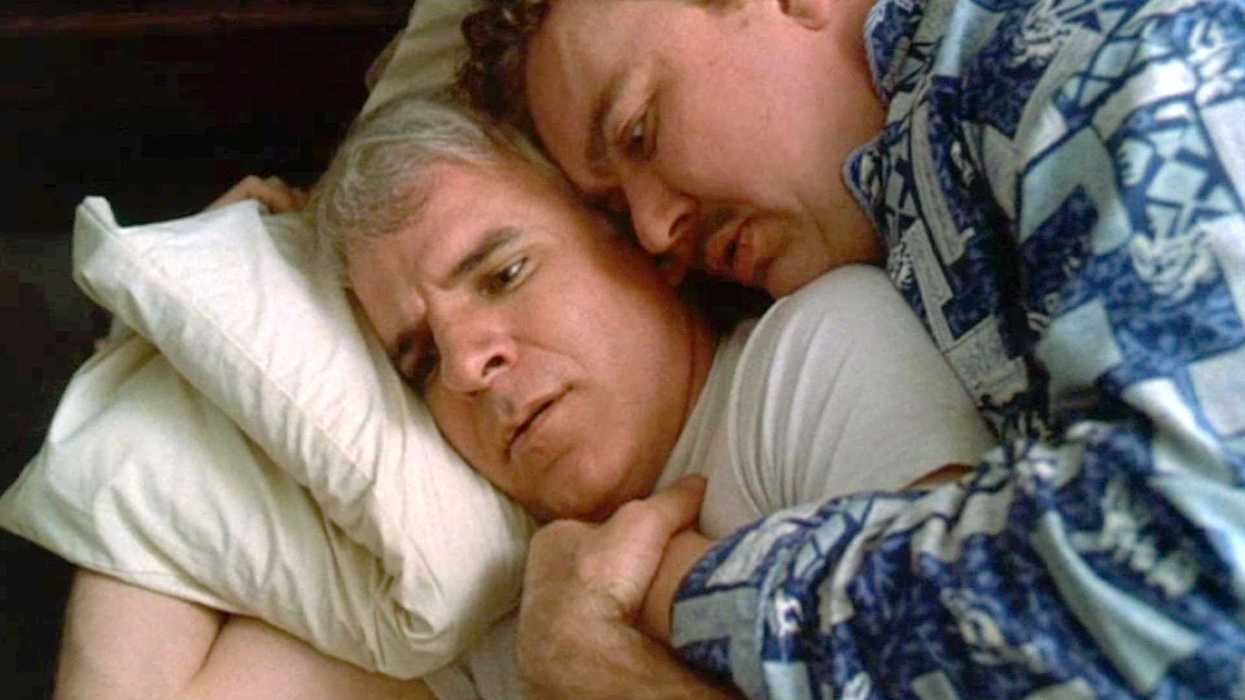
Neal Page (Steve Martin) is an uptight ad executive trying to get home to Chicago. Del Griffith (John Candy) is a shower curtain ring salesman who won't stop talking at Neal. By the time they share a motel room with one bed, Neal has spent an entire act holding in his contempt, and he finally can't take it anymore.
It's a well-known scene for how Del responds, quietly at first, doe-eyed at the barbs Neal sends his way. His response line is famous enough that Colin Hanks' 2025 documentary takes its title, I Like Me, from this scene. The moment is where the comedy stops deflecting. Neal attacks, and Del gives an honest answer instead of a joke.
Writers can learn three things from it. Watch the scene and dive in.
- YouTube www.youtube.com
The Scene
The two men are trying to rest in their motel room, but Del doesn't settle easily, sending Neal into a rage as he tries to clear his sinuses. (In the original script, he threatens a fart.) Neal jumps up and starts to pull on clothes to sleep in the lobby. The confrontation starts with how they view each other and their faults.
"You're not a very tolerant person," Del says.
"You spilled beer all over the bed," Neal says. "You smoke. You mess up the bathroom."
The conversation turns to what they have given each other and how they view themselves. Del calls Neal the intruder, while Neal sees Del as an annoyance with boring stories.
"Didn't you notice on the plane when you started talking, eventually, I started reading the vomit bag?" he says.
Del watches, quiet and wide-eyed, as Neal continues laying into him.
"I could tolerate any insurance seminar. For days, I could sit there and listen to them go on and on with a big smile on my face. They'd say, 'How can you stand it?' And I'd say, 'Cause I've been with Del Griffith. I can take anything.' And you know what they'd say? They'd say, 'I know what you mean. The shower curtain ring guy.' It's like going on a date with a Chatty Cathy doll."
Finally, Del responds.
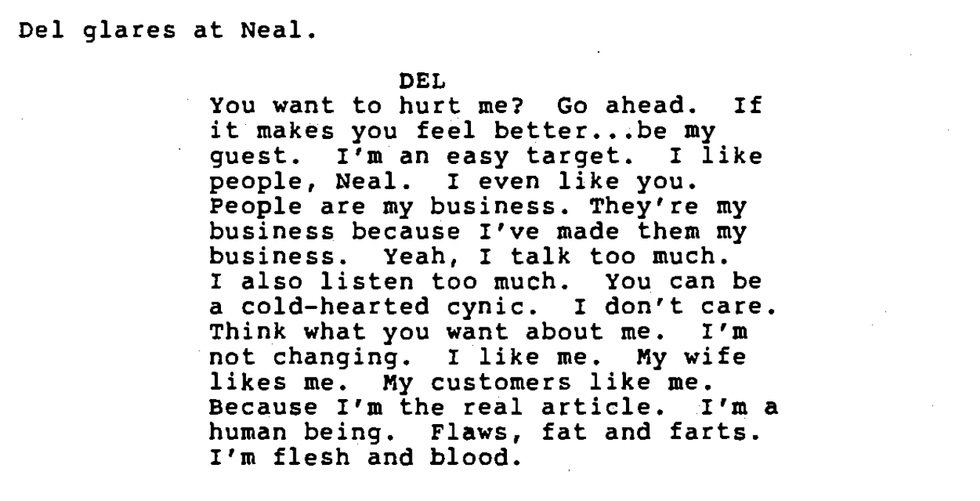
"You want to hurt me? Go right ahead if it makes you feel any better. I'm an easy target."
He's aware enough to know that he talks too much. But what he cares about is kindness, and he's happy with how he is.
"I like—I like me," Del says, emotional. "My wife likes me. My customers like me. Because I'm the real article. What you see is what you get."
He goes back to bed, and Neal knows he's taken things too far.
Neal and the Moment of Catharsis
The scene is so impactful because it's a confrontation that turns comic irritation into something more dramatic between the characters.
Up to this point, Del's chatter has been the joke, and Neal has been the straight-man standing in for the audience and rolling his eyes. It's a wink to the audience, because we know we'd probably find Del annoying, too.
Before now, Neal has been rude in service of comedy. But in this scene he gets rude on purpose, and it's hurtful.
Neal mocks Del's storytelling as pointless and not even accidentally funny, compares talking to him to a date with a Chatty Cathy doll, and tells him his stories need a point. We've probably wanted to say something similar to an annoying friend at some point.
Hadley Freeman's 2021 interview with Martin and Martin Short in The Irish Times frames the scene the same way. She describes Martin cruelly tearing down Candy's traveling salesman before the movie turns on him. It turns out that Del was based on Hughes' father, which Martin didn't know when he was playing the role.
"I didn't know about that. At all. I was looking through the script the other day, because I was finding things that were cut from the movie that were so poignant. Right at the end, there's a scene between me and John [Candy], and he explains his life ... that scene was a page and a half long in the script and in the movie I think it's cut to three lines. But there was such beauty in it, and I never understood why John [Hughes] trimmed that scene," he says.
Neal's snobbery is the character flaw the film has been building toward. It needs consequences.
 Credit: Paramount Pictures
Del Takes the Hit, Then Holds His Ground
The turn in the scene is that Del doesn't crack a joke in response, which might have been his response previously. Or maybe he agrees, withering under the critique. Instead, he stands up for himself, giving viewers catharsis on the other side of the relationship, too.
"You want to hurt me? Go right ahead if it makes you feel any better. I'm an easy target."
Del makes it clear that Neal is the bully here, for the characters and the audience. He admits the criticism is fair, refuses to change, then points to the people who like him for who he is.
His defense has its own subtext. He's self-aware enough to know he can be annoying to others, but he chooses joy anyway because the people who matter to him accept him. (But there's also a twist to the dialogue, as we'll see in a second.)
It's a small monologue that establishes Del's dignity, which is why audiences side with him. That makes him sympathetic, not just likable.
"My Wife Likes Me" Means Something Different the Second Time
The line changes further when audiences get additional information. On a first watch, the line sounds like a man bragging about a happy marriage. The ending changes that. When Neal goes back to find Del at the train station, Del admits he's a widower.
Hughes plants a line that plays as confidence, then reveals it was a cover. Everything Del said in the motel was defending a self he had to hold together. If you can find ways to give your dialogue subtext like this, it deepens your storytelling.
"John Candy was very sensitive and very complex, and we really loved each other," Martin said in the documentary, STEVE! (Martin) A Documentary in 2 Pieces.
Of everything Candy did, this scene is one people often return to because its emotion is so real, and it provides a beat of grounded drama in the middle of a road comedy. What's your favorite part of the movie?