You might be thinking, how much more light-sensitive can video cameras really get if the sensors don't get much larger? Well, if you're Canon, the answer is a lot better. They've just announced a new full-frame 35mm sensor that absolutely swallows up light, and it's specifically made just for video. We may not be seeing it in our cameras just yet, but it's definitely a breakthrough kind of technology for the world of video, and opens up all sorts of possibilities for available light shooting. Check out the video Canon posted on their site below.
Here is a little bit about the sensor from their press release:
The newly developed CMOS sensor features pixels measuring 19 microns square in size, which is more than 7.5-times the surface area of the pixels on the CMOS sensor incorporated in Canon's top-of-the-line EOS-1D X and other digital SLR cameras. In addition, the sensor's pixels and readout circuitry employ new technologies that reduce noise, which tends to increase as pixel size increases. Thanks to these technologies, the sensor facilitates the shooting of clearly visible video images even in dimly lit environments with as little as 0.03 lux of illumination, or approximately the brightness of a crescent moon—a level of brightness in which it is difficult for the naked eye to perceive objects. When recording video of astral bodies, while an electron-multiplying CCD,*2 which realizes approximately the same level of perception as the naked eye, can capture magnitude-6 stars, Canon's newly developed CMOS sensor is capable of recording faint stars with a magnitude of 8.5 and above.*3
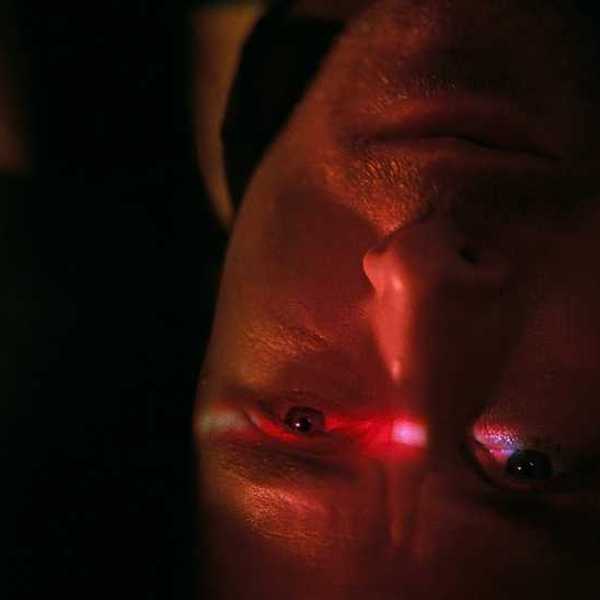
Using a prototype camera employing the newly developed sensor, Canon successfully captured a wide range of test video,*4such as footage recorded in a room illuminated only by the light from burning incense sticks (approximately 0.05–0.01 lux) and video of the Geminid meteor shower. The company is looking to such future applications for the new sensor as astronomical and natural observation, support for medical research, and use in surveillance and security equipment. Through the further development of innovative CMOS sensors, Canon aims to expand the world of new imaging expression.
The video above is just mind-blowing. We've talked about using moonlight as a light source before, but this sensor is actually capable of doing it with little noise. That's just unbelievable on so many levels. While it's not being targeted at filmmaking according to their press release, it could completely change the way people shoot for certain applications. The sensor itself is only about 1920 x 1080 (based on the pixel size), so you're not ever going to get that resolution in color thanks to debayering, and therefore it would fall somewhere between the better DSLRs and cameras like the C300 in terms of resolving a clean 1080.
Even though there would be some technical hurdles, and probably quite a bit of cost, a 3-CMOS camera using this sensor would resolve a perfect 1080p while at the same time literally being able to see in the dark. Focusing with a full-frame sensor isn't easy, but there are so many applications that could benefit from this type of flexibility besides just astronomy and security cameras. I could see news organizations or a documentary utilizing this sensor to take their cameras into places where they can't use any lights or draw attention to themselves, but they want to capture the action clearly and crisply. You have so much light sensitivity that you could even shoot stopped down to f/5.6 or f/8 and still get tremendous low-light performance while keeping things in focus.
Of course, narrative filmmakers could still use it to their advantage. It's certainly not about foregoing the use of lights, either. There are so many possibilities for types of shots that you never would be able to get with even the best low-light cameras today. You could really shoot an entire movie under natural moonlight. The moon can even act as a bounce in these kinds of low-light situations. For anyone who has taken long exposures at night with their still cameras, there is something magical about the way that light reacts to faces and surfaces under such little light. These are the sorts of advancements that push the art form to another level completely by freeing you from having to see the way a camera sees.
Even though we may not ever see it in a traditional filmmaking camera (let's hope we do), what are some of the uses you can think of for the sensor? How could you utilize it to tell a story no one has ever been able to tell before? Have there been situations where this could have saved you from gritty and grainy footage?
Link: Canon develops 35 mm full-frame CMOS sensor for video capture -- Canon Website
[via Canon Rumors]