A father and son on a public basketball court, one dream getting crushed and then rescued inside a single minute. It's not a slogan, not in the context of the film The Pursuit of Happyness, in which Chris Gardner's advice to his young son is really a confession.
The whole film pushes viewers to dream bigger amid obstacles and through the grit of a hard life, and this line encompasses everything in its protagonist and his relationship with his child. Let's look closer.
- YouTube www.youtube.com
The Scene
Chris Gardner (Will Smith) is in the worst stretch of his life. He's nearly broke, close to homeless, lugging a bulky bone-density scanner around San Francisco while chasing an unpaid stockbroker internship that might one day pay off.
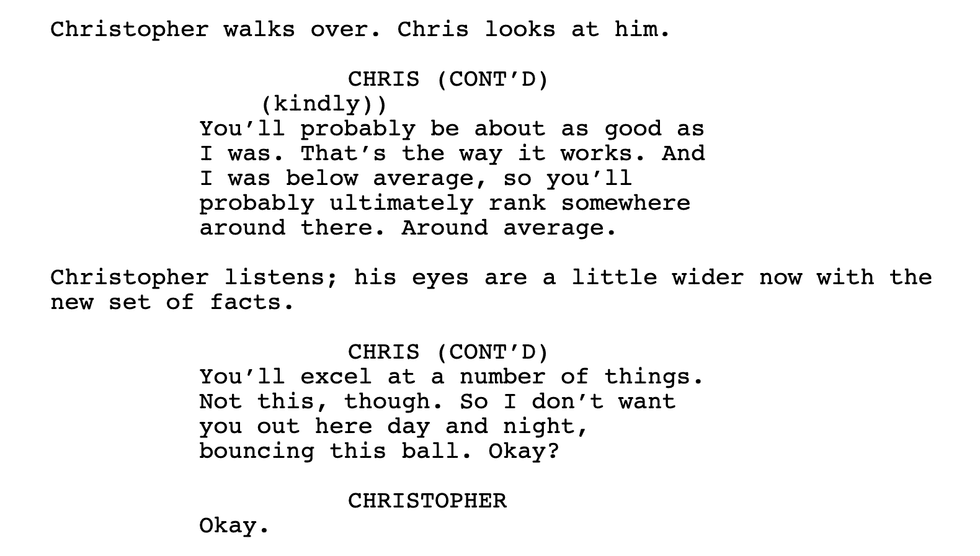
In the middle of all that, he's shooting hoops with his young son (Jaden Smith), and the boy announces he's going to go pro. Chris, tired and honest to a fault, tells him not to count on it. He wasn't much good himself, so the odds are long.
It's standard-issue dad realism, not necessarily kid-friendly. "You'll excel at a lot of things, just not this, so I don't want you out here shooting this ball around all day and night."
"All right," his son says. He throws the ball away, ready to give up then and there.
Chris watches how it makes his kid feel. He deflates emotionally and tucks the ball away, and Chris understands he's messed up. He makes time to undo the damage.
"Don't ever let somebody tell you you can't do something. Not even me. All right?"
"All right," his son says.
A dream is a fragile thing, he says, and the people who couldn't chase their own are the quickest to talk you out of yours.
"You got a dream, you gotta protect it. People can't do something themselves, they wanna tell you you can't do it. You want something, go get it. Period."
What the Line Reveals About Chris Gardner
The reason the line works is who's saying it and when. This isn't a coach giving a pep talk or a mentor with his life totally in order. It's a man who has almost nothing, mid-collapse, and the only thing he has left to give his son is inspiration.
The distance between his circumstances and his conviction is the whole character, really.
It also tells you what kind of father he is by seeing that he's messed up and letting him correct himself out loud. He gives the boy the cynical answer first, because that's his exhaustion talking, then takes it back. And that's such a real, human thing to do.
The script didn't actually have to have this beat, and it does make the scene technically longer, which means money and time spent on set. But this version lets him be human, catch his mistake, and choose to be better in front of his kid, which moves us. And those emotional beats are worth it.
And notice how plainly he talks. There's no poetry in "go get it. Period." It's the blunt, unmistakable speech of a specific man. It opens conceptually then ends on one hard, flat syllable. That's the most powerful spot in any line, the very end.
The line sounds like Chris because it's stripped to the bone, and it comes straight out of what he wants more than anything: for his son to skip inheriting his regrets.
 Credit: Sony Pictures Releasing
How the Line Got Made
We love a behind-the-scenes detail, and this one has a great story. Did you know the scene almost didn't exist?
According to Chris Gardner, who lived it, the original script took the opposite path. In interviews, Gardner has said the page had the father shut the dream down cold, telling the boy that since he'd been no good at the game himself, the kid had no shot either.
There is a draft of the script floating around that ends with the deflation, then moves on without the pep-talk.
Gardner pushed back, because that wasn't what his own mother had told him growing up. On the day they were set to shoot, he pulled Will Smith aside, and after a heated conversation with Smith and director Gabriele Muccino, they threw out the pages and shot the version everyone now quotes.
The defeatist original technically worked. But a rewrite that hunts for the truer scene is better than just functioning. What does the scene now reveal about the character? A sensitivity and a wish for better for his son.
When you go back through your own draft, the scenes that read as plausible but flat are the ones to look at for what they say about character.
The Line You Have to Earn
On paper, this scene button is the kind of thing screenwriting teachers warn you about. It's on-the-nose. It states the theme out loud. It's the sort of line that usually makes a script feel like it's lecturing you.
So why does this one work? Because the movie earns it. On-the-nose dialogue isn't automatically bad. You just have to know when to use it, and the right moment is when a character has gone through the correct beats and experienced enough story for the right to say the plain thing. We've watched Chris get evicted, sleep in a train-station bathroom, and hold his son through the worst of it.
By the time the character says the thing that feels obvious, the obvious thing has cost him everything, so it comes across as hard-won truth rather than a corny platitude. It's still a platitude, but it's something the man would say, so it doesn't feel like it.
That's the takeaway we can all use. If you want a character to land a big, direct, quotable line, make them hurt for it first. We want to see a character fight back and overcome obstacles. Just like in real life, if you are beaten down enough, sometimes the only thing that makes you feel better is being totally honest and a moment of raw catharsis. It makes sense in reality, and it makes sense in fiction too.