You’re likely surrounded by cameras every day. Doorbell cameras, driveway cameras, license plate readers, etc. Writer/director James Mulcahy noticed and saw an idea for a feature.
When he moved back in with his parents in New Jersey during COVID, he saw how the security cameras they'd installed had changed the place. A home that used to welcome every visitor now wanted to know exactly who was coming up the driveway.
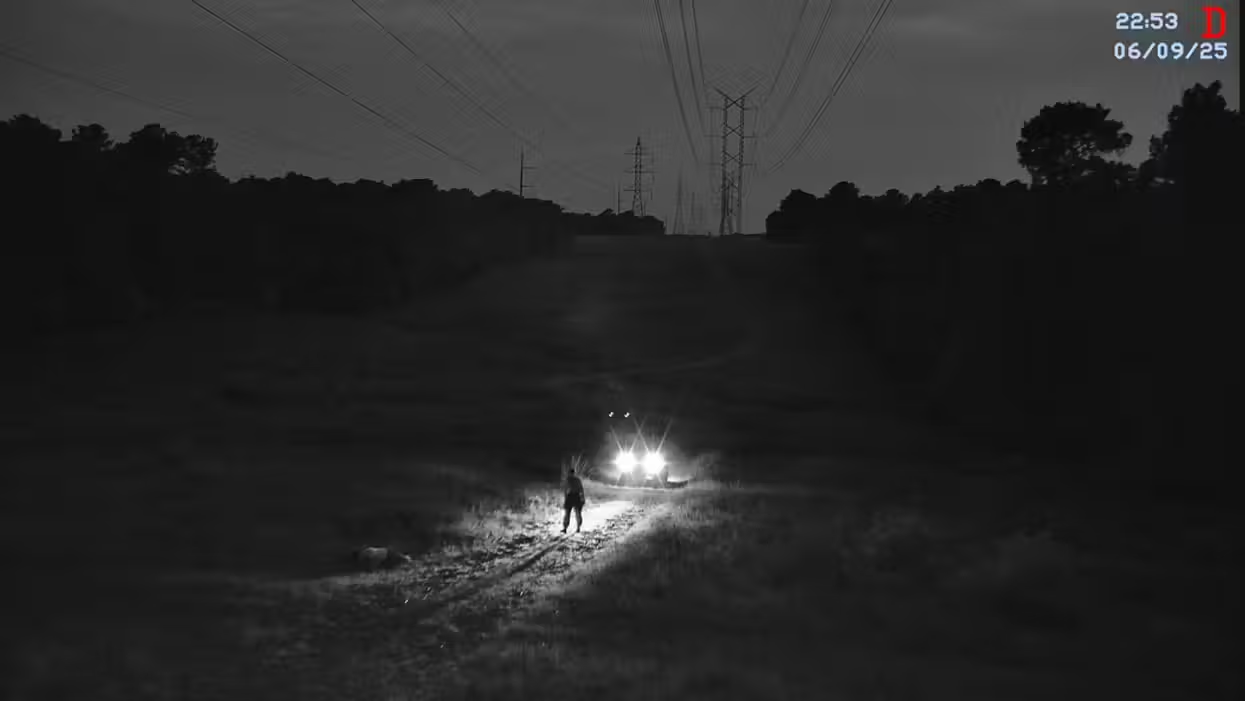
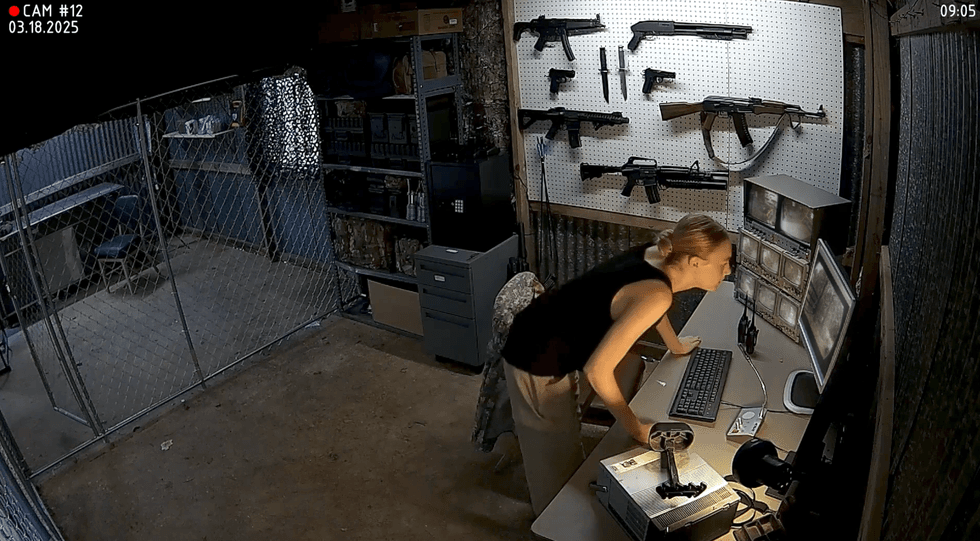
That idea eventually became Compound, Mulcahy's first feature, which he co-wrote with Max Perkins and which screened at the TIFF market this fall. It's a found-footage thriller told almost entirely through security feeds around an off-the-grid compound.
A single father, ex-military like his late wife, has raised his four kids to distrust the government and live surrounded by weapons. When one of them gets shot, and Child Protective Services shows up for a welfare check, everything spirals into disaster.
Mulcahy took the scenic route to his first feature. He started as a food writer in New York, moved into food documentaries and web video, then into commercial work. "So I like to joke that I make the reverse commute kind of like I worked in commercial video and I want to be a starving filmmaker now after that," he told us.
For indie filmmakers, the most useful part of Compound is how it got made. We chatted with Mulcahy via Zoom to learn more.
 'Compound'Credit: James Mulcahy
Editor’s note: The following conversation has been edited for length and clarity.
No Film School: How'd you get into film?
James Mulcahy: Long story medium, I started as a writer. In college, I was an English major and then bounced around New York a bit in my 20s, and then I started a blog about food and drink. So I actually started and came up as a food writer and was employed doing that. It was during the age of blogs, which quickly became the age of video, and I started getting put in charge of video productions for food stuff, like food documentaries and things. I worked for a number of years on food web documentaries and web content, which is much different than now, which is very social-forward, and kind of caught the video bug, but also cut my chops a little bit. I went more into commercial stuff, which is very boring and uninteresting.
I always wanted to be a filmmaker. I watched all the movies in the '90s. Also, I worked in Blockbuster Video in the VHS era, but I never saw the path to it. But then coming up as a writer and then getting into filmmaking, which is so much more collaborative than writing, it was so refreshing because as a writer, you're just yourself in a room, and it's endless toil and thankless. Maybe there's an editor working with you.
And then in filmmaking, it was just a collaborative, amazing space where there's always someone who's better than you. There's always another teammate that can jump in and do the thing that you don't know how to do. It's like, wow, I really want to start doing this. So the storytelling really transferred over, and then the collaborative space from day one, I was like, "I want to work in narrative. I want to try to do a feature."
I like to joke that I make the reverse commute, like I worked in commercial video, and I want to be a starving filmmaker now after that. So hence Compound. The first feature, after learning the ropes ... first documentary, then commercial space.
NFS: With Compound, how did you come to that idea?
JM: It was strategic in a way because you want to do something that's affordable and low budget and something that you actually can think of and execute. I'm from New York, and I've lived in New York City for quite a bit of time now, but during COVID I moved back to New Jersey with my parents. And they live in this rural suburban area. And I grew up there, and it was totally cool and chill, and everyone loves to have visitors.
But when I came back for COVID, they had installed these security cameras around just in the driveway and at the door. And what had become this, or what was once this very welcoming, convivial place in Jersey, became almost like, "Hey, what's this? Who's coming up the driveway?" There was a more suspicious vibe just like that by having these cameras installed and around the property.
So of course, being interested in horror and genre, I was like, "Ooh, this is so interesting. My parents, once so friendly, are now paranoid just because they have this tech."
And then also being in COVID, it was the perfect time, "What are we doing? We're stuck on the property. Hey, let's try to run some scenes and see what we could do on these cameras that might be a little bit more cinematic and still have the kind of fun and graininess of the cameras themselves, but also be able to be scary or threatening and tell a longer form story."
So really it came out of just that experimentation in COVID.
NFS: I would love to hear more about making that footage cinematic.
JM: It starts with a frame, because for most of the security cameras, you're locked and you know what your frame is going to be. A few of the cameras do have, it's called PTZ, pan/tilt/zoom, off-shelf models, but most of these that consumers are buying are just looking at a specific frame.
So you're thinking about how to replicate features of tension and features of drama that might be done via editing in a traditional film, just in the frame itself. ... We got the cabin for Compound, and we had it for six months. So we put our frames up, and we were trying to experiment, and then we did a lot of workshopping to see what kind of action would work, how far away the camera had to be for someone to be recognizable.
Different jump scares are much harder to do when you're just looking at things, so there's not a lot of those in the film. [We're] trying to figure out how to replicate and incorporate surprising moments. So I guess to think about how we did it: establish the frame, and then you build the action in the frame and around the frame.
And for us, the scripting actually came very late because we didn't want to write a script that was not doable with these very static frames. So we put the frames up, did our workshops, and we wrote the script probably only six weeks before production, because by that point we knew exactly the type of sequence and exactly the type of action that would work so that when we were—time and money and a larger crew on set—we weren't upset or found, "Oh, hey, we found that this type of thing won't work on these security cameras."
It was really a lot of rehearsal and workshopping before we committed to the script. And then when we got to set, we knew what would work and what wouldn't. And the stakes are much higher; you have a much bigger crew. So the workshops were a very small group. Producers or writers were all playing the characters and just running around and doing our best. A lot of testing really went into this.
NFS: So it's almost like reverse engineering.
JM: Yes, exactly.
NFS: And you also did something interesting where you weren't on set; you were directing from a distance. Can you talk a little bit about that?
JM: It was actually pretty cool. So the cameras, they're one level above what you might buy at Best Buy. We bought them on Amazon. They're actually the cameras my parents had in New Jersey, but they're Ethernet-wired in.
So we have cameras across this property, which is very practical. The property is mostly what you see. So, the barn: you have a 300-foot cord running from the cabin to the barn. We were in a tiny, tiny little basically closet room in the cabin, and things are happening in the woods 600 feet away in the barn, 300 feet away. And then no one is on set except for the actors because everything is in frame. So people are either hiding somewhere, crouching behind the couch or something that's off frame or out in the wing. The characters and the actors would have to run their scenes without intervention at length.
It would start before the pages. They would be in character; they would keep going. And if they're walking off camera, there is no off camera. They would just walk, and then they sit down, and that's still in play, and they're still in character.
We didn't have a voice-of-God style microphone or anything like that. It's too expensive. So we have walkies, and we would just relay from the control room to the people crouched on set, who would then cut. They would appear; they would do their best to give notes.
And we got so much more than what we had thought we were getting in the control room too, because you're not looking at one shot; you're looking at six shots. So you're missing a lot of the nuance that you might try to go for with an Alexa or with a feature, but you're hoping that you get it.
We'd run the scene four or five times and then have to move on, so we'd do our best to do this relay game of notes. Once the actors understood that you have to stay in character the whole time, even if you're walking "off" what you think is the frame.
We also didn't do a lot of blocking. We did basic blocking like, "Hey, this is kind of where you want to be." But by the time we would set it up, if we set it up too much, it would look artificial. So we started very early, rolling very early to get their natural movements through the space. Because if we caught ourselves as directors telling them to cheat to the camera too much, it would be bad. And you would tell. You would get taken out of this immersive world that we built and know that we were doing certain things just because we knew where the cameras were.
NFS: How much did you end up with in the edit? Was it overwhelming?
JM: The footage size itself is not overwhelming. It's all shot in 1080p. It's actually all shot on these security cameras. So it's all downloaded from a centralized hub at the end of the day. But the angles are—yes, there's so much happening for one scene. There might be six cameras, nine cameras running, and we're trying to take notes and figure out what's working. There's probably a primary camera, but it's almost like a joy of quantity because you know you have the kind of meat of it in maybe two angles, then you have all these weird, surprising things going on in the other angles that are running that we sometimes end up favoring in certain scenes or to create tension.
You might get a strike of lightning in a camera that you didn't see in another camera. You might get one of the quieter moments from the characters when they're just sitting there or reacting that we never would've thought we would've used at all. That goes in.
So it definitely was a lot to sift through, but it was a good problem to have.
NFS: It's always worse when you don't have footage, I feel like.
JM: Also, just to be real, it is a little bit more of a forgiving approach because you're able to do more takes quickly and trust that you have a plethora of material, versus you have to move the cameras; it takes 35, 40 minutes to get the cameras into place, and then you go and start rolling your takes.
You get to do three, then you move again, and you're getting coverage. But our coverage was just roll the scene over and over again and hope that or know that different things would be happening in different cameras and we'd have awesome stuff to use.
NFS: Is there one thing that you feel like you learned from this project that you're going to take forward?
JM: I think I like this phrase, reverse engineering, and to just think about getting a bunch of your friends in a room and just making things up before the stakes are high. I'm a huge proponent.
So I guess two things: it's on both sides. It's on both the edit and production.
Just test it out. On the production side, again, we did it before we even wrote our script, but having these test scenes that were shot on the same cameras, tremendously inexpensive. We'd hang out, we'd say, "This is what's going to happen." It was fun, and it was very low stakes. So if it didn't work, that's fine. We would just come back the next day and try something else.
This was a traditional 26-day production where the stakes are high, and it took the steam off a little bit and took the stakes down a little bit because we knew it was going to work.
And then on the post side, we actually did a number of test screenings with bigger audiences in person, 20 people, 30 people. It's great to send it to your friends and get their honest take, or maybe not so honest, but having people watch it in a room together and just being in that room with them before it's ready, before it's done, that made a huge impact on the final edit that you're seeing or near final. ... When you're in the room, and no one's responding, that's the information you need.
NFS: Is there anything else you want to add about the film?
JM: [We're] just excited, and we're hoping that we're doing something a little bit different in the found footage space that people will respond to. And these cameras are everywhere all around, and this is the type of footage you're seeing in the news and on your social feeds. And hopefully, as a feature, people will really find it compelling, and it will work.