There's a moment early in screenwriter Corey Mandell's career that changed everything for him.
While still in film school, he sold a pitch to Ridley Scott. The project was called Metropolis, and suddenly Mandell found himself on a plane to London, flying first class for the first time in his life, terrified that Scott would figure out he was just a student who had no idea what he was doing.
In their first meeting, Scott asked him a question about his script.
"What's it about?"
It left the young writer dumbfounded. Listen to Mandell tell the story below, then let's dive into specifics.
- YouTube www.youtube.com
What's It About?
When Scott asked this, Mandell just gave him the plot overview. The director nodded and asked again, "What I mean is, what's it really about? Like, at its core, what's it about?"
Mandell didn't know.
He spent that night calling everyone he knew in Los Angeles, trying to figure out what Scott was actually asking him. Eventually, someone explained it, and Mandell went back the next day with a real answer.
Scott made him refine it, write it down, read it back multiple times, and then circle it.
"That's what it's about," Scott said. And everything in the story had to connect to that singular idea.
No, What's Your Story Really About?
Mandell says most screenwriters don't understand this until someone explains it to them—if your story is about more than one thing, it's not about anything.
Mandell uses a metaphor to explain this. Imagine you have a friend who wants to build a spec home. They couldn't decide where to build, so they built part of the house on a beach, part in a forest, and part in the mountains. Now there are just three piles of rubble scattered across the island.
This is what screenwriters do constantly. They go wide instead of deep. They build part of their story on one foundation, part on another, and part on yet another. The result is a pile of rubble that fails to form a cohesive narrative.
Can you point to the one thing your script is about? What thematic idea is it exploring?
The Difference Between a Logline and Theme
This isn't the same thing as a logline. A logline is a selling tool. It's a one- or two-sentence summary designed to get someone interested in reading your script. It's valuable for pitching, but it's not what your story is fundamentally about.
Vince Gilligan's logline for Breaking Bad was "Mr. Chips becomes Scarface." That's an interesting hook. But it only describes Walter White's journey. What about Skyler? What about Saul? That logline can't be what the entire show is about, because it doesn't encompass everything.
According to Mandell, Gilligan told viewers what the show was actually about in the second scene of the pilot. Walter White is teaching his chemistry class and explains that chemistry is about the study of change.
That's the unifying idea that guided every character and narrative decision across the entire series. How would these characters evolve? How would their circumstances change them? And what are the byproducts of that change?
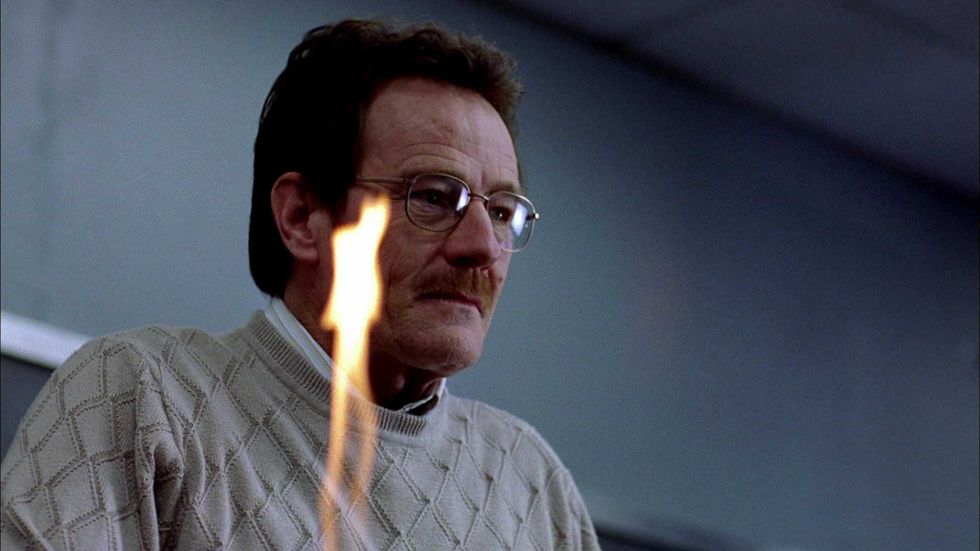 Breaking BadCredit: AMC
Why This Matters More Than You Think
Mandell points to Paddy Chayefsky, who wrote what many consider the best screenplay ever (Network). He said he felt sorry for any writer who doesn't know what their story is about. He wouldn't write until he figured it out. It took him a year to determine that Network was fundamentally about the question, "How do you live your life when you live in a society that doesn't value human life?"
This central message isn't explicitly mentioned in your script, but it's the emotional and spiritual driving force behind everything. It's what makes audiences feel something.
Most screenwriters can't articulate their story's theme, even after writing 100 pages. If you can't answer what your story is really about in one sentence, you're flying blind.
As Mandell warns, if you can't answer this question, your pitch or script won't get the attention it deserves, no matter how talented you are.
Before you write, figure out what your story is really about. It's not the plot or the logline. What are you really trying to say?