
Making a movie is brutal. It's hard. We know.
But the lead-up to the green light might even be worse. Before you get to hire actors or buy props, you often have to sit across from someone holding the money and talk them into parting with it. It's a skill that has almost nothing to do with filmmaking. You have to be a performer yourself.
StudioBinder's new video on how films get greenlit is basically a clinic on pitching, assembled from writers and directors who have managed to get good at it.
As screenwriter Jeremy Slater puts it, "It doesn't matter how good you are on the page if you don't get hired for the job in the first place. And that's a problem, because most writers are introverted weirdos who spend way too much time alone. Suddenly we're shoved into a room and asked to be passionate and funny and charismatic, and for a lot of us, that's an utterly foreign skill set. It's f***ing terrifying" (via SYFY).
If that's you, here's what the people who've cracked it do differently.
- YouTube www.youtube.com
Find the Right Room
Before anything else, figure out who you're talking to. Do your dang research and know the platform you're pitching.
A studio executive and an indie financier want different things, and if you're just starting out in the industry, your idea should read as manageable and low-risk, not a hundred-million-dollar gamble.
For example, Jordan Peele approached Get Out as a producer first, mining what worked without a big budget.
Neill Blomkamp says in the video (speaking during San Diego Comic Con):
“I suppose if you're James Cameron or you're Peter Jackson, then having a lot of money probably is pretty cool because you can have a lot of money and do what you want. But if you're not them, you have to kind of start off with films that are, you know, either smaller and you can do what you want, or bigger and you can't do what you want.”
Knowing your buyer influences everything that follows.
Get Yourself Excited First
Guillermo del Toro says there's exactly one secret to pitching, and it's the opposite of what you'd expect.
"I find that there is one secret and one secret only to pitching, and it's exactly the same advice you get when you fail rather than when you succeed at pitching," del Toro told SYFY. "I find that I never, ever, ever think of the people listening. I pitch to get excited myself. I find that if in the pitch I get excited and enthusiastic, I start adding details and I get really caught on the tale. I have now for 20-something years pitched successfully and unsuccessfully, and what I've learned is that the only time it comes alive is if I am completely caught up."
When he gets energized by his own enthusiasm, he starts adding more, and the whole thing comes alive.
The corollary is that you're selling yourself as much as the story. If you try to walk into the room with something that isn't instinctively yours and, as one director in the video puts it, you're lying.
Executives have little imagination, so your conviction is often the most persuasive thing in the room.
Know Your Audience
You also need to know precisely who the finished film is for.
Producer Patricia Weiser told Backstage:
“I’m most interested in pitches that present a whole package: creative idea plus identifiable audience. At the end of the day, independent filmmakers have to take ownership of the whole project from beginning to end, create a compelling story idea, and pitch who your audience is and how you’re going to get them ... It’s important to know who the characters are and what conflicts they have to overcome, and you have to make me feel a connection to them. If you don’t believe in yourself, why should I?”
Once you know the who, make the room care.
YouTuber and TV creator Olan Rogers told SYFY, "It's characters, characters, characters, characters. We hit those characters on Final Space. I want people to feel something in that pitch. If you can get them to feel something, then you've accomplished what you want in your story. That means they understand the character arc, and they bought it, and they're in."
Characters and emotions are what live under the logline. Though you still need the logline.
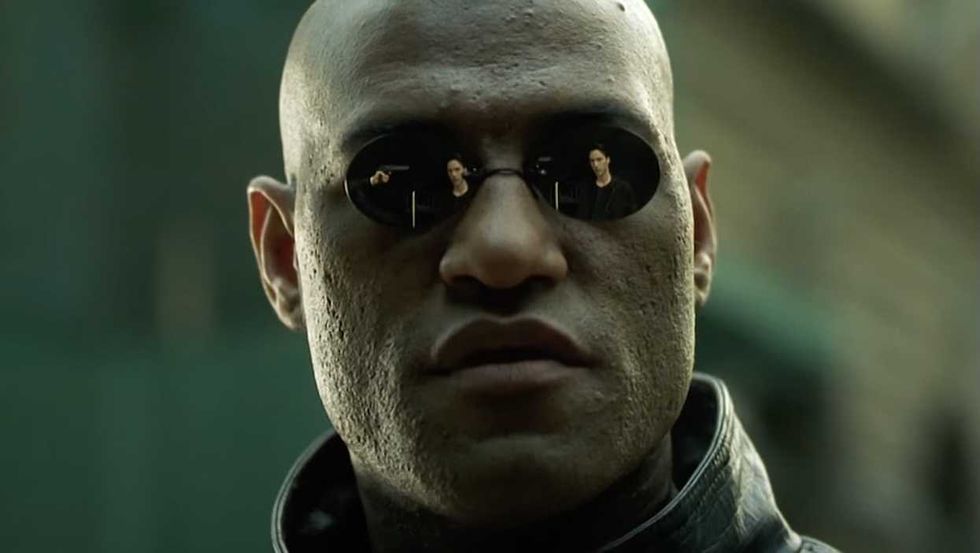 ‘The Matrix’ Credit: Warner Bros.
Show It, Don't Just Say It
When words aren't enough, show them the movie.
For example, Damien Chazelle shot a single scene from Whiplash as a proof of concept precisely because, "as a script alone… it was a hard sell," he said.
For worlds that are hard to picture, art can go a long way in the pitch. The Wachowskis storyboarded The Matrix so executives could finally grasp the action, and James Cameron mailed Arnold Schwarzenegger a painting of the Terminator wearing his face.
Sometimes you're pitching the talent, too. Because a big name brings the money in. Ti West reeled in Ethan Hawke for In a Valley of Violence with a no-pressure promise. Read the script, and if you hate it, we never speak of it again.
I've found that a pitch deck can be a great communication tool to send talent so they know what you're trying to achieve.
Forget Being a Showman
You don't have to be slick. Kevin Smith, who's a performer, has made peace with the fact that he's not a natural.
"I tell you I'm not good at the pitch. So much so that later in life, I've just taken a laptop and read my pitch," he told Adam's Apple. "I've never been good at the pitch, so much so that later in life, like in later years, I've just taken a laptop and read my pitch. Like I was doing this pitch for Disney Channel years ago, and I was just like … honestly I wrote eight pages, and I'd rather just read it from the laptop, and I'll look up at you from time to time."
You don't need to be a great showman to be a great filmmaker. Bring in your idea with passion, detail, emotion, and vision. Charisma will help, but it won't kill you if you're a little awkward.