Why Ben Affleck Says a $25 Million Movie Needs a $100 Million Box Office Just to Break Even
The price of making movies has gotten very expensive.
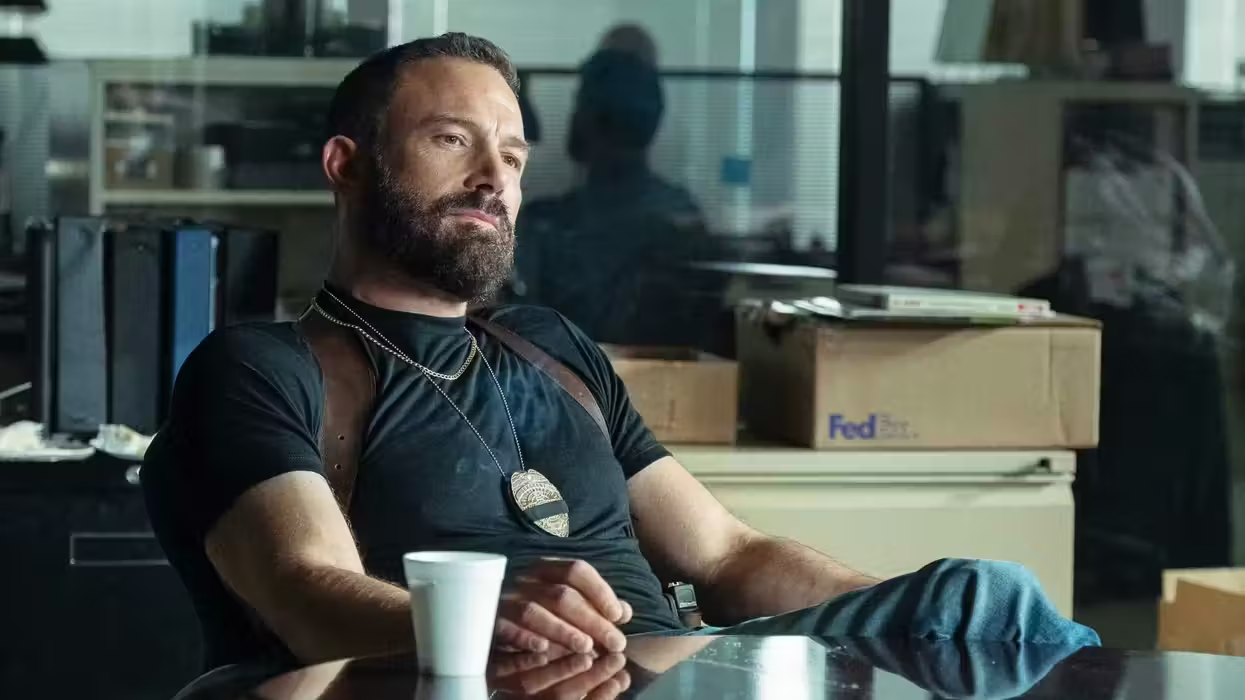
'The Rip'
If you’re trying to understand the current state of Hollywood, look no further than Ben Affleck’s recent breakdown on the All The Smoke podcast for the answers to your questions.
I've said it before, but Affleck is like the best podcast guest ever. He breaks down complex things into bite-sized chunks, and if you want to understand modern Hollywood, his take here clears the air for you.
Let's dive in.
- YouTubewww.youtube.com
The "Baseline" $25 Million Budget
This whole conversation comes around the 40-minute mark of the episode during the Ryan Coogler section, where they start talking indie film.
The whole idea here is that it now costs around $25 million to make any movie.
Affleck started by debunking the idea that a mid-budget indie is cheap to produce in the current landscape.
Once you pay out the unions and the star, you're jacking that budget up a ton. That, plus the sheer cost of keeping a crew fed and housed over a standard 30-to-40-day shoot, has made the baseline cost of production skyrocket.
So that $25 million isn’t going toward star salaries or vanity trailers; it's just what it costs to pay everyone and to get a product out there for audiences.
P&A Costs
Okay, so let's talk about why it takes the $100 million to actually make any money.
Making the movie is only half the battle. If you want people to actually show up at an AMC or Regal on a Friday night, you have to tell them it exists.
What most people don’t realize is that you often spend about as much marketing the movie as you do making it.
That's become the real cost of cinema; you need people to want to see them, and have it pop up and be advertised to them in the spaces where they consume media.
You have to get your movie out on billboards, commercials, and even on social media.
If the movie costs $25 million to make, you might spend another $25 million promoting it. Now you’re $50 million into the project, so the budget has doubled.
The 50% Exhibition Split
Now, your $25 million cost $50 million total to make and launch, and if it goes on to gross a respectable $100 million at the global box office. You’re up $50 million, right?
Nope. The thing is, you have to pay theaters to exhibit the movie as well.
Usually, that's a 50% split of the box office revenue.
So, when the dust settles, a $100 million gross yields roughly $50 million back to the studio. Against a total investment of $50 million, you have made exactly zero dollars in profit.
That's why we need to see movies become incredible breakout hits domestically and abroad; they have to be global phenomena now to actually rake in cash for the studio and for any participant who may have a slice of the back end.
The Lesson for Filmmakers
This math explains why the theatrical landscape has fractured into micro-budget horror films like an Obsession, that can turn a profit, and $200 million IP blockbusters that rely on global brand recognition to guarantee massive turnouts.
These studios don't see a way to profitability in the middle, because all they can see is that $100 million ceiling that says they broke even. That makes them nervous.
This is why other models like releasing directly to an AMC or even cutting teeth on YouTube to show you have an audience in order to work out a deal with a studio make a ton of sense moving forward.
Let me know what you think in the comments.