Independent filmmaking often means making decisions around time constraints, budget, equipment, and resources. But those decisions also come with important lessons about filmmaking in general and creative solutions that make you better at your craft.
For The Veil Chapter One: Roadkill, the first installment of Brooke Becker and Delaney Sharpe’s new horror anthology series, the filmmakers faced a number of challenges, including a significant electrical setback that cost them 90 minutes of an already tight eight-hour shoot.
Sharpe says, “We learned that resourcefulness isn’t just about solving problems when they arise; it can actually become part of the creative process, forcing you to think differently about how you build tension, environment, and scares.”
In this conversation with No Film School, Becker and Sharpe discuss everything from drawing inspiration from The Haunting of Hill House to navigating challenges on an indie set, including rethinking coverage and shooting setups, incorporating unexpected drone footage, and using practical lighting and post-production techniques to maximize their resources.
Let's dive in.
- YouTubewww.youtube.com
NFS: Both, What first sparked the idea for The Veil Chapter One: Roadkill, and what made it the right project to launch Black Ribbon Productions?
Brooke Becker: For this series, I took inspiration from vintage paperback scary story anthologies; the kind I used to get at the Scholastic Book Fair for five dollars and read under the covers at night until I got too scared to sleep. The Veil was developed as an ongoing horror anthology series for YouTube from the beginning, so we wanted to optimize it for the platform by parceling out each story to be a bite-sized watch, leaving you wanting more.
Delaney Sharpe: Brooke and I had been working on pre-production for the first two chapters of The Veil, and at the time, Roadkill was actually slotted to be the second installment. But when Brooke came to me with the script for Chapter Three, I immediately knew we needed to switch the order and put Roadkill first. I think as all three pieces come together, the interweaving connections unfold in a way that will be very satisfying for audiences to uncover.
 Credit: Black Ribbon Productions
NFS: Brooke, what did pre-production look like for you as a director on The Veil Chapter One: Roadkill? How did you establish the tone you wanted from the very beginning?
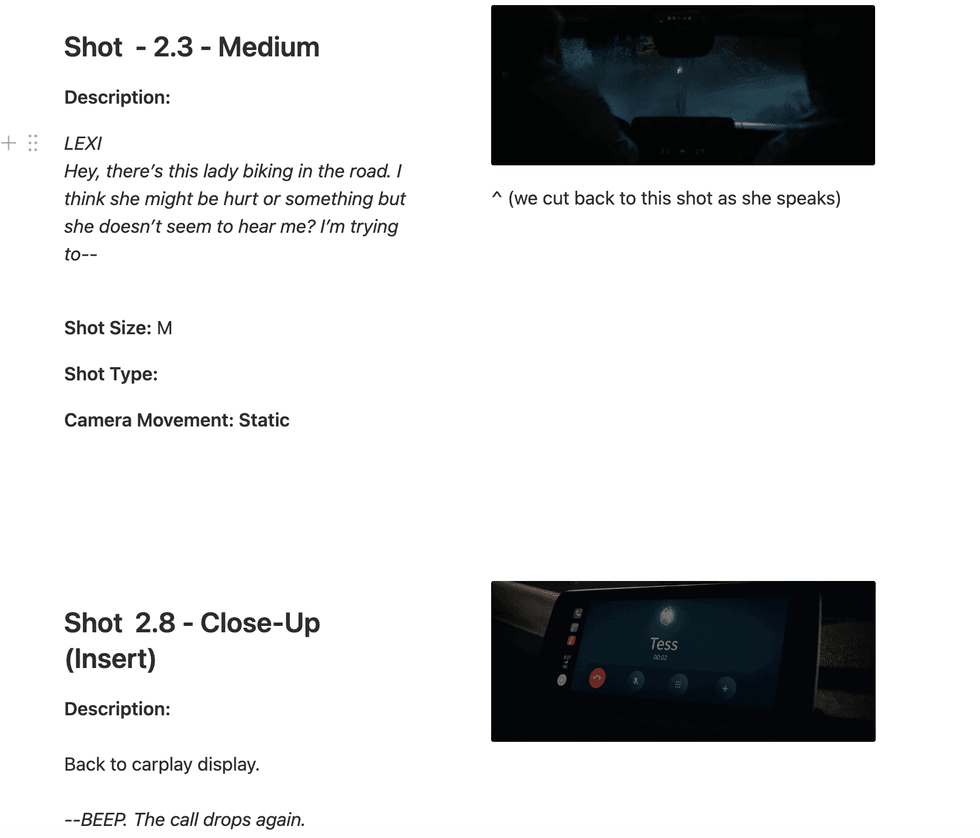
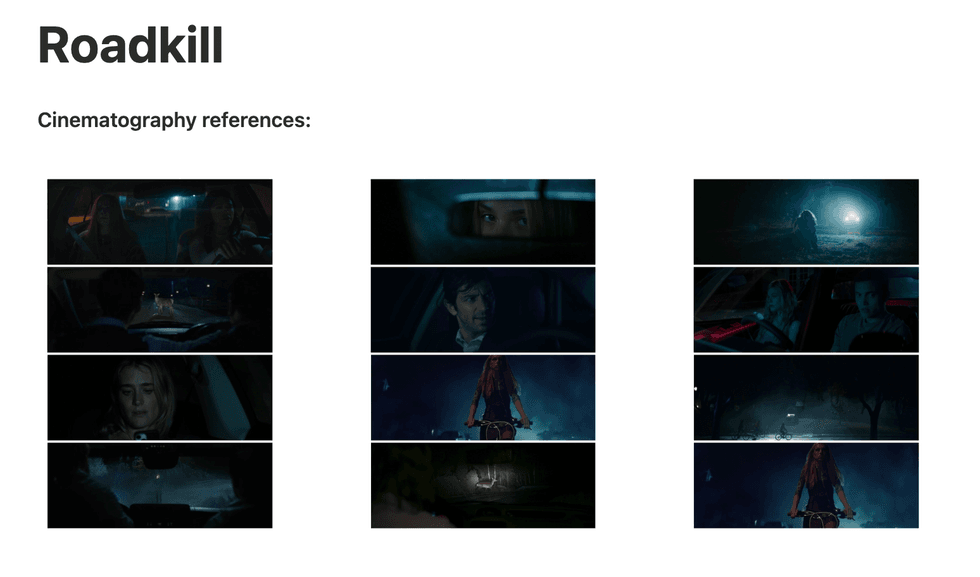
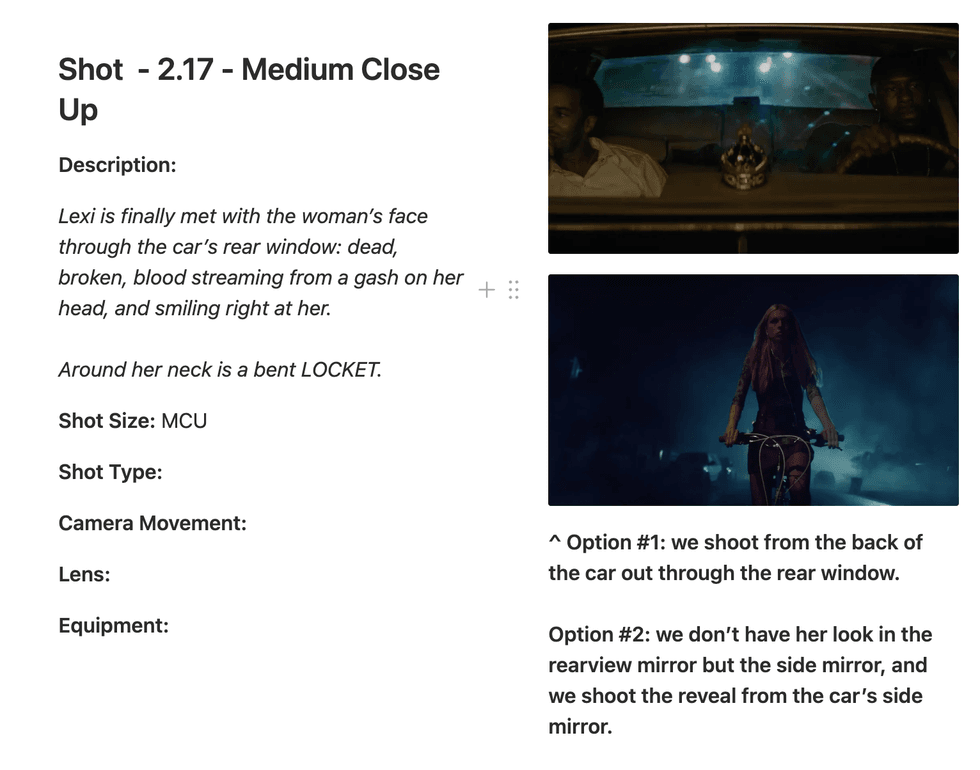
BB: I’m a very visual person, so when I begin to write (and sometimes before I write), I always create a moodboard. Each chapter of The Veil has a distinct color palette and visual tone. One of my favorite tools is ShotDeck, which I use to pull stills for moodboards, cinematography references, and my storyboard. I organize everything in Notion, which makes it easy for me to share with our crew and get feedback from their perspectives. My goal is for everyone on the team to know exactly what we’re getting before we step onto set, and how we’re going to shoot it.
I come to every meeting in preproduction prepared with visuals, questions for our department heads, and ready to receive their technical and creative notes so that we can best collaborate. I never went to film school—my degree is in English—so when I first began producing and directing a few years ago, my years of training and being on set as an actor prepared me for how valuable collaboration and prep is in preproduction. Even if I’m steering the vision, it’s our team who brings it to life, and we’re lucky to have such talented and easy-to-work-with people on our team. The more prepared we are beforehand, the less stressed we’ll be (especially when it’s 2 am and freezing cold), because we have such a solid roadmap.
We knew that we wanted the tone of this show to be grounded but with a lot of room for creativity and world expansion. Roadkill starts us off by establishing our eerie setting in which the veil between this reality and the next wears thin, and our upcoming Chapter Two release, Ophelia, will bring in some more stylized and darkly whimsical elements. Our third chapter… well, you’ll have to wait and see!
NFS: Delaney, since the short unfolds in one continuous scene, what was the biggest challenge of maintaining the character’s emotional intensity throughout the shoot?
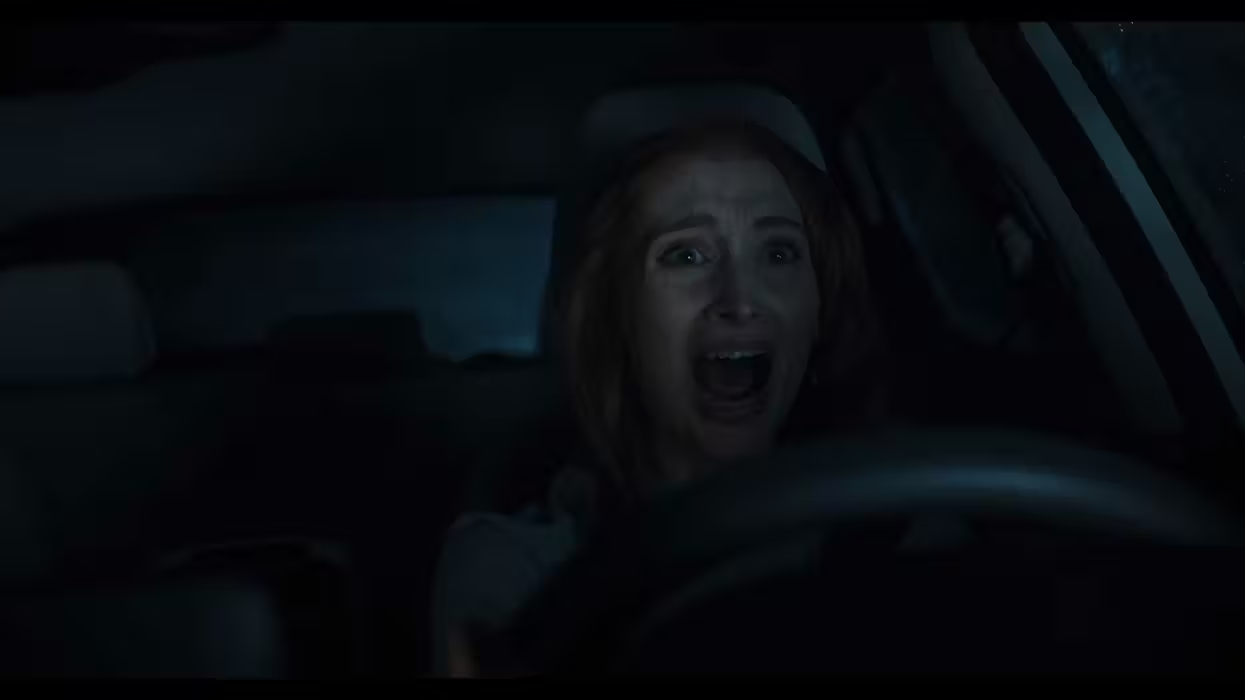
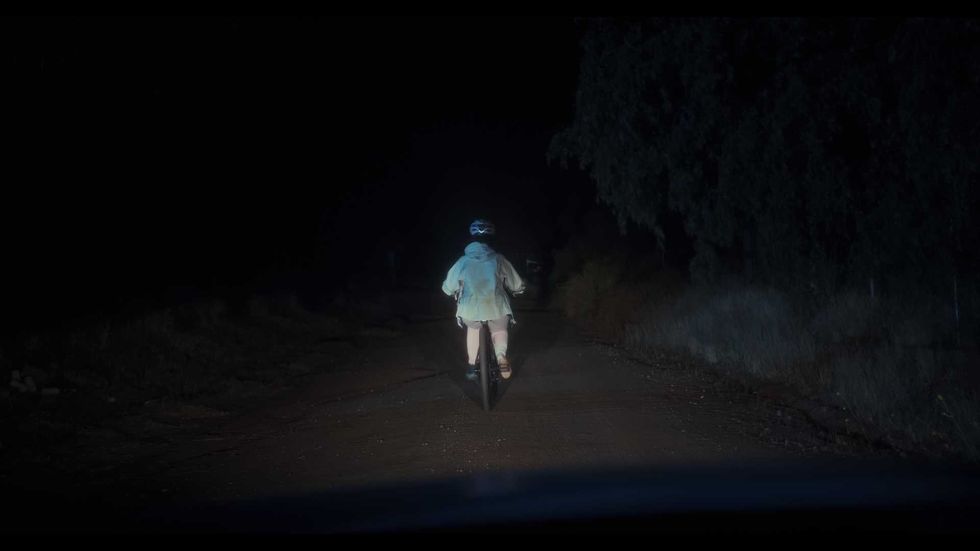
DS: For the most part, we actually filmed my coverage all the way through for each take. We’d get set up for the shot, and I would run the scene from top to bottom by myself, without the other characters. Because I was able to go on the full journey each time, I could psych myself up for Lexi’s initial frustration and then progress into the fear and panic. The on-ramp was there every time, so I didn’t have to manufacture each emotional beat in isolation. The challenge really just became reacting to nothing, with sincerity: imagining the voice on the other side of the phone call, the radio popping on, the woman on a bike, etc.
NFS: Brooke, horror is all about creating tension. What filmmaking techniques did you rely on most to build suspense without giving too much away?
BB: We only have a few minutes to tell the story, so I simplified the script as much as possible before we started preproduction (including cutting the character of a passenger for time and budget). We started Roadkill with the shot of the dead rabbit to quickly set the tone and for a little foreshadowing, then moved right into some disarming humor and a simple head-on shot of Lexi to give us a baseline to build on. She drives briefly past a roadside memorial, something we’ve all driven past, which gives the audience a sense of foreboding.
Once the radio pops on for the first time, we cut briefly to a low angle for the first time to begin building suspense. As we continue, the sound design and score from Sarita Gutierrez become more intense, we punch in more on Lexi, and we switch to handheld to provide even more camera movement. We worked with our editor Donnie on pacing in post to make sure that the story was succinct, but didn’t feel rushed.
NFS: Brooke, can you talk about what cameras and lenses you used on The Veil Chapter One: Roadkill?
BB: Our Director of Photography, Steven Busby, shot The Veil on the RED Komodo X and Angenieux EZ Zooms. We discussed utilizing Atlas Mercury Anamorphic lenses, which we used on our previous collaboration Thin Air, a Victorian time-travel horror piece, since they create such a sense of space and isolation. However, we knew we wanted the option to create vertical cuts for platforms since we were intending to distribute through social media, we decided against it for this project.
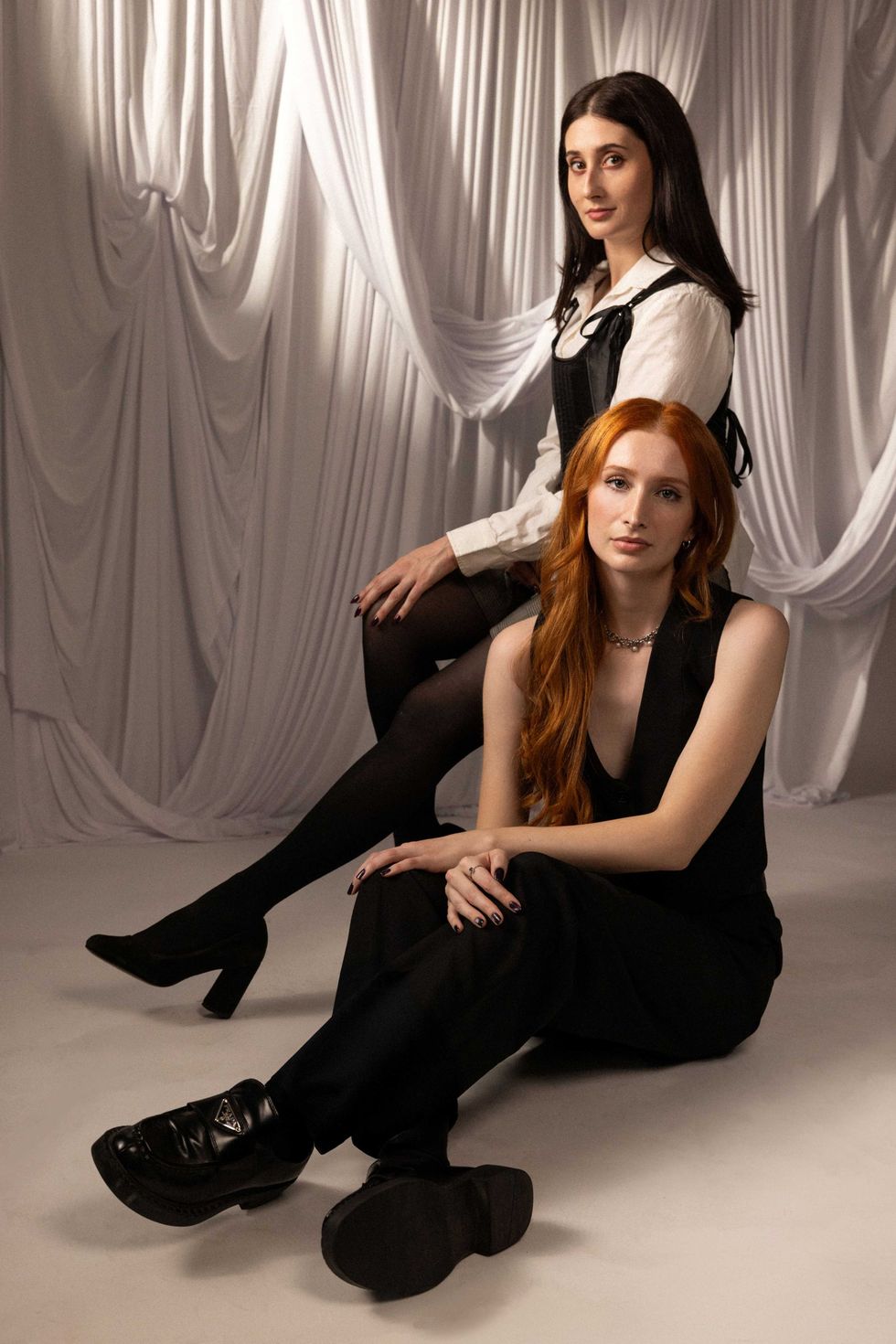 Brooke Becker and Delaney Sharpe of Black Ribbon Productions Credit: Impact24
NFS: Delaney, you weren't just in front of the camera—you were also involved in the production. Horror filmmakers are often forced to be resourceful; was there a production challenge that ultimately made the project better?
DS: We had a pretty significant technical setback during the filming of Roadkill. There was an electrical issue that resulted in about a 90-minute delay in our shooting schedule, which, on an already tight eight-hour shoot, felt catastrophic. We had to cut some shots and were worried we would find ourselves in the edit with insufficient coverage. Thankfully, after doing as much as we could in our limited window, we wrapped up the day with some quick, not-exactly planned, drone shots to make up for the coverage we’d lost. The drone moments ended up looking incredible and certainly heightened the production value of the project. I don’t think Roadkill would have had the same visual identity without them.
NFS: The film takes place in a constantly moving car, shot from the inside and out. Are there any tips you would give to indie filmmakers about shooting a scene like this?
BB: For Roadkill, we put extra emphasis on safety, especially since we had crew filming around a moving car and an actor on a bike in the dark. We rigged both the car and the bike for moving shots, and our main straight-on shot of Delaney was actually filmed stationary while a crew member gently shook the car. Shadows, lights, and extra shake were added in post by our editor/VFX artist Donnie Mathias to blend it seamlessly with our shots where we’re actually moving, then our colorist Ashton Thomas tied it all together.
Our DP Steven adds, “We had a very limited stretch of road to work with, and it would have been difficult to rig a light onto the hood in order to motivate the glow of the headlights to get the look we wanted. We opted to keep the car stationary for that shot, get our headlight glow as key with a couple of Aputure 300xs, and give some soft moonlight from the side and rear of the vehicle with a 1200x.
The profile shot was through the rolled-down passenger window with a Mathews hostess tray. That was a fairly simple rig, and our main concern was keeping the driver and the camera safe, which we were able to do with a safety cable wrapped around the frame of the car door. We were also very fortunate that our scene called for a slow pursuit. If you have the resources, don’t skimp on the equipment that will keep your camera safe!”
 Black Ribbon Production's The Veil
NFS: Because you're now running a production company together, did making this short influence the way you think about the kinds of stories Black Ribbon Productions should tell? What other projects are in the pipeline?
BB: Before we started writing anything, we got specific on what we wanted our channel to be, and what stories we wanted to tell in general through our company. We spent about seven months developing the company and our vision before we began filming The Veil. Our team is majority female and nonbinary, and we knew that we wanted our projects to reflect underrepresented voices while remaining focused on storytelling.
DS: I think our time making The Veil helped to solidify some of our M.O.s—the ways we want to go about filming and telling these stories. We were already quite set in the “why” of what we are doing, but production for The Veil refined the “how.” We’ll be taking those lessons into the next chapters of our original anthology, as well as the other projects we produce. We are currently in pre-production for a sci-fi/horror short centering around the dangers of A.I. in healthcare, called “Emergence,” created by Ambar Martinez (The Pitt, 9-1-1) and directed by J. Scott Miller.
 Black Ribbon Production's The Veil
NFS: Delaney, what did producing this short teach you about the resourcefulness and problem-solving required to make an effective horror film on a smaller scale?
DS: I think our best ideas can come from navigating limitation. Some of the most creative and inventive work is happening on sets without multi-million dollar budgets, so it was affirming to see what we could achieve with our relatively small team. We learned that resourcefulness isn’t just about solving problems when they arise; it can actually become part of the creative process, forcing you to think differently about how you build tension, environment, and scares. And while chapters two and three are on their way, I’m proud of the complete (and truly scary) story we were able to tell in just two and half minutes.
 Black Ribbon Production's The Veil
NFS: Were there any films or filmmakers that inspired the visual language or atmosphere of the short?
BB: For Roadkill, I pulled visual references from The Haunting of Hill House (which has one of the most effective car jump scares I’ve ever seen—IYKYK), Euphoria, and Speak No Evil, among others. I also referenced the episode of The Midnight Club called Road to Nowhere, which takes place largely in a car. I love Mike Flanagan’s ability to create tension, and Tim Burton’s whimsical-yet-creepy, almost otherworldly style. One of my goals as a filmmaker is bringing my own style and personal experiences as a woman into my work, which is something that I didn’t grow up watching, especially in the horror space.