Alec Puro has scored zombie thrillers, sitcoms, animated kids' shows, indie horror, and indie drama. He also founded Viralnoise, a royalty-free music platform for content creators. This month, he adds a Green Day-inspired road comedy to his slate.
Nimrods, out August 14, follows three teenage bandmates who steal a taxi and drive from Kansas City to Los Angeles, convinced they've been booked to open for Green Day on New Year's Eve.
Writer/director Lee Kirk developed the story with Billie Joe Armstrong, Mike Dirnt, and Tré Cool. The band is threaded through every layer of the film, from cameos to a 30-track soundtrack featuring 22 career-spanning Green Day cuts and four unreleased live recordings from a Palladium show captured during the making of the film.
Puro's original score has to live inside that framework (he's also scored Lila McLaughlin's Don't Let Them Out, out the same day, and Joseph Hahn's Linkin Park doc Unshatter, due later this year). We spoke with him via Zoom ahead of the film’s release to talk about his work, and to pull out what you can steal from his experience the next time you're working with a composer of your own.
- YouTube www.youtube.com
You Can Bring Your Composer In Early
Puro said Kirk pulled him into the project long before there was a picture to score to. Kirk and the band had been developing the story for a while, he said, and Puro spent months in conversation with Kirk about what the movie was, what it wanted to feel like, and where music might live in it. He watched a rough cut much later.
Puro said he especially likes collaborating with bands (he came up as the drummer for the rock band Deadsy).
“It's a team sport, which I love.”
A composer can come in at many different points of a production. They might see a script, or they might be delivered a final product. But when a director treats the composer as a creative partner from the front end instead of a vendor plugged in during post, the score you get back might be closer to your vision. The director/composer conversation, started early, changes what music can do for your film.
Know When to Cut the Music
With so much of the Nimrods soundtrack occupied by Green Day needle drops, his job was to work around the songs and hold space for the film's quieter beats.
"The score should be the glue that connects the character arcs and the emotional undertone of the film," he said. In practice, that meant weaving in and out of the Green Day songs and getting out of the way. His job "was to almost be unnoticeable."
He also learned to let go. During the spotting session, he said, he pushed for music in more places than the film wound up needing.
"We did end up pulling a lot of things back and out to have that silence because sometimes that works better than music, especially for an emotional scene. You don't always have to have score letting you know," Puro said.
Filmmakers, more music is not more emotion. Sometimes it's the opposite.
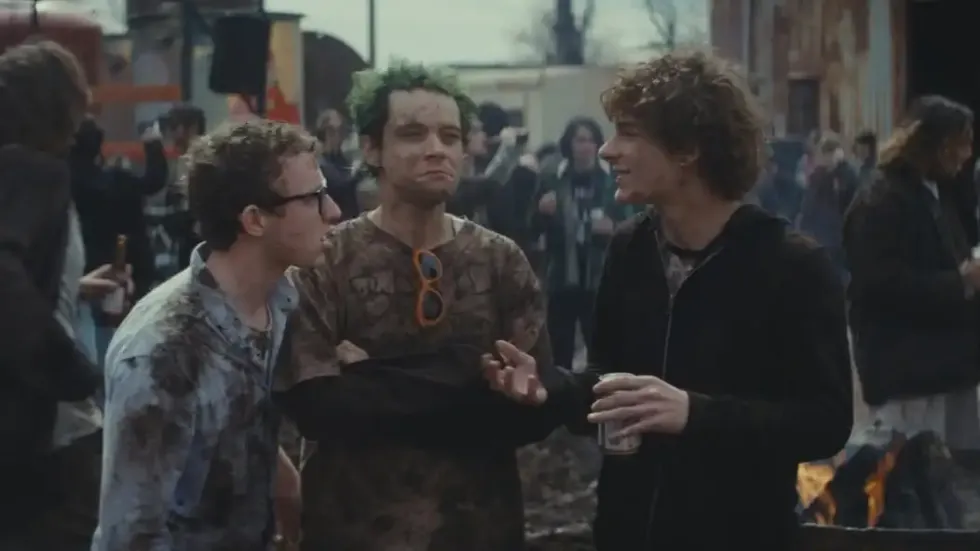 'Nimrods'Credit: Inaugural Entertainment
The Temp Track
Puro doesn't hate temp tracks. He just knows what they do to a project.
First, there's the licensing headache every composer probably knows.
"Usually as a composer, you watch a rough cut, and they temp it with The Beatles or Led Zeppelin or just some crazy music that they're never going to be able to afford to license."
Here, that wasn’t the issue, because Green Day was a collaborator on the film, so they had all the Green Day songs from the start. But generally, temp tracks can be their own obstacle.
"I mean, it's hard for people to temp a movie, and it's usually the wrong songs, but with the right emotion. Where they're trying to say, 'I want it to sound like this,'" he said.
He'll take a project either way, with a temp or without. His preferred mode is without. When he starts writing while the director is still shooting, based on conversations rather than a locked cut with a needle drop, he finds things he might have otherwise missed. He said his best work happens when he has "the freedom to try things and not be under the gun, time-wise; you do find some cool things that you might not have found when you're just in it and hustling."
If you're going to temp your film, be honest with your composer about what you truly love in the temp and what you slapped in as a placeholder.
Learn to Translate Vague Notes
Most directors don't speak music, and Puro said that's fine.
"Somebody could be like, 'I want it to have more reverb.' To a non-musician, that can mean so many different things," he said.
His fix is to steer conversations off technical vocabulary and back onto the story. Talk about scene, character, emotional temperature. Then let the composer translate.
Puro said he's gotten wild notes. "I've had people be like, 'I just want it to sound more red.' And you need to know what that translates to. And by talking through it, you can actually get to the core of, ‘Oh, wait, you've sent all these notes, but it's such a simple fix. I know exactly what you want.’"
That kind of translation is the composer's responsibility. "That's your job to translate and bring that vision to life."
So if you're a director without the technical vocabulary, don't fake it. Describe the feeling and let your composer do the translating. Puro would rather hear "red" than a note you don't fully mean or understand.
Spin 10 Plates
Puro's last piece of advice was less about Nimrods and more about being a composer right now. He said the industry demands versatility.
"We have to spin 10, 20 plates at the same time and do all these different projects because you don't know what might lead to what," he said.
With his work spread across horror, comedy, drama, and animation, as well as Viralnoise and his music production company (Gramoscope Music), he has a lot of plates going.
"You can't be too precious in terms of what you think you should be doing or what you think your career should be, I think," he said.
Which reads like advice for filmmakers too.
"Work begets work, and you never know where anything leads."
Nimrods is in theaters August 14, 2026.
- How Can Composing With a New Director Spark Your Creativity? ›
- How 'Hey Arnold!' Composer Jim Lang Creates Iconic Sounds for Animation ›
- Translating Story into Sound: Lessons From a Modern Film Composer ›
- Hans Zimmer on How to Be a Composer with 'No Technique and No Formal Education' ›
- Actor-Turned-Director Lee Kirk on Directing Actors and the Making of 'Nimrods' | No Film School ›