The most quoted thing in Trainspotting started life as an advertisement for staying clean. Kinda ironic, right?
"Choose life" was a wholesome anti-drug slogan before the iconic character of Mark Renton got hold of it, essentially turning a public-health message into a battle cry for anyone who ever wanted to opt out of what he feels is a normal, boring lifestyle. Here we are, 30 years later, and the "choose life" monologue is still iconic.
Let's get into why.
- YouTube www.youtube.com
The Scene
In Trainspotting, heroin addict Mark Renton (Ewan McGregor) struggles through cycles of getting clean and relapsing while living chaotically in Scotland with his equally chaotic friends.
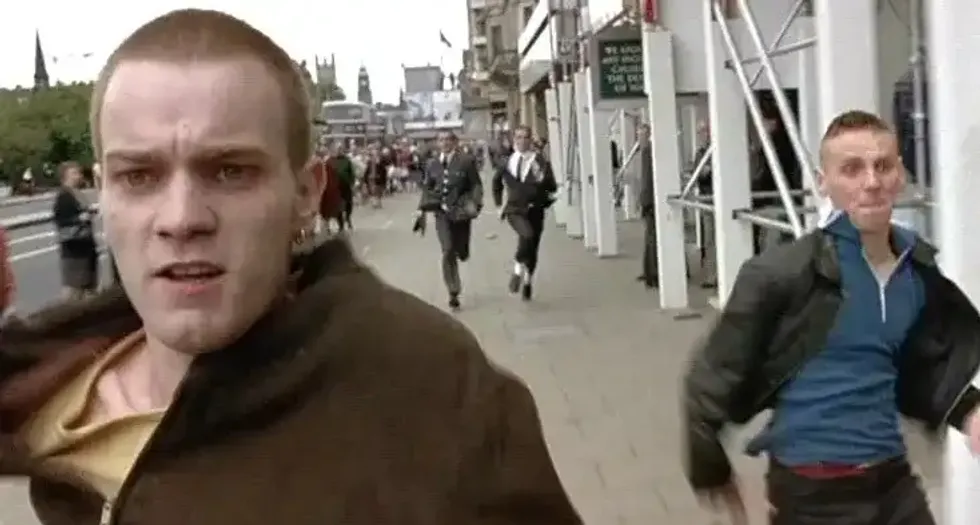
As the film opens, Iggy Pop's "Lust for Life" kicks in with its drumbeat, and Renton and his friend Spud are sprinting down an Edinburgh street, stuff that they've shoplifted spilling from their jackets with store security on their heels. Over the noise and confusion, Renton's voiceover begins one of the greatest opening salvos in movies.
"Choose life. Choose a job. Choose a career. Choose a family," he says. It's like a checklist of a respectable existence.
Meanwhile, he's fleeing down the street, leaping down stairs, rolling over the hood of a car.
He says, "Choose a fucking big television."
The monologue pivots starkly.
"Choose washing machines, cars, compact disc players, and electrical tin openers."
He grins into the car that clipped him as his friends flee. We see him in a rundown flat.
"Choose good health, low cholesterol and dental insurance. Choose fixed- interest mortgage repayments. Choose a starter home. Choose your friends."
We see him and his friends on a soccer pitch, playing another team. The monologue continues:
"Choose leisure wear and matching luggage. Choose a three piece suite on hire purchase in a range of fucking fabrics. Choose D.I.Y and wondering who you are on a Sunday morning. Choose sitting on that couch watching mind-numbing sprit- crushing game shows, stuffing fucking junk food into your mouth. Choose rotting away at the end of it all, pissing your last in a miserable home, nothing more than an embarrassment to the selfish brats you have spawned to replace yourself. Choose your future. Choose life."
Renton passes out on the pitch, and in the flat.
"But why would I want to do a thing like that? I chose not to choose life. I chose something else. And the reasons? There are no reasons. Who needs reasons when you've got heroin?"
That's the set-up of the entire film and character.
Where "Choose Life" Came From
"Choose life" didn't come from Trainspotting. British fashion designer Katharine Hamnett put it on an oversized T-shirt in 1983, drawing from Buddhist teaching to create an anti-suicide, anti-drug, anti-war message.
Wham! wore it in the video for "Wake Me Up Before You Go-Go," and the slogan went on as an inspirational message of positivity.
So it's clear the message came before both the film and the novel by Irvine Welsh that inspired it. So Renton's version of the slogan is a deliberate hijacking. No self-destruction? Boring! In his eyes, "choosing life" doesn't mean staying alive, but instead means giving up and falling into a life made up of consumer choices and a slow death.
The feel-good slogan and its years of positivity collapse when this seemingly happy-go-lucky addict twists them around to serve his own outlook.
 'Trainspotting' Credit: Miramax
How the Monologue Works
Obviously, this all takes place via voiceover. You'll hear plenty of warnings (including from us) about voiceover narration, because to be frank it can get clunky in the hands of inexperienced writers.
But Renton's works because it doesn't just explain the plot or who he is. He's not telling the audience what he's doing or where he comes from or the why about anything. This voiceover adds to the images and tells us more about the point of view than the visuals ever could. He's running, he's using, and he probably wouldn't realistically say these things in any other context.
Still, we get it in Renton's clear voice. It's profane, sarcastic, and belongs to him.
Screenwriter John Hodge took the speech that originally fell in the middle of Welsh's novel and moved it to the front so we would understand who Renton is immediately.
So that's why it functions for the character and structurally. But we can go deeper. The speech repeats "choose" throughout. That's textbook anaphora, which is a rhetorical device that uses repetition, like a hammer hitting. It builds pressure with every beat. The tension increases with the speech and with the building action, until Renton passes out in a drug haze.
Why the Anti-Establishment Claims It
Even though this character is a disaster and things don't go super well for him, his carefree attitude still comes off as inspirational to those who feel boxed in, especially in the context of this story.
The monologue illustrates the period's Thatcher-era consumer culture. At this point in the U.K., the youth especially felt trapped and stifled under the expectations of older generations who only seemed to be making things worse for them. And were things so good for their parents, anyway? Not in this character's view, who saw them surrendering to boredom and retirement after following the rules. So why not have a little fun and destruction on the way?
That's why the monologue became so iconic and essentially defined a generation. It took a public service message and turned it into rebellion. Again, the addicts of this story don't have a sunny alternative. But seeing a character reject the default was invigorating.
Danny Boyle'smovie also inspired filmmakers. It made a generation of storytellers feel like anything was possible. Break the rules, tell the story you want, use the tools you have. Reject what is expected of you, take routes outside the studio system. It's admittedly an easy message to get behind!
The monologue has kept its bite through the generations. When Boyle and Hodige revived it for T2 in 2017, they updated the message's targets to things like social media.