Did You Know? This Iconic Indie Horror Movie Had Almost No Script
Analyzing the role of improvisation in The Blair Witch Project.
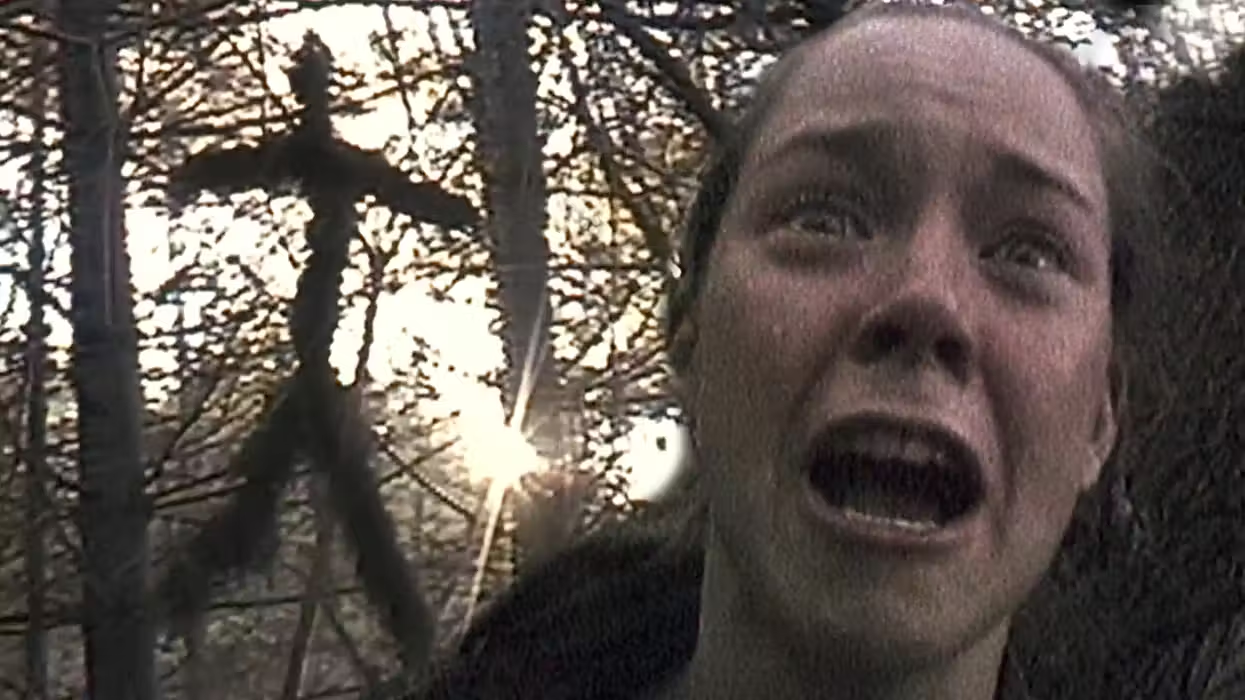
'The Blair Witch Project' (1999)
In my early days of filmmaking, I dreaded improvisation. The fact that anything can be left to be figured out on set never made any sense to me. I even low-key considered it to be a sign of laziness.
While I still believe in preparation, films like Casablanca and The Blair Witch Project have pulled me down off my high horse, forcing me to look at the brighter side of improvisation. They are a testament to the power of improvisation, as both include improvisation and are milestone films in the history of cinema.
In one of our previous articles, we examined how Casablanca leveraged improvisation in its narrative.
In this article, we examine the behind-the-scenes of a pioneer in found-footage filmmaking, The Blair Witch Project, and assess the role of improvisation in it.
A Quick Recap
The Blair Witch Project follows three film students who venture into the Maryland woods to document the Blair Witch, but they never return. The story is presented through footage retrieved from their Handycam long after their disappearance.
How the Blair Witch Directors Relied on Improvisation
1. A Script Without Dialogue
While an average screenplay is somewhere between 100 and 120 pages, The Blair Witch Project was only 35 pages in its original draft. This was because the script had essentially no dialogue.
"We had always wanted the dialogue to be improvised. We didn't want to put those kinds of limitations on the actors. The prime directive was not to give away anything that was fiction," Eduardo Sanchez said in an interview with The A.V. Club (via MeTV).
2. Unpredictability and Ambiguity
Open-mindedness and unpredictability shaped both the narrative and production process of the film.
“We were kind of in a state of flux as the film was evolving, and these actors were interacting in this world we created. We were adjusting as we were going along, too,” Sanchez told The A.V. Club.
While the co-directors were particular about the outline they had created for their story, they wanted improvisation to be a huge part of their treatment. In an interview with Vice, Myrick shared that they auditioned for the lead roles and focused on finding actors who had a natural flair for improvisation.
To ensure the leads could be left alone as much as possible, they were trained in filming equipment and GPS systems. The filmmakers had “marked all the areas where the campsites were going to be, and where we were going to pull off the gags, so it was all very methodically thought out,” Myrick told Vice.
The actors were then taken to their respective locations and left unaccompanied, with basic survival kits and instructions for their use. The crew tried working from the shadows all the while, but that didn’t pan out too well, because staying out of their way proved to be rather difficult.
So the filmmakers left the actors on their own with directions and watched the footage only at the end of the day. They only communicated “if something went wrong, or there was a big question that had to be answered immediately.”
3. The Use of Method Acting
The entire movie was shot over eight days, with the entire crew camping out in the woods. Method acting techniques, such as rationing food, were employed to make performers as uncomfortable as possible without endangering them.
“Obviously not starving or anything, but you get irritable whenever you’re not eating full meals every day, so it was a little bit of this method kind of survivalist approach that we prepped them on in advance,” Myrick told Vice.
The mantra on set was, “Your safety is our primary concern, but your comfort is not.”
For the horror scenes, the crew would play the Blair Witch. They’d go around the actors’ campsite, run around, or make spooky noises to cue them for reactions.
“It was actually really cool because you never saw where they were. You knew it was them, but your job as an actor is to put the reality of it being those guys out of your mind, just focus on the sound,” Williams told Vice.
The closing scene, Heather’s confession, was the most difficult sequence to shoot. Primarily because, while the actors were learning the narrative in real time as they performed their scenes, the climax had to be revealed to everyone due to logistical constraints.
However, the filmmakers kept the details as vague as possible to elicit the most realistic reactions from the actors, and, boy, it worked wonders!
“My direction for the last scene was, 'Mike will hear something tonight, and when you hear it, you’re going to follow it all the way up, until Heather reaches you, and when Heather reaches you, you want to run all the way down,’” Williams told Vice. He added, “We had walkie-talkies to radio to Ed Sanchez, and I said, ‘I don’t really understand the last note,’ and he just said, ‘Listen, I promise you, you will understand it when it happens.’”
The Significance of Improvisation in The Blair Witch Project
The Blair Witch Projectis shot as a documentary and presented through found-footage techniques. Here’s how improvisation helped elevate the realism in every sequence.
1. Only Ad-Libbed Dialogue
A script without dialogue can seem daunting; however, it allows the actors to respond to cues and to both external and internal stimuli.
When creating a horror story that revolves around a powerful, unknown threat, it’s the stutter, overlapping dialogue, and broken sentences that keep us rooted in reality. Naturally, shooting rehearsed scenes in a controlled setting might not have produced a similar impact.
2. Method Acting
Because the actors were subjected to real discomfort and the problems that accompany camping—exhaustion and frustration—had naturally become part of their performance, they only added to the visuals and the narrative.
3. The Documentary-Style Edit
Co-directors Myrick and Sanchez didn’t really shoot each scene as though they were referring to a bound script.
Rather, they left the actors in the setup and then let the cameras roll until the end of the shift. The footage was reviewed at the end of the day, and appropriate sequences were selected from the bulk of videos, employing a documentary-style editing approach. This lent intentional imperfections to the narrative, helping the audience to build a stronger connection.
Would you try out this level of improvisation for your film?
- The Horror Movie That Terrified Audiences Without a Single Kill ›
- How 'The Blair Witch Project' Changed Horror with Cheap Shaky Cameras & Genius Marketing ›
- State of Horror: 'Blair Witch' Co-Director Talks Tech, Terror, and Tomorrow's Filmmaking Landscape ›
- Scary Good Filmmaking Wisdom from 'Blair Witch' Director Daniel Myrick ›