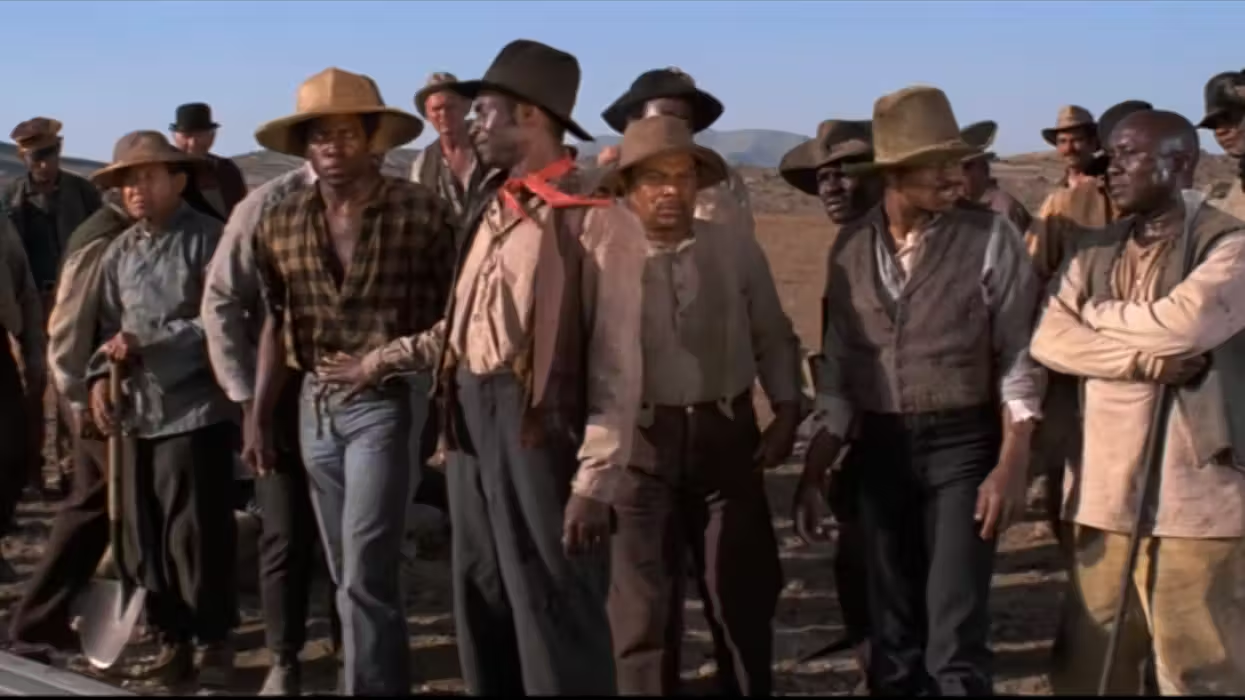
Blazing Saddles is one of Mel Brooks’ comedy masterpieces. Released in 1974 and starring Gene Wilder, Cleavon Little, Madeline Kahn, and Harvey Korman, the film lampoons the Western genre and racism in one fell swoop, while engaging in musical numbers, physical gags, wordplay, and more. The script was co-written by Mel Brooks, Andrew Bergman, Richard Pryor, Norman Steinberg, and Alan Uger.
Set in 1874, it follows a Black sheriff appointed to a frontier town. A corrupt state politician (who happens to be named Hedley Lamarr) put him there as part of a plan to take over the town’s land for a proposed railroad. He’s counting on racism for his plan to work, but with the help of the sheriff’s new partner, the alcoholic Waco Kid, they keep the town together.
The film is endlessly quotable, and you could easily find a dozen iconic lines in the first half-hour alone. But today we want to look at one line that demonstrates why the whole film works so well from a comedic standpoint.
Saddle up and join us.
- YouTube www.youtube.com
The Scene
The film opens on the railroad workers and the ruthless crew working them under a hot sun. The assistant foreman Lyle (Burton Gilliam) demands good attitudes and a song—immediately after one of the workers collapses, and they declare that his pay will be docked.
Bart (Little) and a group begin a beautiful a cappella rendition of Cole Porter's "I Get a Kick Out of You," which is not exactly what the foremen want.
Interrupting, Lyle and the foremen instead demonstrate a poorly improvised take on “Camptown Races,” dancing around as an example of a “real” work song. The railroad crew snickers.
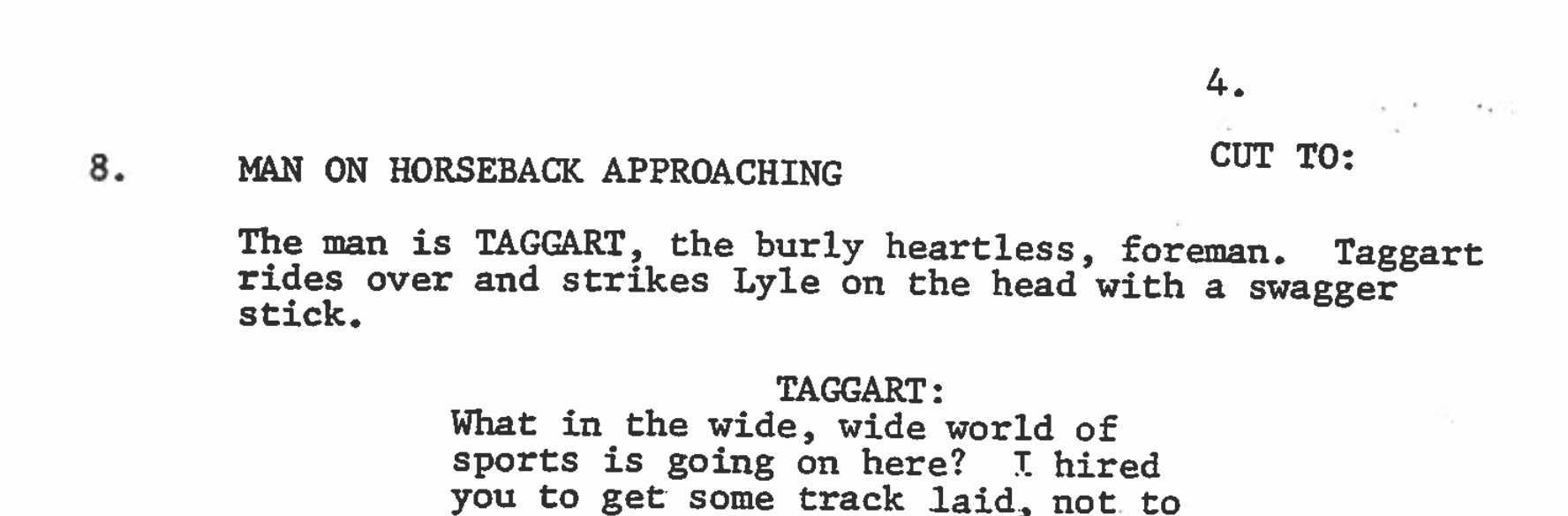
Suddenly, up rides Taggart (Slim Pickens), firing his gun to cut through the noise.
“What in the wide, wide world of sports is a-goin' on here?! I hired you people to try to get a little track laid, not to jump around like a bunch of Kansas City f*****s!”
Lyle responds, “Sorry, Mr. Taggart. I guess we kind of got caught up.”
The full line does include a slur, but the whole film is filled with off-color jokes to emphasize how silly and prejudiced many characters are. Taggart runs the railroad crew for the film's villain, Hedley Lamarr. He's a bigot and a bully who takes obvious pleasure in tormenting the Black workers.
We’ll also point out that in this scene, the joke is on Taggart and Lyle, not the workers. Brooks is positioning the racist boss as the fool who can't even run his own crew.
 Credit: Warner Bros.
Why This Line Is So Funny
So much of Brooks’ comedy is about inconsistencies and anachronism, and that’s definitely the case here.
“What in the wide, wide world of sports is a-goin' on here?!”
ABC's Wide World of Sports premiered April 29, 1961, and became a Saturday-afternoon institution for anyone watching American TV in the '60s and '70s. It was the "thrill of victory, agony of defeat" anthology show that featured a different sporting event for each episode. In 1974, when Blazing Saddles hit theaters, every adult in the audience knew that reference.
The film, as we mentioned, is set in 1874. An anachronism is something or someone out of place in time; in this case, what would have been a “modern” phrase being said in the Wild West.
A comic principle Brooks understood is that surprise comes from perspective, not from setup. Nothing prepares a viewer for a 19th-century railroad boss to reference a Saturday-afternoon sports show.
Taggart could have said the classic, "What in tarnation!" That scene would have worked. It still serves its beat in the plot. Nothing really changes. But nobody would be quoting the line 50 years later because “tarnation” is expected. “Wide world of sports” is a surprise, which makes it funny.
- YouTube www.youtube.com
Brooks Does This Everywhere
You can find anachronisms throughout this film, and almost all of Brooks’ films. Even "I Get a Kick Out of You," released in 1934, is a small anachronism.
There are designer Gucci saddlebags. A tollbooth in the middle of the desert. The governor (Brooks) jokes that if the real-life Hedy Lamarr threatens a lawsuit over a character name, they’ll be fine ("This is 1874, you'll be able to sue her"). The Waco Kid claims to have killed more men than Cecil B. DeMille in his movies, which would have come much later. Count Basie and his orchestra play the famous "April in Paris" coda, a jazz arrangement, in the prairie as Bart rides past. They wear modern concert attire, with Basie’s branding everywhere.
Then, of course, there’s the finale, in which a big chase literally spills off the set onto a modern-day Hollywood soundstage.
Brooks uses anachronism to remind the audience that we are watching a 1974 movie about a mythology, not a real 19th-century place, and many people are pretty stupid in his version of the Western. The Taggart line is doing the exact same thing.
Brooks' running gags are helping do thematic work, not just filling time.
What You Can Take for Your Own Comedy
A surprising word choice can make a boring line come to life. Look at your own dialogue for lines that are doing plot or exposition work and see whether the joke can sneak into a single word even you weren’t expecting.
Trust the audience to catch the reference. If you’re making a cultural joke, make sure it’s not too niche that no one will get it, but if it’s included, don’t overexplain because it’ll cheapen the moment. This principle is what made a show like Gilmore Girls so fun—constant literary and pop culture asides in fast-moving dialogue that rarely helped the audience keep up.
Blazing Saddles is satirizing the Western through a modern lens, calling attention to all the -isms of the era that made many stories pretty problematic, if you’re using a critical eye. The anachronisms are certainly funny, often silly, but they’re there in service of that approach and help remind the audience that we’re not watching a normal Western. Make sure your jokes mean something.