There's absolutely no one like Mel Brooks, and yesterday the comedy legend celebrated his 100th birthday. You probably have a favorite Brooks film, and there are so many to choose from—Young Frankenstein, Spaceballs, Blazing Saddles. For me, it's the often-overlooked To Be or Not to Be, a WWII Chaplin-esque farce in which he starred with his wife.
So it's a great time to take away some lessons from his work. Let's look at his running gags.
Most comedies treat the running gag as filler. These can be a catchphrase, a repeated visual, or something else to give the audience a comfortable laugh every time it appears. Brooks treats these gags as structure. Almost load-bearing. And they're almost always hilarious, tucked away within other layers of jokes.
Let's dive in.
- YouTubewww.youtube.com
Repetition and Escalation
"I, as the governor, called him Hedy Lamarr, and he said, 'Governor, it's Hedley, Hedley,'" Brooks told PBS. "And I said, 'What are you worried about? This movie's taking place in 1874. If she makes a fuss, you can sue her.' And what happened? And what happened? She actually sued us for using Hedley Lamarr, too close to Hedy."
Breaking the Fourth Wall
Brooks doesn't break the fourth wall as a one-off gag. He uses it as a recurring gag, deployed differently across films but always for the same structural reason, and that is to remind the audience that the world they're watching is constructed.
In Blazing Saddles, characters eventually acknowledge they're in a Western, then step off the set entirely into a modern movie studio. In Spaceballs, characters solve their problems by watching the movie they're currently inhabiting. His characters are constantly looking to the audience as if they can't believe their own circumstances.
Brooks told The New Yorker in 2021:
"That may be in your bones, to know, okay, it’s time to shatter the illusion of make-believe and bring it into the real world—because it’s going to get a big laugh, and a big laugh is worth a lot. That was when I gave in to a new kind of comedy. Like in High Anxiety, the camera getting closer and closer to the glass door and then finally not knowing when to stop, and it shatters the door, and everybody at the table turns. That was in my domain, this business of exploding into reality any time I felt it was good for the movie.
Brooks does this because it's funny, and in his own career as a performer, he found that fourth-wall breaks could get huge laughs.
But what Brooks also understands is that once you've shown the audience the scaffolding holding up the genre, you can never put it back. The running gag is that the genre itself is exposed as a set of arbitrary rules. And Brooks repeats that exposure across multiple films, training audiences to look for the seams.
 History of the World, Part I Credit: 20th Century Studios
Honoring and Demolishing Simultaneously
Young Frankenstein is shot in black and white. It uses props from the original Frankenstein films. It treats the source material with genuine reverence. Then it undercuts every earnest moment with vulgarity, absurdity, and chaos.
Blazing Saddles opens like a John Ford Western with sweeping landscapes and the full mythology of the frontier. Then it slowly reveals that the genre's entire foundation is built on racism and violence that the old films never examined.
Of Saddles, Brooks told The Hollywood Reporter, "It’s good to have something underneath everything, an engine. We attacked race prejudice, and that worked for us because we knew we were right. When you know you’re right, nothing can stop you."
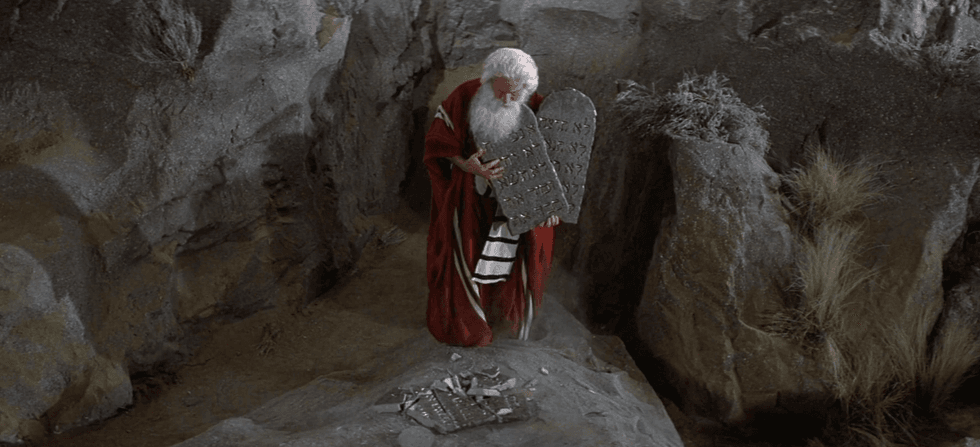
In History of the World, Part 1, he plays with Bible stories without being mean, adding a server to the Last Supper or giving Moses 15—er, make that 10—Commandments.
This is Brooks' repeating structure. Commit fully to the form, understand it deeply, then watch it collapse under the weight of scrutiny. (And take risks.) The parody works because the filmmaker respects what he's parodying. And knows that he's right about it.
Brooks discussed his approach in an interview with PBS.
"Comedy is a weird thing. Even though it’s it seems foolish and silly and crazy, comedy has the most to say about the human condition. Because if you laugh, you can get by. You can struggle when things are bad, if you can get a sense of humor."
His parodies are affectionate. A running gag across his career is this method, obviously, as a filmmaker who loves the genres he's deconstructing, which is why the deconstruction lands.
Casting as a Running Dynamic
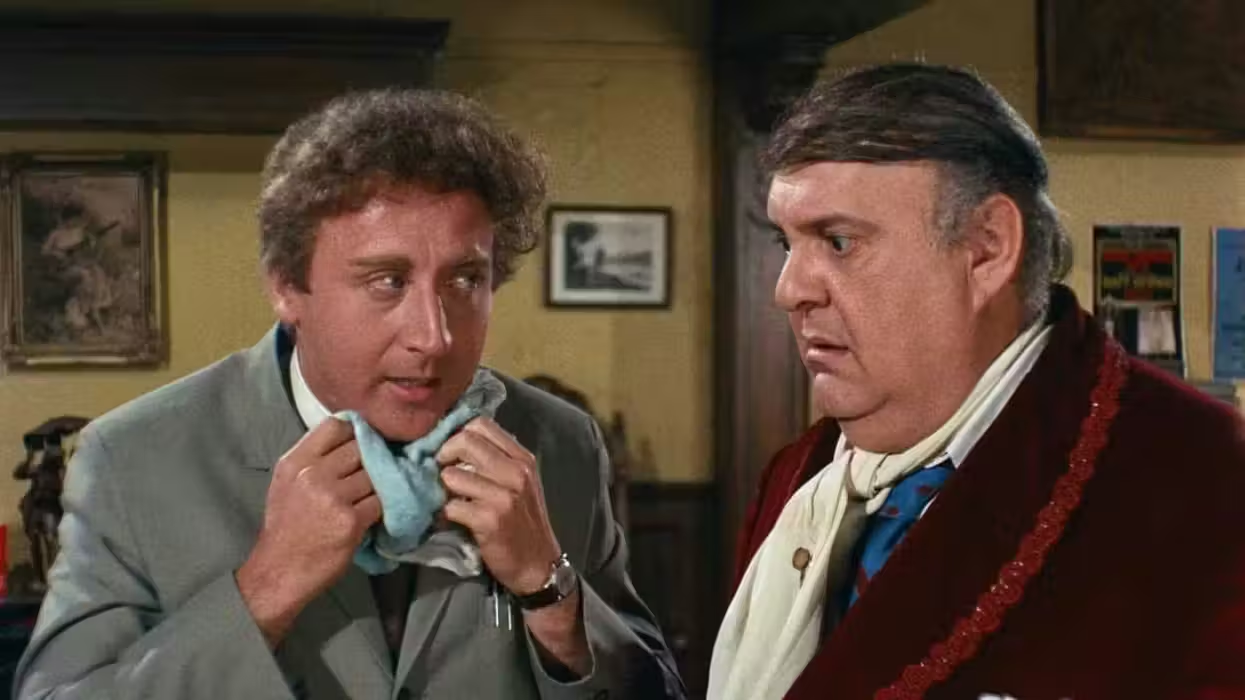
Gene Wilder appeared in three Mel Brooks films. In each one, he played a fundamentally different character. But the dynamic between Wilder and the chaos around him stayed the same.
In The Producers, Wilder's Leo Bloom is a nervous accountant drawn into an increasingly absurd scheme. In Blazing Saddles, he's the Waco Kid, a drunk gunslinger who's seen enough of the world that almost nothing surprises him anymore. In Young Frankenstein, he's Dr. Frederick von Frankenstein, a man trying to conduct serious scientific work amid pandemonium.
The running gag across all three films is Wilder himself as the straight man, or rather, what Wilder refuses to do with the character. He doesn't break. He commits fully to his character's internal logic, no matter how bonkers the situation becomes.
Mel Brooks described Gene's approach in an interview with The Hollywood Reporter.
"He was a very rare actor. Gene actually listened to the other actor facing him. He really stuck to the story. And he kept the story going by listening and responding. He breathed. A lot of actors don’t breathe. They just say their line right after it’s their part to go on. Gene considered what the other person was saying to him. I would call it naturalism. Gene always made it so real."
The dynamic is usually that chaos erupts, and Wilder processes it as if it's normal.
"When I first met Mel Brooks, he told me that, in his eyes, I was like a sheep surrounded by wolves," Wilder once said (via Time Magazine).
The serene center amid absolute mayhem recurs in every Wilder-Brooks collaboration. The audience learns to expect it. By the third film, viewers watch and wait for Wilder to stay composed while everything around him disintegrates.
What are your favorite Mel Brooks running gags?
- Why Do We Joke About Horrible Things? 'The Last Laugh' Asks Mel Brooks, Sarah Silverman & More ›
- Mel Brooks Turned 93 So Enjoy These Hilarious "Young Frankenstein" Bloopers and Outtakes ›
- Mel Brooks Gets Most of the Original Cast For 'Spaceballs' Sequel - Is that a Good Thing? ›
- 7 Best Mel Brooks Movies, Ranked ›
- Mel Brooks Celebrates His 100th Birthday With His 20 Favorite Films | No Film School ›
- Film Quote of the Day: This 1974 Mel Brooks Comedy Gave Us One of Cinema's Funniest Lines | No Film School ›