While the fear of the unknown is based on anticipation of the worst, sometimes a narrative demands that the horror be shown explicitly. So, while movies such as Jaws and The Blair Witch Project kill you with anticipation, David Lynch movies take a slightly different approach by bringing you face-to-face with the fear. You want to look away so bad, but Lynch just won’t let you! How about that?
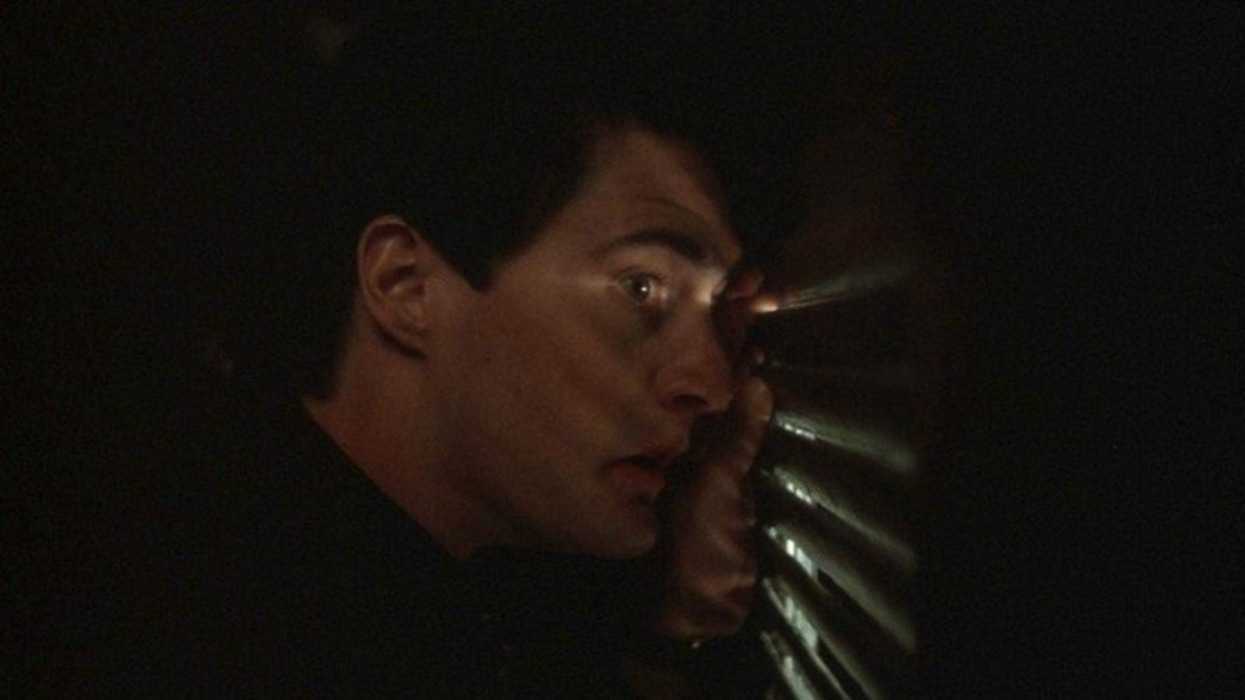
One of the finest examples of this Lynchian horror treatment is the voyeuristic scene in Blue Velvet, where Jeffrey (Kyle McLachlane) discovers Dorothy’s (Isabella Rossellini) abusive arrangement with an older man, Frank (Dennis Hopper), as he looks on through the slats in a closet that he is hiding inside.
In this article, we’re unveiling how David Lynch took voyeurism and put it in beast mode in this iconic Blue Velvet scene by not allowing us to blink through the entire sequence.
To Give You A Little Context…
Blue Velvet is a neo-noir crime thriller that explores the ominous dark underbelly of a seemingly mundane, idyllic American small town. The narrative follows Jeffrey, who returns to his hometown to manage his family business after his father falls ill. Back at home, Jeffrey is living an idyllic life until he discovers a severed human ear in a nearby field and becomes obsessed with solving the mystery behind it. His quest leads him to Dorothy Vallens, a nightclub singer, and a secret that changes his life forever.
Themes
Lynch’s Blue Velvet is a fearless investigation of the moral decay and complex power dynamics even within a seemingly small and peaceful ecosystem. Through Dorothy’s arc, Lynch uncovers the rotten, endless abyss that society creates for women. Dorothy’s sacrifice for her kidnapped family, as she surrenders herself sexually to Frank to keep them safe, is a representation of both feminine instincts of protection and society’s expectations of women. As Jeffrey gets entangled in Dorothy’s life out of sheer voyeurism, Lynch spotlights the loss of innocence caused when you come across cyclical and generational violence.
Lynch has seemingly focused on chasing the truth without a care in the world about whether it makes the world uncomfortable about what they’re seeing. Where horror thrives on subtext and suggestive storytelling, Lynch has ensured that you stare deep into the eyes of the horror.
The Scene
Blue Velvet (1986) Source: Paramount Pictures, De Laurentiis Entertainment Group, Metro-Goldwyn-Mayer
The scene starts at a point when Jeffrey is aware of Dorothy and suspicious of her connection with the severed human ear, but with no proof, he is stuck. To find out more, he plans to break into her house while his girlfriend, Sandy, stands guard outside.
But what he sees inside turns out to be wilder than anything he could have imagined. Trapped inside the apartment, he stands hiding in the closet as Dorothy has unexpectedly returned. Dorothy stands in the living room in a blue velvet robe. An older man (who we later come to know as Frank) has come to visit her, but it’s no ordinary visit. The man proceeds to sexually assault Dorothy, which she endures quietly, following his commands to a T, as he hits and verbally abuses her. Every second in that five and a half minute scene breaks you a little bit on the inside. As a woman, I can say I was slightly scarred. But hey, the trailer says, “One of the most controversial motion pictures of all time,” so it’s on me if the truth pill is too large for me to swallow.
Breaking Down the Scene
Jake is the intruder — but so are we. How does Lynch establish this? The sequence utilizes several different cinematic techniques to turn the audience into voyeurs.
Let’s break it down.
Editing
Pacing
The pacing of the entire sequence mimics real time. The actors are in no hurry, and neither is the director.
The cuts are timed with a breathing space. Lynch holds each shot for a few seconds longer than you would expect, which surprisingly not only seemingly “stretches” time but also adds to the suspense and voyeurism. To me, it felt like I could get away with the voyeurism if I were Jeffrey—you know that kind of liberty with a tingly feeling of guilt. At the same time, the cuts ensure that you don't get to look away, exactly when you’re desperate to do so.
J and L Cuts
The use of J and L cuts is also extremely powerful in this sequence. Hearing the audio from the previous or preceding shot ensures that the audience is always connected to the moment. Though you’re watching a scene play out over multiple shots and POVs, the audio connects each one to form a single, unbroken moment, which is profoundly integral for creating a voyeuristic feel.
So, even when you’re not witnessing Dorothy's sexual assault, you can comfortably gauge what’s happening outside the closet. You’re looking away now, but are you really?
POV
Lynch seems to have emotionally categorized the shots in two segments instead of three—the assaulter and the man who’s watching, and he maintains the same chronology in the edit, for the most part. He begins with Frank and binds us to him for some time—no cuts in between to show Dorothy’s reactions, leaving us with his animalistic sexualism, ending with only a quick reaction from her, when he yells at her not to look at him.
Proceeding, Lynch sticks to two POVs majorly, throughout the sequence: Jeffrey’s to Frank and Dorothy, and Frank’s to Dorothy.
A scene which traditionally would’ve been treated from Dorothy’s POV in terms of editing and direction, Lynch seemingly steers us away from her plight, making us focus on the other two, which I felt, somehow draws us even more to her. Seems like he played reverse psychology on the viewers.
No Non-Diegetic Score
There’s no background score in this scene. Why is that important? Because to sell the illusion of being a voyeur, you have to put the audience inside the diegesis. Including non-diegetic audio, like a score, would pull the audience from the diegesis and put them right back into their seat.
Immaculate Mise-én-scene
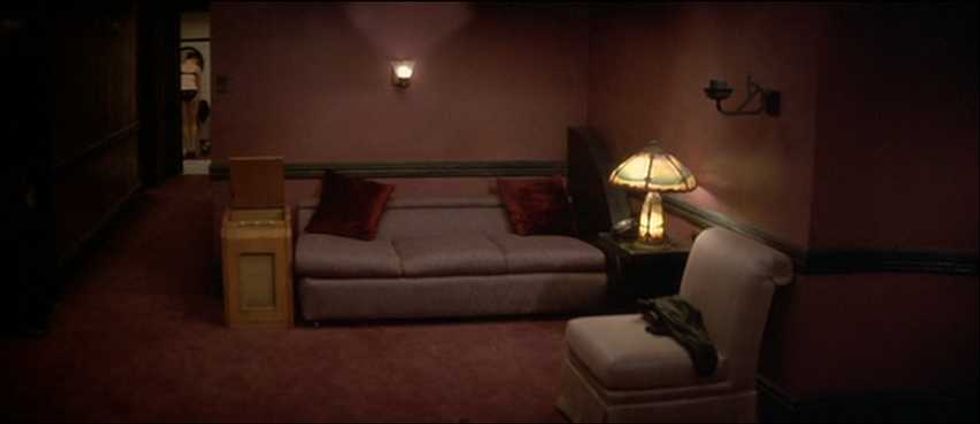 'Blue Velvet'Source: Paramount Pictures, De Laurentiis Entertainment Group, Metro-Goldwyn-Mayer
Lighting
The lighting in each shot is clean with pockets of darkness. The room is dimly lit with shadows all over. Lynch doesn’t focus on cleanly lighting the faces of the actors, and the intentional visual obstruction by the shadows works in favor of the sequence. Outside the closet, the red floor and the red walls add to the sense of plight, fear, and unease.
Inside the closet, however, chiaroscuro lighting is used — a black background with Jake’s face illuminated by slices of light coming through the slats of the closet door. He’s cloaked in darkness — he’s hidden, and thus, so is the audience as they join him in looking at the horrific scene across the room.
Shot Size
Lynch plays between wide shots and close-ups, sort of skipping the mid shots, swiftly bringing the viewers in and out of the action and the minds of the characters. This is a brilliant choice, because it mimics the way humans tend to process information as they look at something. The wide shots provide the context for what’s being viewed, and close-ups provide the details we focus on once we understand the context.
Furthermore, as I mentioned earlier, close-ups are a cinematic shorthand for “the mind of a character.” When we’re in the closet, Jake is shot in an extreme close-up, which not only puts us inside his head but also suggests that his thoughts are ours. To put it another way, we’re not observing Jake looking at Dorothy and Frank — if we were, we’d see him in a wide shot — we’re observing with Jake.
Overall, with Lynch’s treatment, a simple living room with a closet in it becomes a surrealistic space marked by sexual assault and voyeurism.
Blue Velvet is definitely not for everyone. Honestly, it was a bit too strong a brew for me, but even then, I can say that I realize why it’s one of the finest works of cinema. It’s like a walk into the murky waters—it’s yucky, but it exists and therefore needs to be explored. Maybe that’s where the purge will start.
Have you watched Blue Velvet? Let us know what you feel about this Lynchian masterpiece.
- How Do You Define 'Lynchian'?: An Exploration of David Lynch's Cinematic Style ›
- Read and Download the Most Iconic David Lynch Scripts ›
- Here Are David Lynch's Simple Tips for Writing Screenplays ›
- Waking from a Dream: Deconstructing David Lynch's 'Blue Velvet' ›
- Listen to What David Foster Wallace Learned from 'Blue Velvet' ›
- David Lynch's 'Blue Velvet' is Headed to the Criterion Collection ›
- 9 Times Iconic Movies Cleverly Dodged the Censor Board ›