Think of this as the beginning of a beautiful friendship. The best directors have longtime casting directors, creative collaborators they trust deeply. Most of the time, they came up together, and their intertwined tastes show in their shared body of work.
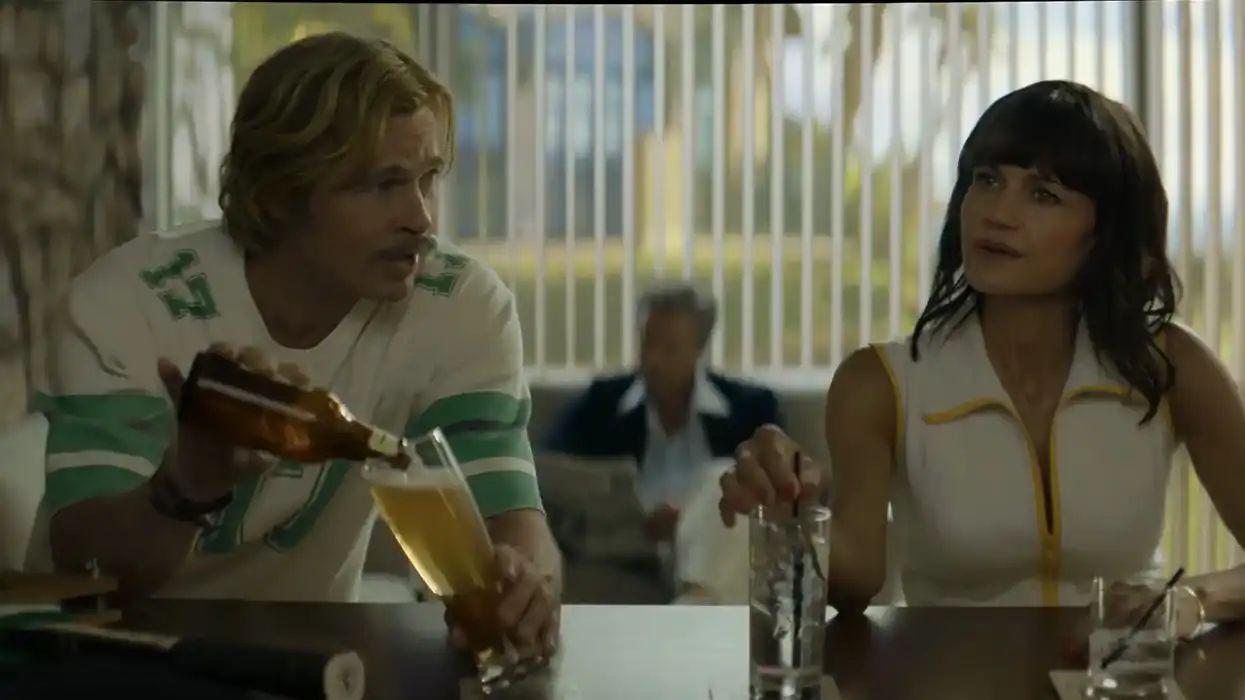
Last year, as associate casting director for The Further Mis-Adventures of Cliff Booth, I worked with one of the greatest partnerships in Hollywood: casting director Laray Mayfield and director David Fincher. Witnessing firsthand how this longtime duo brought to life the Quentin Tarantino-written, Brad Pitt-starring script was, in a word, cool.
I’ll always remember finding out I’d get to work with my casting icon, for my favorite director, on a movie written by my other favorite director. I made my dad, then my mom, get on FaceTime so I could see their reactions, then sent them a link to the Deadline article announcing Fincher would direct Tarantino’s sequel(ish) to Once Upon a Time in Hollywood.
“That’s the movie I’m gonna get to cast.”
“Whoa,” said Mom.
“Fuckin’ A,” muttered Dad.
Mayfield and Fincher’s partnership is the stuff of casting lore. Mayfield met Fincher on her first day in Los Angeles in the 1980s, and he urged her to start casting. She started casting his music videos, and then in 1999 Fincher asked Mayfield to take on a feature: Fight Club. Since then, she has cast all of his films, including Zodiac, Mank, The Social Network, Gone Girl, The Girl with the Dragon Tattoo, and The Curious Case of Benjamin Button.
But it’s not just Fincher; look at an acclaimed director, and you’ll find a casting director they’ve worked with for decades. Tarantino and casting director Victoria Thomas have been on a legendary run since Django Unchained, through The Hateful Eight and Once Upon a Time in Hollywood. Martin Scorsese famously said, “More than ninety percent of directing a picture is the right casting.” He’s worked with casting director Ellen Lewis since Goodfellas (her second solo feature credit), through Killers of the Flower Moon. Steven Soderbergh has trusted Carmen Cuba with nearly everything he’s made for two decades, including Contagion, Side Effects, Magic Mike, Logan Lucky, and The Knick.
Ellen Chenoweth has cast every Coen Brothers film since O Brother, Where Are You?, including No Country for Old Men and True Grit.
Spike Lee always works with Kim Coleman; they go way back to She Hate Me, through Inside Man, Blackkklansman, and Da 5 Bloods. Sam Mendes hired Debra Zane to cast his very first film, American Beauty, and their collaboration continued with Road to Perdition and Revolutionary Road. Wes Anderson has had Douglas Aibel since The Royal Tenenbaums, through Moonrise Kingdom and (my favorite) The Grand Budapest Hotel.
Judd Apatow and Allison Jones go back to Freaks and Geeks, where she discovered Seth Rogen, Jason Segel, and James Franco. “Allison doesn’t just find us actors; she finds us people we want to work with the rest of our lives,” Apatow has said.
This year, the first casting Oscar went to Cassandra Kulukundis for One Battle After Another. She started as an intern on Paul Thomas Anderson’s first feature, Hard Eight, in 1996, and has worked on every one of his films since. Accepting the award, she said the two of them “grew up together.”
That’s the common thread.
When it comes to choosing a casting director, the best directors are looking for a connection: someone to grow with. It’s why I started Chaos Casting: to give independent filmmakers that kind of partner from their very first feature.
Start Casting At the Right Time
8–12 weeks minimum before shooting starts; casting is on the early side of pre-production. This time will fly by. Giving the casting process enough time lets you explore the best possibilities for every role, hold callbacks, and close deals before actors book other jobs.
Casting usually starts with the leads and works down through supporting roles to day players. Your film should be fully financed and entering pre-production when casting starts.
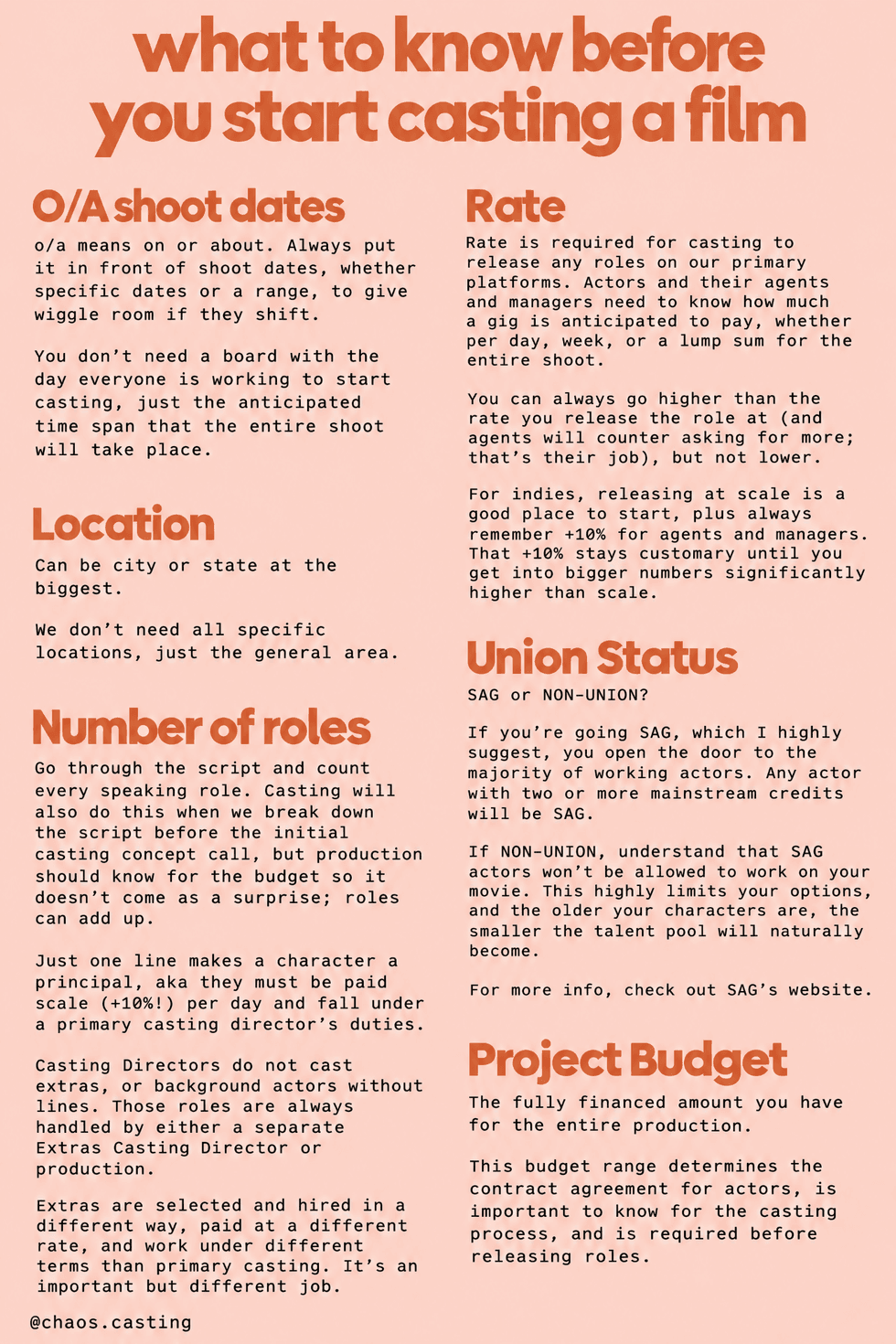
Come Correct: What To Know Before You Begin Casting
Here’s what you need to know when approaching a casting director:
- O/A shoot dates
- Location
- Number of roles
- Rate
- Union status
- Project budget
 Credit: Chloe Curran Casting
Explore the Possibilities
Ellen Lewis says that casting is “where you open your mind, your imagination,” and that is deeply true. Sometimes I get chatting with an inexperienced filmmaker, and they seem to see only two destinations for the casting process: someone they know, or a movie star.
If casting the coolest actor you know personally is staying in your backyard, and casting a movie star is scaling Everest’s summit, then a casting director is your guide to all the beautiful forests of possibility that lie between. Every story is different, every character and creative team is different, but the paths we tread to find the right actors for each role are well-trodden, soft underfoot; we walk these groves every day and know every twist and turn.
Casting, and filmmaking as a whole, is not about chasing clout or slouching into convenience, but about creating characters in the most fascinating way possible.
Audition, Audition, Audition
Audition. They need to audition. I am telling you they should audition. For the love of God, audition. Like a weird little priest, I feel a fanatical devotion to the principle of casting THE BEST ACTOR FOR THE ROLE REGARDLESS OF PERSONAL FEELINGS.
I have many actor friends who I adore and would cut from selects without a second thought if they weren’t among the best options. I’d cut my mother. I told my mother that, and she replied: “You know I was in drama club through senior year, so if there’s ever a role…” You see what I mean.
EVERYBODY READS. Unless the movie star is really, really offer-only, and you have a fully financed, non-cast-contingent budget of $3 million and above, in which case, sure, let’s put out some big boy offers too; that’s fun, love to see it. But for indies anywhere in the low-budget realm, or filmmakers who just have big balls and wanna cast the right person for the role regardless of fame (call me bb!), everybody reads.
Every Role is Worldbuilding
Stanislavski said there are no small parts, only small actors. At the very least, all roles worth casting are worth casting well. The right actor for a character can turn the most throwaway couple of beats into something unexpected and electric. I watch it happen all the time.
The most brilliant lead actor in the world will be dulled by a bland, undercooked supporting cast. How many of the movies you love have those random little side characters and moments that made you cackle, or your heart clench in a scene that, with a different actor, would have been forgettable? The actors playing supporting characters today are the movie stars tomorrow, and every opportunity means something to those artists.
I see actors pour everything into self-tapes for roles with, like, one line. And there’s nothing small about their care and time. So when someone is like “who cares” about a day-player role, I can’t help but think: Actors. Actors care. And that’s worth something, to me, to you, to the character, and to the world you are creating on screen.
Craft Compelling Character Breakdowns
It’s character first. When someone asks me what actor I’d suggest for their lead, my first question back is: what’s the character? A good character breakdown is like a net: you want it big enough to grasp all the wriggling possibilities that casting will later comb through, but not so big you have thousands of people who are completely wrong to sift through.
Start with the character’s name, then gender, age (I like a nice decade: 20s, 30s, etc.), ethnicity. Then briefly summarize their traits, especially the ones that shape how they interact with their world.
A solid character breakdown highlights the key psychological and physical attributes of the role, both as written and as discussed in casting concept calls, before it goes out to agents and managers.
Attachments Matter
As a casting director, I am as attracted to attachments as Leonardo DiCaprio is to women in their 50s. My affection for attachments rivals that of Kendrick Lamar for Drake. Given the choice between a world without attachments and a world where I stay thin forever, I would choose to stay thin forever, but I would still fucking hate attachments.
Attachments are like Santa Claus in that they would bring you everything you need wrapped in a beautiful bow if only they were real. For unfinanced projects by unknown filmmakers, attachments are rarely realistic.
The bar for the kind of name that secures financing (international pre-sales) is so high (an A-list movie star who headlined a successful movie internationally in the last few years, oh, and you’ll probably need two). Attachments are more likely but still rough for filmmakers with a respected track record whose work the movie stars might know and like. But no money, no festival wins or box office success? About as likely as being struck by lightning.
Attachments break my heart. Because I want them to be real. I want to help. There are as many brilliant producers, directors, and writers with projects that could be great as there are talented actors who could be stars if only given a shot at that breakout role. But there’s never enough money or roles.
Supply vastly exceeds demand.
On an emo day, attachments remind me of that old heaven-and-hell parable with long spoons: everyone in hell is starving at a full table because their spoons are too long to feed themselves, when all they’d have to do is feed the person across from them.
That’s showbiz, baby. So it goes.
Make The Most Out of Callbacks and Chemistry Reads
This is the fun part! Work with the actors, adjust them, give notes. PLAY! Actors love being adjusted (or at least are good at acting like they love adjustments). Be confident, but also open. When you work on a scene with an actor, you’re collaborators in make-believe, a joy and a privilege worth savoring. Ask questions. Explore motivation. Try things you don’t know will work.
As a casting director, I read and adjust actors constantly during auditions, and the more you do it, the better you get. Chemistry and vibes between actors and directors are best felt out live. No callback session I’ve done has been a foregone conclusion.
A self-tape favorite is frequently outdone by a last-minute wildcard. I LOVE seeing directors work with actors and get the first glimmer of how their character will be brought to life; it’s a high.
Follow the Path to Its End
You gotta ride the wave. Whoever you’re hung up on initially will often pass, and the actor who steps in will be the one destined for this role. If you do it properly (audition the roles, explore the possibilities, make the most of the process), the best possible cast will come together naturally.
These characters started as hastily typed words and were workshopped and beaten into shape in countless drafts, compacted into breakdowns sent out to hundreds of agents and managers, made real in a hundred shades by actors, real flesh-and-bone people creating what was once a figment of your imagination, the right one making it richer and stranger than you pictured it.
We are adults playing make-believe. Everyone has a lot to say about Hollywood people, but as someone living and working in Hollywood, I know we are all, at our core, weird, lonely little kids who fell in love with stories, who escaped into the possibility of living a thousand different lives, right there on screen.
My generation of young Hollywood has gone through hell after COVID, after the writers’ strike, after the actors’ strike, after the network collapse, after the streaming bubble pops, after the production exodus, after AI doom, and we’re still like, “aight, what else you got?”
Everybody wants this. The process is the point. The mystery is the mystery. That’s casting. Isn’t it gorgeous?