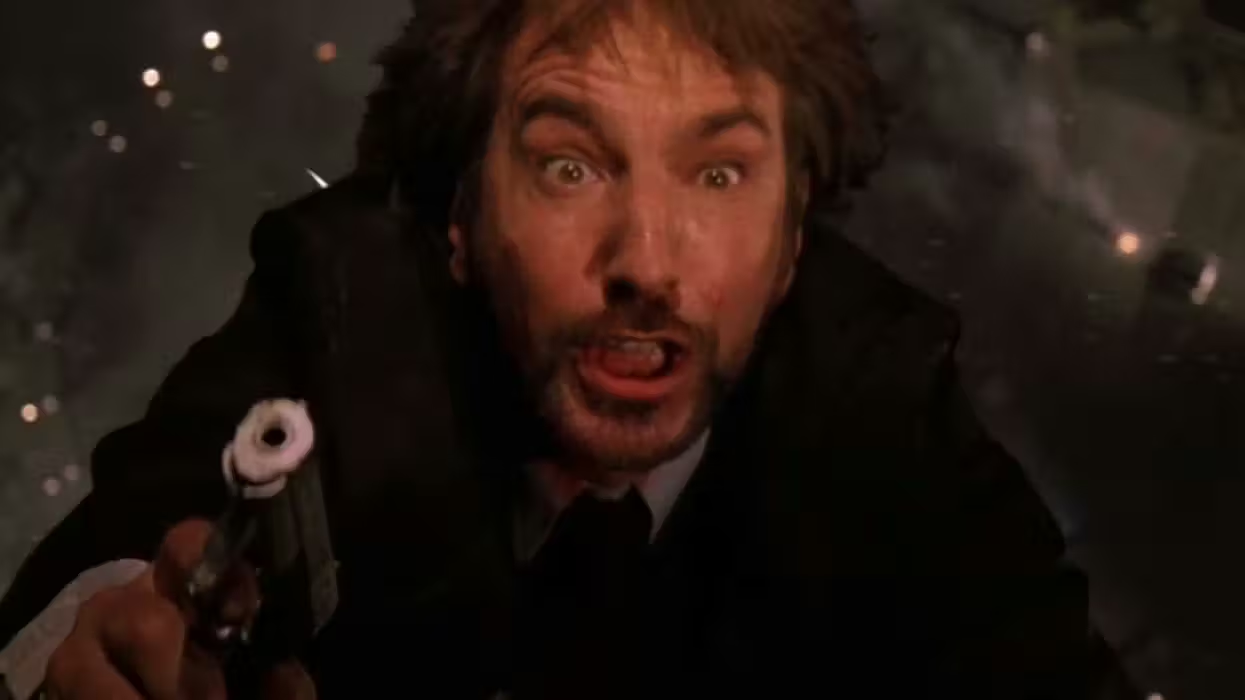
Before 1988, the action-movie villain was mostly a caricature, and usually all about appearance. Creepy and cat-cuddling, a wall of muscle, a trigger-happy psycho, or a sneering Cold War stand-in—you rooted against all of them. Then Alan Rickman strode into Nakatomi Plaza in his first film role, and he redefined what the genre could do with a bad guy.
The whole performance is incredible, but there's a scene in the latter half of the film that shows how different he was as an antagonist.
Let's revisit it together.
- YouTubewww.youtube.com
The Scene
At the top of the scene, Gruber is trying to secure the electronic detonators (which he needs to blow open the vault) and eliminate "that cowboy" (John McClane, played by Bruce Willis), who is interfering with his heist.
He jumps from a platform to find that McClane has his gun pointed right at his face.
McClane says casually, "Hi there. How you doing?"
Gruber processes for a moment. Then launches into a totally unexpected reaction. "God, no. You're one of them, aren't you? You're one of them. No, no, don't kill me, please. No, please!"
McClane frowns. "Whoa, whoa, relax, relax. I'm not gonna hurt you. I'm not gonna hurt you. What the f*ck are you doing up here? What were you looking for?"
Still using his American accent, Gruber says, "I managed to get out of there. Uh, well, I was just trying to get up on the roof and see if I could signal for help, you know."
McClane pivots to protector. "Forget the roof. They got people all over. You want to stay alive, you stay with me."
Gruber becomes a terrified man pleading for his life in a turn no viewer could have predicted. The dramatic irony is that we recognize the man immediately. McClane doesn't. He's the mastermind McClane has only heard as a clipped commander on a stolen radio, now trembling in an American voice and calling himself Bill Clay.
The scene is one of the quietest, most nerve-wracking stretches in the whole movie. It also didn't exist on the page. Someone invented it in the middle of the shoot.
A Scene That Didn't Exist on the Page
Die Hard was directed by John McTiernan from a script by Jeb Stuart and Steven de Souza. It gave Alan Rickman his first film role, and per de Souza's 30th-anniversary account on Slashfilm, his signature scene came about by accident.
It was Rickman's first movie, so the crew barely knew him. During a break, someone asked him offhand whether he could do an American accent. Rickman offered up "a California one." De Souza told Slashfilm:
"So I dropped my sandwich and said, 'Oh my God.' I ran over and found Joel on the set, and brought him back and said, 'Do that again.' Rickman does it again, and Joel says to me, 'Yeah, so?' And I'm like, 'So?' and before I could explain it, he says, 'Oh! Oh! You're right! You're right! Get McTiernan!'
So we got him and asked Alan to do it again, and he said, 'Why are you doing this to me?' And I said, 'If McClane only knows Hans as this disembodied voice on the walkie-talkie, if Hans can do this, they can meet. If we can contrive a way for them to them to meet, he can mind-f*** him!' John [thought about it], and said, 'No, McClane saw Gruber kill Takagi.' I said, 'Did you shoot that yet?' The first assistant director said they were going to shoot it the next day. [So they came up with] a way to shoot that scene so that McClane didn't see Alan Rickman pull the trigger, so they could meet later."
What de Souza saw in that moment was simple. If Rickman could bury his accent, the two could finally share a scene, and McClane wouldn't recognize him. Writer, producer, and director threw the whole thing together in under half an hour, in the middle of a shoot, because a first-timer's party trick landed in front of people who knew what it meant for the story.
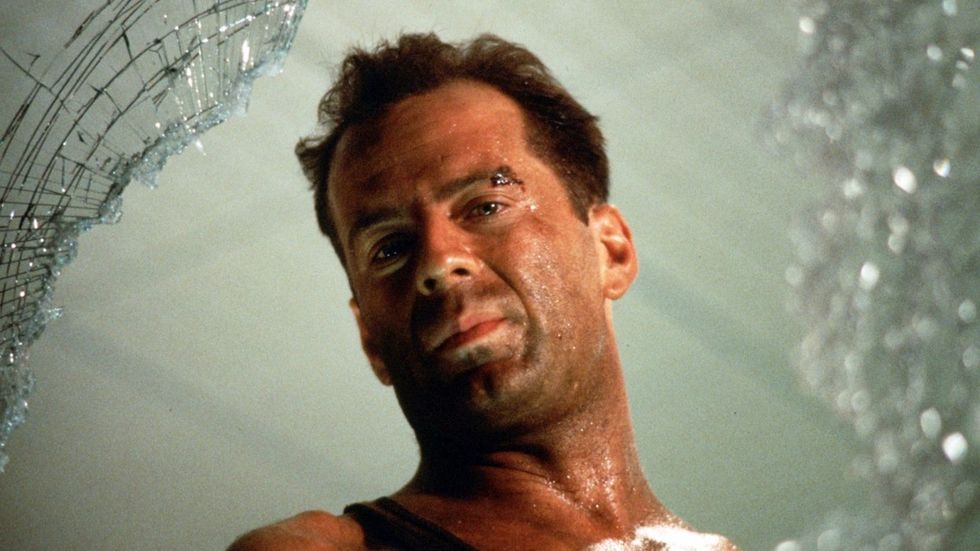 'Die Hard' Credit: 20th Century Studios
Why the Hero and Villain Need to Meet
Typically, your hero and villain need a face-to-face before the finale, and you can, as we see here, get creative with it. Up to this point, McClane and Gruber are separated by radio signals and gunfire.
The Bill Clay scene finally lands them in the same room, and the irony is delectable. We know who "Clay" is. McClane hasn't pieced it together (we think). He tips to the lie only when he hands "Clay" a cigarette and a gun and watches him a beat too long.
The scene rewards patience and quiet, which is a trick most emerging writers miss. If you want to see how far a strong antagonist can carry a scene like this, we've broken down the secrets to writing unforgettable villains and what makes a compelling one.
The point is that it is really dramatically gratifying to see two opposing forces come together. Another example is the iconic coffee scene in Heat. There would typically be no real way for a thief and the detective chasing him to sit down together, but Michael Mann achieves it beautifully. A villain who can meet the hero as an equal grants scenes a special tension and electricity.
Stay Loose on Set
The scene created a real problem to solve. According to de Souza, the Takagi murder hadn't been shot yet, so McTiernan restaged it to keep McClane from getting a clean early look at Gruber's face and blowing the later reveal.
For his scene with Willis, Rickman had cracked his knee jumping off a ledge in the previous setup, so he played the entire cigarette exchange balanced on one leg, out of frame (per All the Right Movies).
McTiernan even tilted the camera into a Dutch angle to whisper to the audience that something was off (per Empire).
The filmmakers reshuffled a shoot and reworked coverage all to chase an idea that showed up by luck. The best beat in one of the best action movies ever made came from a crew loose enough to jump at an opportunity. Rickman redrew what a screen villain could be, charming and unbothered and always ahead, in a scene his filmmakers built on the spot. Leave that much slack in your schedule and your ego, and you might catch something nobody conceived of during development.
- The ‘Die Hard’ Comeback That Made Action Heroes Human ›
- The Movie That Changed Action Films Forever: 'Die Hard' ›
- The Unforgettable Line That Made 'Die Hard' an Instant Classic ›
- 10 Facts About 'Die Hard' You May Not Know ›
- Iconic Villain Moment: Anton Ego - One Bite Changes Everything | No Film School ›
- The 5 Most Ridiculous Action Movie Villains Ever | No Film School ›