Hedwig and the Angry Inch, a boundary-busting 2001 movie musical written and directed by its star John Cameron Mitchell, rightfully received a lavish physical media release through the Criterion Collection in 2019, cementing its status as a classic of LGBTQ+ cinema. However, its initial release shows that it wasn’t necessarily appreciated in its own time. In fact, it was a notable flop at the box office in spite of its relatively low budget.
Let’s break down what happened and why it enjoys a reputation that is far superior to its commercial performance.
The World Wasn’t Quite Ready for Hedwig and the Angry Inch
The 1990s were a great time for LGBTQ+ movies. While titles like In & Out, The Birdcage, and To Wong Foo, Thanks for Everything! Julie Newmar were playing to wide audiences, the indie scene was teeming with New Queer Cinema classics like The Watermelon Woman, Poison, The Living End, My Own Private Idaho, and The Doom Generation.
This might be how Hedwig and the Angry Inch scraped together a surprisingly sizable budget of $6 million, in spite of the fact that nothing about it screamed “Y2K blockbuster.” This is more than two times the $2.5 million budget of My Own Private Idaho. Heck, it’s twice the budgets of The Watermelon Woman, Poison, The Living End, The Doom Generation, Trick, and But I’m a Cheerleader put together.
This type of money is obviously a huge win for a first-time filmmaker like Mitchell, who wrote the book for the stage musical upon which the movie is based (which had music and lyrics by Stephen Trask). It’s also a huge win for movies about non-mainstream topics. That would certainly be the right word to describe this glitter-encrusted rock musical about the life of an East German singer named Hedwig (Mitchell) who has a “one inch mound of flesh” between her legs following a botched vaginoplasty and who is getting revenge against her song-stealing age-gap lover Tommy Gnosis (Michael Pitt of The Dreamers) by performing at chain restaurants in the cities where his tour is stopping. Oh, and it ends with an abstract fantasy sequence about the creation and destruction of one’s own other half and transcending to Heaven.
Mind you, this is a movie that debuted in July 2001, which is a month when the Top 10 movies at the domestic box office included Jurassic Park III, Tim Burton’s Planet of the Apes, Scary Movie 2, The Fast and the Furious, Legally Blonde, Dr. Dolittle 2, and the Julia Roberts-John Cusack romantic comedy America’s Sweethearts.
It is perhaps not shocking that the movie only managed to pull in $3.6 million at the box office through the end of its run, earning back just over half of the money that was put into it (and falling significantly short of its break-even point - considering the fact that theaters keep half of ticket sales and publicity costs are not factored into production budgets, it may have needed to earn about $13 to $15 million in order to end up in the black).
However, the movie still managed to make a splash with the critics and the industry establishment at the time, thanks to one important fact: it’s great.
Hedwig and the Angry Inch Is a Dazzling Film Musical
There is basically nothing that Hedwig and the Angry Inch does wrong. First, it brings the already-great stage show to life well, transferring its punk rock energy and vibrant character designs perfectly to the screen. As a matter of fact, it elevates the stage show into the stratosphere by virtue of drawing viewers into Hedwig’s offstage life in addition to her performances.
Mitchell’s camera is also a daring, irresistible agent of aesthetic chaos. Once freed from the limitations of the stage proscenium, Mitchell’s creative instincts went hog-wild. Rather than just using this freedom as license to add off-stage material to the screen adaptation, he invents a loopy visual style all his own that perfectly captures Hedwig’s glamorous counter-culture vibe.
In addition to dazzling moments like the staging of the fantasy number “Wig in a Box,” where a trailer park transforms into a concert, Mitchell profoundly evokes the themes of the story with a series of fetching images. While there are plenty more moments like this scattered throughout the film, one that always catches my eye in particular is a moment where Tommy Gnosis is looking at himself in a hand mirror. While Hedwig’s face is perfectly completing his reflection, he ultimately pulls the mirror more toward himself, bringing his entire arc toward selfishness to life in just a few potent, dynamic frames.
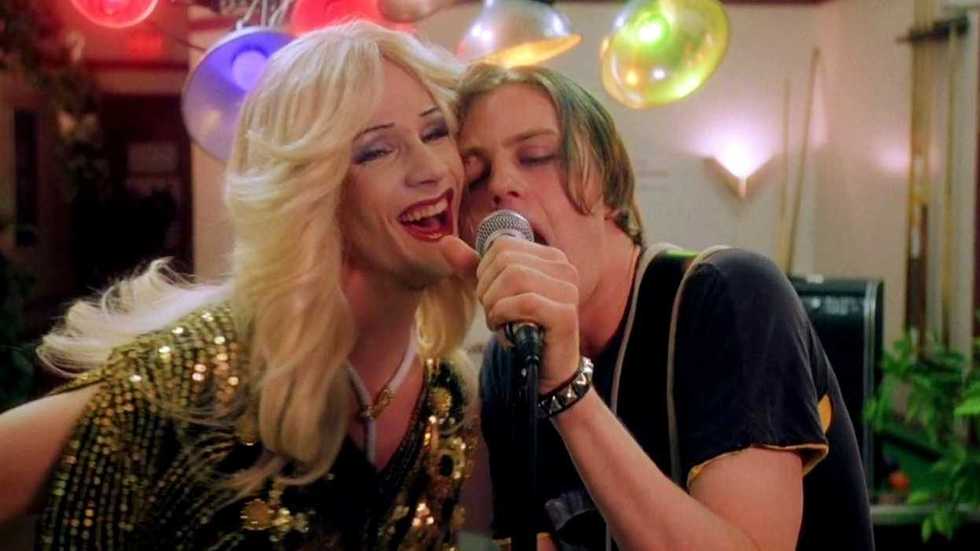
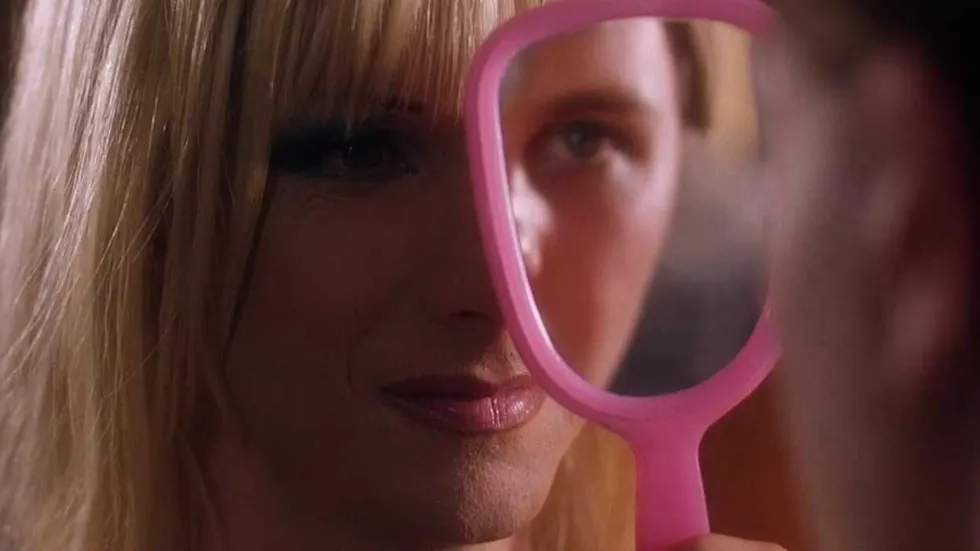 ‘Hedwig and the Angry Inch’ (2001)Credit: New Line Cinema
The whole movie is exuberantly creative, from the animated sequences by Emily Hubley that turn key moments into beautifully handcrafted music videos on down to the costume design by Arianne Phillips (Once Upon a Time in… Hollywood, A Single Man, The Crow) that turns every character, but especially Hedwig, into an outrageous, distinct, and vivid figure.
Hedwig and the Angry Inch’s Legacy Goes for Miles
So, as I said, Hedwig and the Angry Inch was already pretty well received at the time. In addition to winning the Teddy Award for Best Feature Film at the Berlinale, it won the Audience Award and Directing Award in the Dramatic category at the Sundance Film Festival and the Open Palm Award for Best Debut Director at the Gotham Awards. The movie was also nominated for five Independent Spirit Awards (including Best Picture), and John Cameron Mitchell was nominated for the Golden Globe for Best Actor – Motion Picture Musical or Comedy (though he lost to Gene Hackman for The Royal Tenenbaums).
This was more than enough for it to earn enough of a reputation that it would land on Criterion’s radar, but it has also become a bona fide cult classic in the meantime. This accumulated goodwill toward the movie is shown in its Rotten Tomatoes audience score of 93% as well as its Letterboxd user score of 4.1 out of 5 (a rare score, considering the highest-rated title on the platform, 1962’s Harakiri, only has a 4.7). The movie’s success almost certainly led to the stage show finally making its Broadway debut in 2014, with a variety of major stars stepping into the title role, including Neil Patrick Harris (who won a Tony for his troubles), Andrew Rannells, Michael C. Hall, Darren Criss, and Taye Diggs.
So have you seen Hedwig and the Angry Inch? What do you think of the movie, and are you surprised to learn that it wasn’t a box office hit when it debuted? Sound off in the comments below!