How to Expand a Franchise Without Losing Its Soul: Inside ‘Murder at the Embassy’
Director Stephen Shimek breaks down the challenges of shooting a period piece in Cairo, how to pivot when equipment fails, and why he believes the "process" is the most vital part of a filmmaker's life.
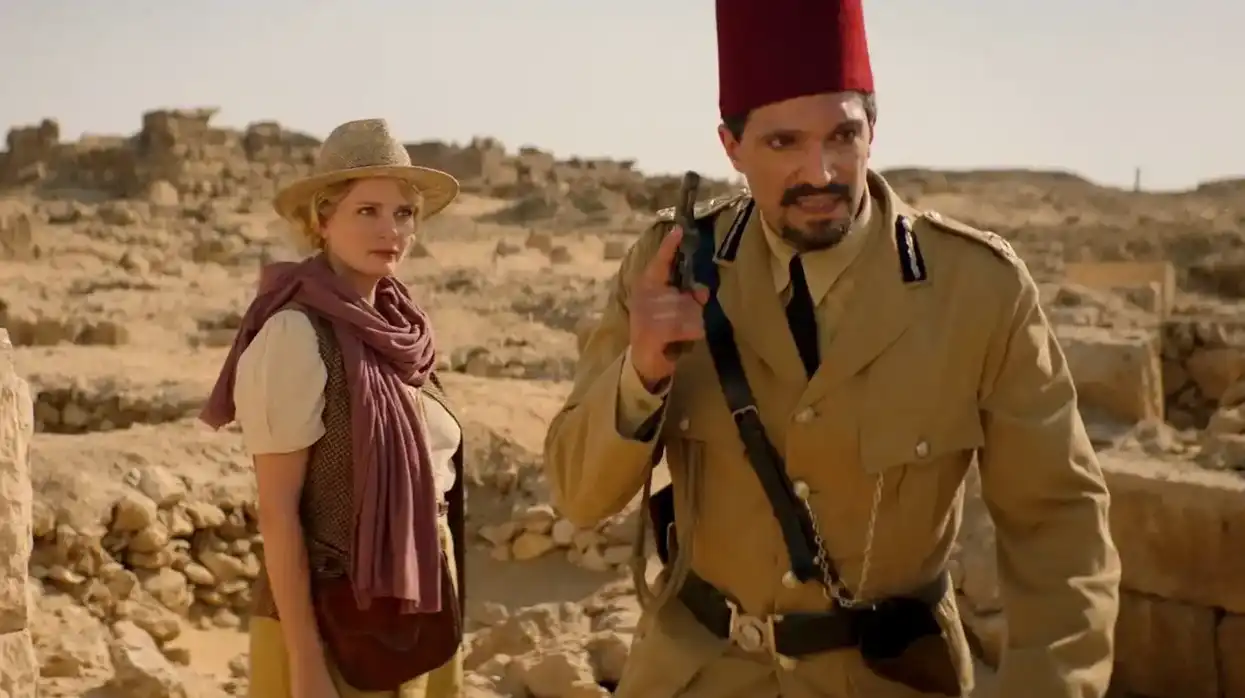
'Murder at the Embassy'
Filming a sequel presents a unique set of challenges: you have to honor the aesthetic of the original while expanding the world enough to justify a second chapter. Doing so while battling the Egyptian summer sun and navigating active archeological digs is a different beast entirely.
For director Stephen Shimek, the production of Murder at the Embassy—the second installment in the Miranda Green Mysteries series starring Mischa Barton—was a masterclass in adaptability.
In this interview, Shimek discusses the realities of on-location shooting, how to handle the pressure of a period piece, and his desire to move into the "cerebral horror" space.
Check out the interview below.
- YouTube www.youtube.com
No Film School: Hi Stephen! Because Murder at the Embassy is the second film in the Miranda Green Mysteries series, how did you balance your desire to evolve the franchise with the need to stay true to its established aesthetics and themes?
Stephen Shimek: I’m very fortunate in that regard because I really feel that those two ideas go hand in hand for us. The themes we establish in Invitation to a Murder revolve around Miranda’s world expanding as she embarks on this mysterious adventure that pushes her personal growth and puts her capabilities as a detective to the test. Murder at the Embassy is the second chapter in Miranda’s journey, and her world continues to expand, as do the consequences of her discoveries and scope of the story. The evolution came quite naturally, I think, and I remember having an experience on the very first day of principal photography for Murder at the Embassy that confirmed that sentiment for me. We were shooting at the Giza pyramid complex with the full power of the Egyptian Summer sun beating down on us. It was an incredibly overwhelming set of circumstances, but in spite of that, as soon as we started rolling on our first take and Mischa [Barton] brought Miranda back to life again on screen, it honestly felt like we had picked up right where we left off.
NFS: Beyond the compelling murder mystery at its core, the film also tackles issues of fascism and corruption. What drew you to these topics as you expanded this story?
SS: With historical fiction, research can often bring some of the most compelling ideas to the table, and with a series that takes place in the 1930s, there’s a lot of interesting history to draw from. Mark Brennan, our writer, is so very good at finding relevant pieces of history to weave into the script, so we had a lot of fun finding exactly what to use and how. With the spy-thriller elements of the story, leaning into the Nazis made a lot of sense for multiple historical reasons, and exploring the character motivations within that political milieu gave us a lot of room to create tension and suspicion as the characters interact with each other.
NFS: Do you have any favorite anecdotes from your time shooting the film in Egypt with your cast and crew?
SS: Something incredible happened to me on the first day of principal photography that shifted my perspective and really helped me appreciate how special this experience was. We had spent several days scouting various locations in Egypt with multiple trips to the pyramids as we were searching for a very specific location that needed to look like an active archeological dig site. I had spotted an area that I thought was perfect, but I hadn’t heard if we were going to have permission to shoot there. Schedules on film shoots are very volatile things with so many factors in play that can affect where you’re going to be on any given day. In our case, we ended up shooting at the Giza pyramid complex on day one. It was an overwhelming day with some key character and story beats, not to mention scenes with animals, all while trying to find ways to make it look like we’re completely alone at a world-famous destination that sees thousands of daily visitors. There was a lot going on and plenty of stress to go around. I found myself racing from spot to spot, desperately trying to get what we needed to make our day.
The time came to move to the archeological dig site location, and I was thrilled that we were able to shoot in the area that I had hoped for. As I surveyed our surroundings, preparing for our next setup, our on-set archeologist casually mentioned that no one had ever shot anything in this area before. That statement pulled me out of my “film-set” brain and forced me to take a moment and really appreciate where I was standing. It was just another day at work for him, but we were nestled between two active archeological dig sites, studying the thousands of years of human history that surrounded us. I doubt he realized how profoundly his relatively nonchalant observation had affected me, but it was the absolute best thing that could have happened that day. It really set the tone for the rest of the shoot.
NFS: What effect did shooting the film on location in Cairo have on the final product?
SS: Shooting on location in Egypt was invaluable. Physically being in these locations brings a life and an energy to the film that you can feel in the final product. It’s something we also felt during production. There’s a magic in shooting on location that you can’t capture any other way. It brings an almost tangible quality to the film, and I think that’s something audiences are hungry for. Nothing beats the real thing. It’s freeing as an artist, and it’s compelling as a viewer.
NFS: Were there any unique challenges that arose because of the film's on-location shoot?
SS: The heat was one of the constant challenges we faced every day. It was unforgiving. And every location had its own way of testing our ability to stand the heat. There was no shade in the desert, but plenty of wind. Then on the city set, all the shade you could want, but not even the slightest breeze. You end up acclimatizing to it, but you’ve got to be careful to stay hydrated. It’s brutal.
Each location was so distinct, and so were the challenges that came with it. It’s normal to be in a perpetual state of problem-solving on a film set, but it felt like we were being forced to start from scratch, somewhat, every day. We had the challenges that come with shooting at one of the world's most famous tourist destinations. We were out on the Nile trying to coordinate movement between a felucca and our camera boat as the sun set. We navigated densely packed crowds in an active bazaar; every day was a new adventure.
But the challenge that almost broke me was the day we shot the car sequence. We had been trying to find a location that would allow for what we needed to shoot, which would involve period-appropriate cars turning down multiple streets with period-appropriate architecture, art, and background actors. After a thorough location search, we finally ended up finding exactly what we needed on the back lot sets at the Egyptian Media Production City. It’s funny to think about traveling all the way to Egypt to then shoot in a “fake” Egyptian city, but it really was exactly what we needed, and they also had picture vehicles available for us to use. The day we shot there, we got off to an incredible start, and the footage was looking great, but right before we broke for lunch, one of the cars died and absolutely refused to come back to life. There was no matching car available to replace it, and we had only shot half of the sequence. We only had one day at this location, so we had to take the half day that was left and find a way to not only shoot the second half of the sequence, but also reshoot the first half of the sequence, as well as a handful of other scenes. So what started as one of the least stressful days on set very quickly became the most stressful day. But that’s filmmaking in a nutshell, I guess, problem-solving.
NFS: Having directed films across a wide variety of genres, how do you tailor both your creativity and your leadership style to fit each new film you work on?
SS: Every project deserves to be met where it’s at. My approach is to find that place, nurture what’s there, and then explore to find out what else it needs. That applies to both my creative approach to any given genre and the way I communicate and interact with the cast and crew. Every film is a meeting of minds and circumstances that will never be the same again. And I’ve been fortunate to work on a wide variety of projects. The style, scope, and technical execution of every film I have ever made have been unique. It’s kept things fresh, but it’s also helped me approach every project with an openness and curiosity that has served me well over the years.
NFS: Are there any other genres in which you would love to direct?
SS: I can’t think of a single genre I wouldn’t want to try at least once, but I am very drawn to cerebral horror films, the sort of projects you see from studios like A24 and NEON. Horror has this incredible ability to present abstract ideas in relatable ways while sending you on a heightened emotional journey. I’m actually working on a screenplay right now that’s firmly in this camp. It’s a very special story to me, and it’s not like anything I’ve ever seen before. I think a great horror movie is a gift, and I’d love to share this little gem with the world.
NFS: Do you have any advice to share with aspiring or up-and-coming filmmakers?
SS: The process is just as important as the product. The product is important. It needs to be as good as it can possibly be, maybe better than it ever deserved to be. But 99% of your life will be spent in the process, not the product. Make sure that process doesn’t kill you or ruin your relationship with those around you. Your life will be making films. Not the films themselves. So make it good.