The Best Uses of Dolly Parton's Music on Screen
Remembering Dolly Parton with the five best uses of her music in movies and TV.
'The Best Little Whorehouse in Texas'
Dolly Parton died Tuesday in Nashville at 80. The songs she wrote—and she wrote a lot, thousands of them, in fact—have been used across film and TV shows. She performed many of them, wrote for other artists, or had her iconic tunes covered by others.
She was an iconic singer/songwriter who had no problem being herself and letting others do the same. Somehow, even in an increasingly divided reality, most people in the world agreed that Dolly was a gem.
When you have a catalog 3,000 songs deep, you're going to see quite a few needle-drops. She wrote Dumplin''s original tracks for Jennifer Aniston. Her music plays in Straight Talk, Sweet Home Alabama, Alice Doesn't Live Here Anymore, Steel Magnolias, Big Love, and dozens more.
Today we're looking at five of the best uses of her songs on screen.
- YouTube youtu.be
9 to 5
This legendary film about women in the workplace was Parton's feature film debut. It also happened to be her price of admission for the film.
To get Parton for one of the lead roles, Colin Higgins' producers let her write the film's theme song, which became a defining workplace theme. It was also just a great song, rising to No. 1 on the country, pop, and adult contemporary charts. Parton earned an Oscar nomination for Best Original Song, plus two Grammys.
Parton famously worked out the song's percussive typewriter beat on set by clicking her acrylic fingernails together.
"No, I did it on my fingernails," she told TODAY, demonstrating. "I don't know if you can hear that or not. Anyway, it sounded like a typewriter, and I didn't have my guitar because I didn't want to get too too scattered. Because we were trying to stay in the mood … it was about women in the workplace, so I would just kind of do my, you know, 'I tumble out of bed and stumble to the kitchen,' or 'nine to five,' and just kind of play my little fingers. Go back to the hotel at night, write down the words, and get my guitar and start singing it, but that's how that all works. And then I played my nails on the real record just for fun because all the girls got a kick out of me singing it to them running around."
Lily Tomlin later described how Parton approached her first-ever film role in the same way (via Country Rebel).
"9 to 5 was Dolly's first movie, and she was fabulous," she said. "During one of our rehearsals, I forgot a line, and she recited it for me. I asked her how she knew my line, and she said, in her rapturous drawl … 'Well, I never made a movie, and I thought I better memorize the whole darn script.'"
The whole intro of the movie is built around this theme song.
- YouTube youtu.be
Sneakin' Around
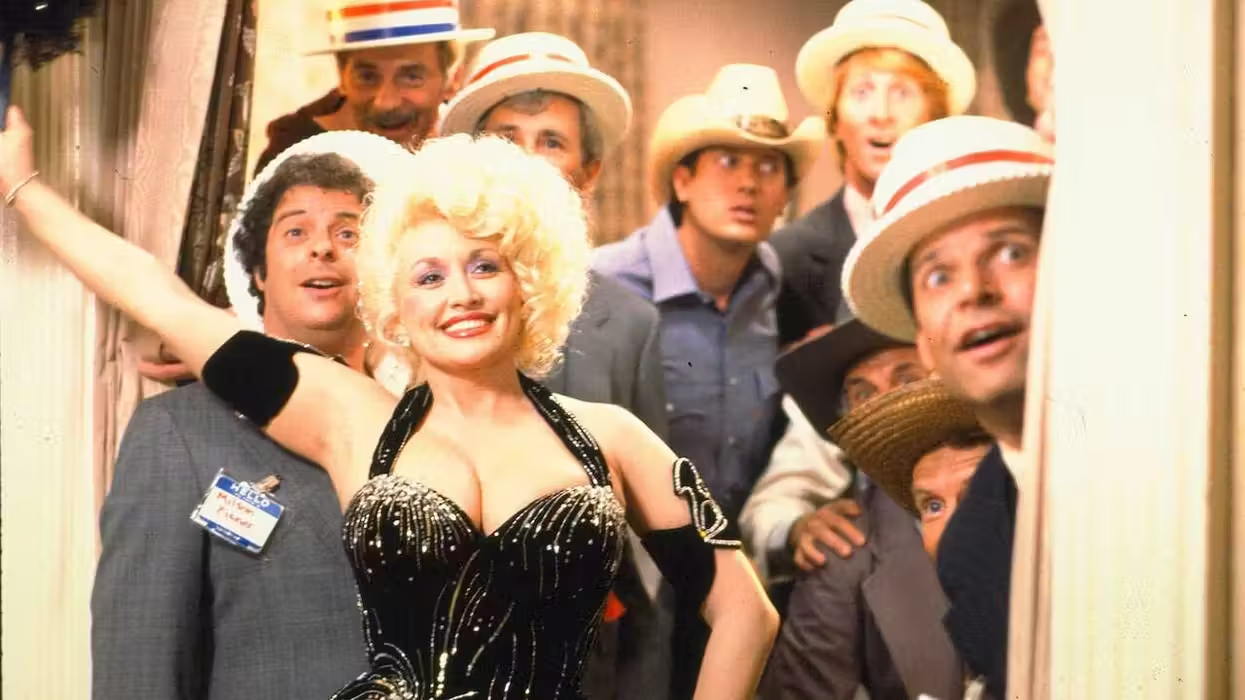
Parton pulled double duty on Colin Higgins' adaptation of the Broadway musical The Best Little Whorehouse in Texas, both starring as Miss Mona Stangley opposite Burt Reynolds and writing two original songs ("Sneakin' Around" and a re-recorded version of her 1974 song "I Will Always Love You"). The latter topped the country charts again in September 1982.
Speaking to Rolling Stone in 1980, Parton said:
"When they started askin' for suggestions, I said I would like to see more of a romance. Wouldn't you feel like you wasted five dollars if you paid to see Whorehouse and you didn't see me and Burt kiss? I was makin' a joke, and I stuck to it—I'm not going to miss my chance to kiss Burt Reynolds. There ain't no way I'd do sex scenes. I'm talking about love scenes."
"Sneakin' Around" is a duet and helps sell the romance Parton was talking about here.
- YouTube youtu.be
I Will Always Love You
Speaking of that other iconic song… it was later used in The Bodyguard and made famous yet again.
Parton wrote "I Will Always Love You" in 1973 as a farewell to her mentor Porter Wagoner, per Biography.com. She'd already had a hit with it twice, once in 1974, and as mentioned, in 1982 for The Best Little Whorehouse in Texas.
Then Kevin Costner called. He asked Whitney Houston to record it, with producer David Foster rearranging. Parton had one specific request.
"I sent [the song] to them," Parton told BBC Radio 2 (via American Songwriter). "I said, 'Be sure and make certain that that last verse can be sung.' I did a recitation. But don't leave it off like Linda Ronstadt did because she thought, 'I can't do a recitation.' But it's in the same melody. I just talked it. But I had written it."
Parton stepped back and didn't hear the cover until much later.
"My heart just started to beat so fast, and then when she got into 'I Will Always Love You,' when that opened up, and I realized that was my song, it was the most overwhelming thing," Dolly told The Oprah Conversation (via The Mix).
- YouTube www.youtube.com
Islands in the Stream
Now for a couple of deeper cuts. This is a duet between Parton and Kenny Rogers, used in an episode of Stranger Things. Specifically, Season 2, Episode 2, "Trick or Treat, Freak." Sean Astin's Bob Newby, Joyce Byers' (Winona Ryder) new boyfriend, is one of the show's warmest and most tragic characters.
Music supervisor Nora Felder told Deadline:
"Through Bob, our Joyce is able to possibly love, laugh, and break out with a slow dance to one of Bob's quirky, hopelessly romantic and refreshing song faves, Kenny Rogers & Dolly Parton's 'Islands in the Stream,' serving as a perfect reflection of his character, [who has] always the best of intentions."
It's an era-appropriate song, but it's also character work through sound.
- YouTube youtu.be
Light of a Clear Blue Morning
Parton wrote "Light of a Clear Blue Morning" in 1976 after her last meeting with Wagoner.
In her 2020 book Songteller, Parton described what the song is about (via Songfacts):
"'Light of a Clear Blue Morning' was my song of deliverance. I felt like I was trapped in a situation and needed to be free, because God was calling me, life was calling me, to something bigger. But I felt like my feet were nailed to the floor."
The song was featured in GLOW at the end of Season 3, Episode 7 to close the contentious desert-camping episode. Fitting for characters moving on from a time of dissonance.