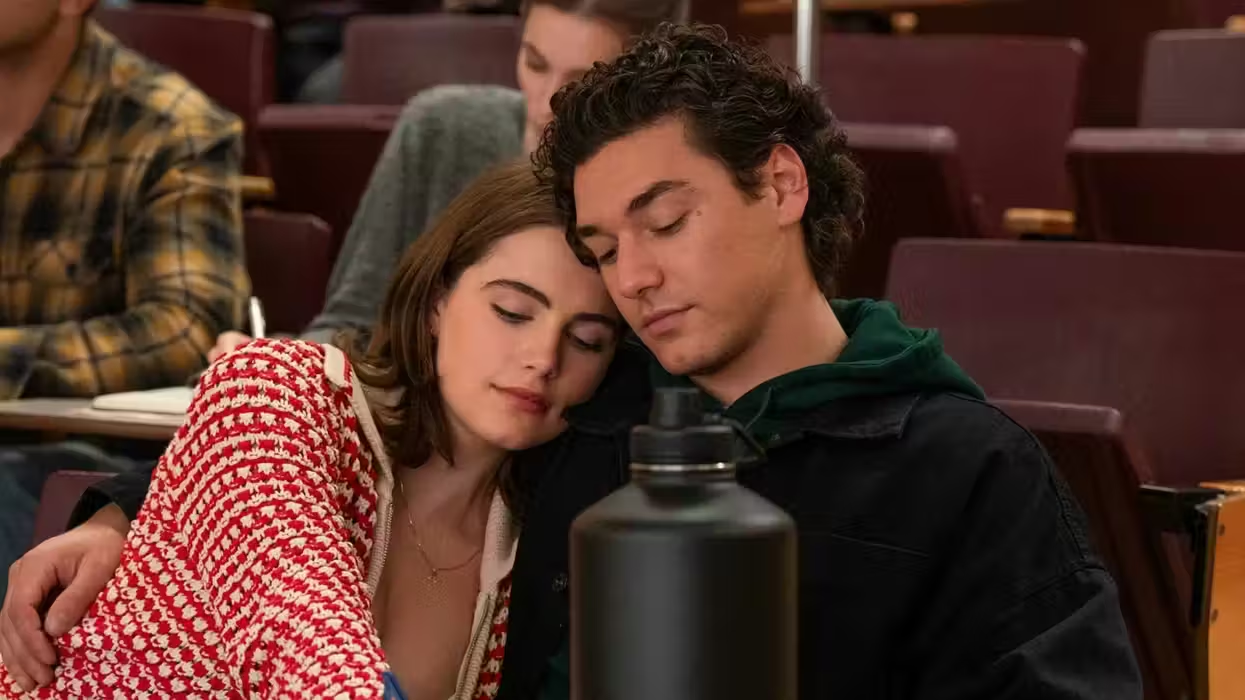
Emmy-winning and Billboard chart-topping Songwriters / Producers Doug Rockwell and Tova Litvin, the duo behind the music of High School Musical: The Musical: The Series, Julie and the Phantoms, and the ZOMBIES franchise, have recently brought their signature sound to Off Campus.
They worked with executive music producer Alana Da Fonseca; they co-wrote original songs like "Yellow Haze" and "Keep Pretending" and reimagined pop favorites for the series.
These songs helped the show become a viral sensation and hit the right love notes that kept viewers tuning in.
Today, they talk about balancing storytelling with standalone hits, how their process differs from their more musical-forward work, and what's next.
Let's dive in.
- YouTubewww.youtube.com
NFS: How did you two first get brought into the Off Campus world, and what was the initial creative brief for the music?
Tova Litvin: The executive music producer, Alana Da Fonseca brought us in from the very beginning. We’ve known each other for years, (and have a total mutual obsession with each other.) We had been looking for the right project to do together, and one day she called us and was like “YOU GUYS, THIS IS IT.” We loved the story and were excited to get to craft the sound for the band and be a part of Hannah’s story.
NFS: The show blends original songs with well-known covers – how early in the process did you know which songs would be original versus covers?
Doug Rockwell: From the very beginning. Several of the covers were part of the script and important to the story, so right from the front there was a list of covers we would be doing, and then there were the spots we needed to write originals for.
NFS: What made "Yellow Haze" and "Keep Pretending" feel like the right songs to co-write with Alana Da Fonseca specifically for this show?
TL: Yellow Haze specifically was kind of hilarious, because Alana hit us up and was like, we need to write a really great song, but it also needs to have a lyric that could be interpreted as kind of lame, and at the same time, double as a joke about urine. And we were like, ok got it. We also had to keep in mind that since the characters were “writing” the song in the show, the lyrics had to fit their personalities and stories. If I remember correctly, Alana already had the title, and then we just built off that, and kept shooting lyrics and audio notes with vocal melodies and chord progressions back and forth.
DR: For Keep Pretending, we just wanted to write a really good indie rock song, and we had more flexibility lyrically because it didn’t need to serve the script the same way that Yellow Haze did. Funny enough, Keep Pretending (which was the first one we wrote) started off as a pop-punk song because originally After Hours was going to be a pop-punk band. They ended up changing the direction of the band, and luckily the song still translated well!
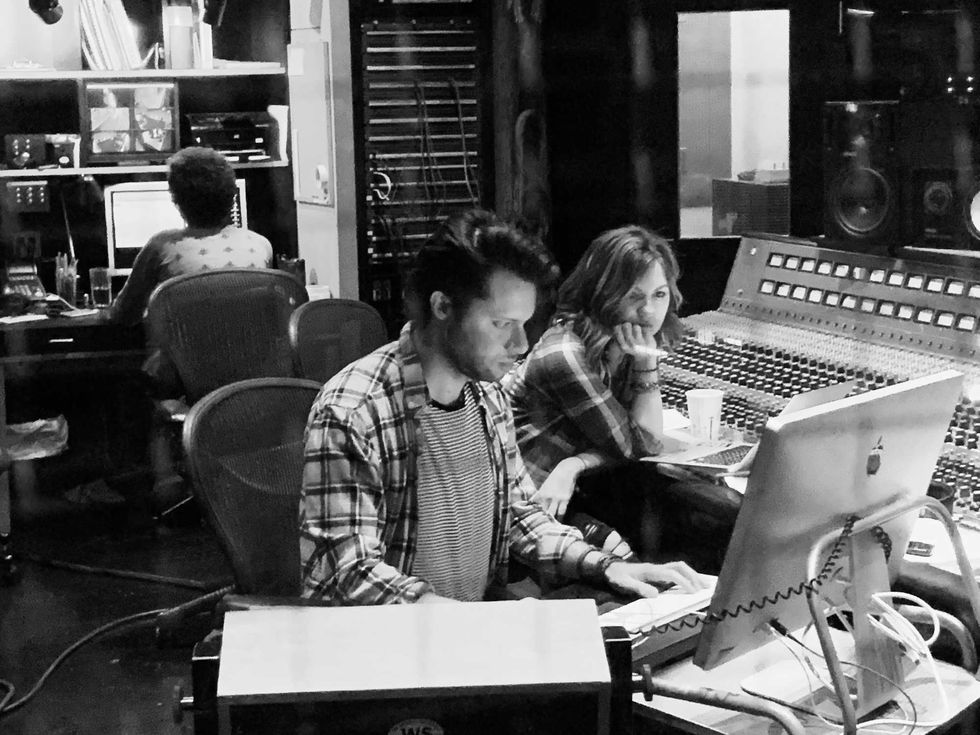 Doug Rockwell and Tova Litvin Credit: DT Studio
NFS: Doug, you played nearly every instrument on these tracks yourself – guitar, bass, synths, keys. What does that solo-producer approach give you creatively that a full band session might not?
DR: It helps me get exactly what I’m hearing out and recorded quicker. Being able to jump between instruments back to back gives me much more flow creatively because there’s very little downtime. But I do really love working with other musicians too. It gives me a chance to hear things from another perspective that I may not have explored. Especially when you trust the player. My buddy Mike Diggs graced us with his drum chops on all of the songs we were involved in. He and I have been playing together for almost 15 years, so it’s like working with an extension of myself. During the sessions, we’d literally communicate mid-recording with just a look, and he’d know exactly what to do next. And he’d play it 10x better than I ever could!
NFS: When you're covering a song like Ariana Grande's "Into You" or One Direction's "Kiss You," how do you decide how far to push a reinterpretation versus staying close to the original?
DR: Alana had done some mock-ups before we recorded all of the live instruments, so it made it pretty easy. She knew just how close she wanted to stay to the original. I think the most challenging part was genre-shifting it while not going too far into another world altogether. If you do a whole revamp, it’s easier, because you’re giving the song a whole new identity; none of the instruments have any boundaries. But when you need to find a happy medium between new and old, you have to have some constraint on where you let all of the new elements take you.
NFS: How do you divide labor when co-writing – is there a natural lane each of you falls into, or does it shift song to song?
TL: It really shifts song to song. We both write melody and lyrics, and so the best-case scenario when we have enough time is to sit down and throw ideas back and forth, building off each other in real time. That’s my preferred way to write for sure. But if we’re super slammed or have multiple deadlines at once, then we’ll divide and conquer. Doug might work on the track and arrangement, while I work on a lyric or a melody, and then we’ll come together and edit. Or one of us will have an idea for a piece of a song that we start with and then see where it leads us. Every song is a little bit different. The one job I have consistently across the board is script reader. It’s one of my favorite things to do, and I tend to read really fast, so I’ll usually read the script and then map out the elements we need to know and focus on for whatever scene or character we’re writing for.
NFS: How do you write a song that has to work both as a piece of the show's storytelling and as something that could stand alone on a playlist?
TL: It’s a really specific skillset, and figuring out how to do that every time is like solving a puzzle, which is what we love about it! On one hand, you want the song to be livable outside the show, so it needs to be relatable for everyone, and general enough so people can find themselves in it, but the flip side of that is it can’t be too general, or it’s going to feel cheesy or really generic in the scene. Writing lyrics for TV and film is a completely different ballgame, because a lot of the time, it’s functioning as part of the script, so it has to be seamless. There’s no blanket way to do that, but more often than not, we hone in on how the characters are feeling and experiencing what’s happening to them. What’s the universal message in it? What baggage are they bringing to the table that’s relatable? What do they secretly want for themselves? It’s really just finding the human thread in any experience.
DR: Once we think we have something great, I’ll start producing it. One thing that IS consistent across the board is that mostly everyone wants whatever music that’s going to be on their show to be able to compete with whatever is popular right now. So I usually approach production with a Pop (genre) mindset. And that doesn’t mean instrumentation or arrangement, because even if we’re doing something very theatrical, SONICALLY I want it to feel current and exciting. People get bored easily these days (I’m guilty of it too), so it’s more important than ever to keep the listener’s attention.
NFS: You've both shaped the sound of shows like Julie and the Phantoms, HSMTMTS, and Zombies – what's different about scoring a contemporary, grounded show like Off Campus versus those more heightened, musical-forward worlds?
TL: The biggest difference was that this show was not really being “branded” as a musical show; it’s a show that just happens to have great music in it. Usually, a lot of the songs we write in our world have plot points we need to hit at certain spots in the song. Like little milestones as the song progresses, since the song is being used as a storytelling tool to guide what’s happening on screen. Very similar to a stage musical. The song moves the entire story, so the lyrics have to be carved out extremely specifically to make that happen. But the songs for Off Campus just needed to be great songs, and work lyrically with who the characters are.
DR: We still used the script as our compass, but we had more poetic freedom to reach for lines that worked because they painted an overall picture instead of story-specific lyrics line by line. At the end of the day, we just wanted to write something cool and relatable that everyone would want to listen to. We both started that way - we were artists in bands, and then eventually grew into songwriting for other artists and bands before we ever even began writing for TV & Film.
NFS: Looking ahead, what can you share about what projects you have on the horizon?
DR: We've always wanted to get into theater, and we have two projects we're working on now that we're really excited about. One is a show we're developing with the Goodman Theater in Chicago, and another one is an original concept we're developing with one of our favorite Broadway producers.
TL: We're writing for a new animated show for Disney, and are also developing a couple of other musical projects with some of our dream collaborators. This is all annoyingly cryptic, but we really feel like the new stuff we've been writing lately is some of our best work!