How to Write an Emmy-Nominated Docuseries, with Timothy Moran From 'Chimp Crazy'
What kind of writing does a documentary really involve?
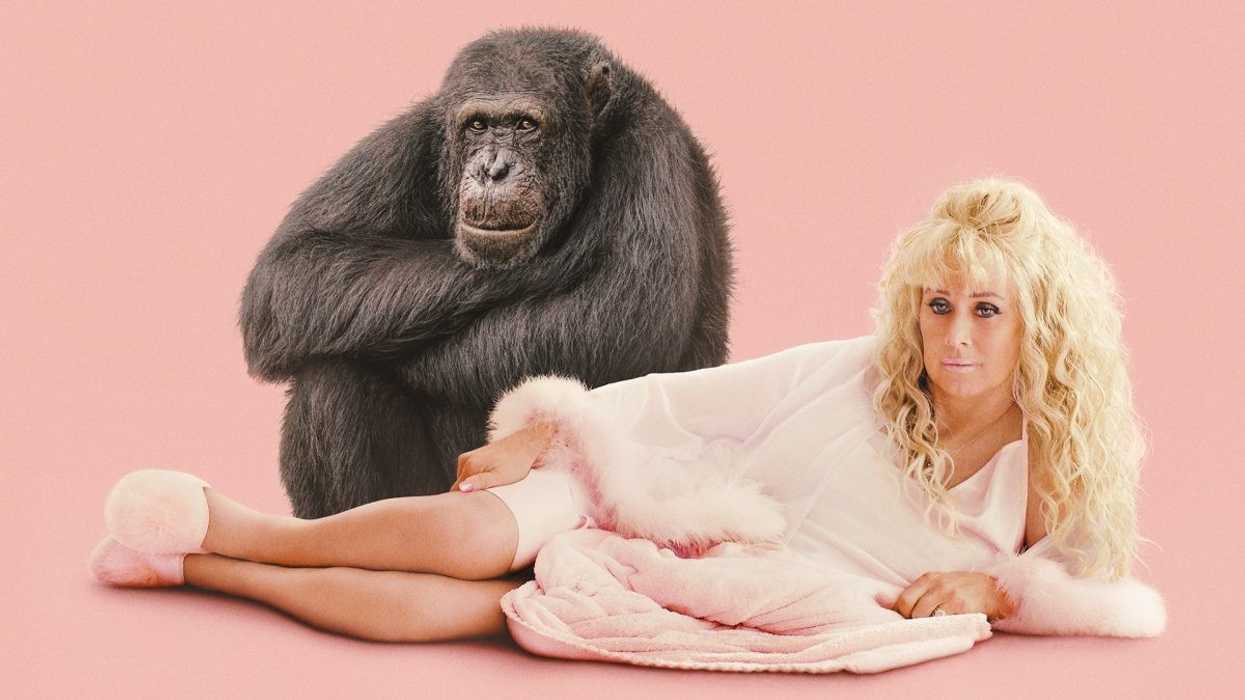
'Chimp Crazy'
Timothy Moran is an Emmy Award-winning producer and writer whose work has consistently captured the cultural zeitgeist. His most recent series, Chimp Crazy, became HBO's most-viewed documentary series in four years.
It was such an exciting, funny, and weird look at these people who keep exotic pets that should probably be in zoos or in the wild.
Moran previously earned Primetime Emmy nominations for two projects that re-examined the lives of iconic women: the 2020 series Hillary and the 2022 special The New York Times Presents: Controlling Britney Spears.
We spoke with Moran about the success of Chimp Crazy, his approach to revisiting complex histories, and what drives his powerful storytelling.
Let's dive in.
- YouTubewww.youtube.com
NFS: Congrats on being nominated for your writing work on HBO’s Chimp Crazy! Can you begin by explaining the role of a writer on a documentary project?
Timothy Moran: Thank you! Chimp Crazy was a dream project, and the recognition, especially in this category, has been really gratifying.
The role of a writer on a documentary project is a big topic, and how it’s defined shifts from project to project. In the case of a series like Chimp Crazy, where we had more than a thousand hours of footage and a dozen potential storylines – some of which unfolded in front of our cameras and others which would be constructed from archival material and retrospective interviews – I perceived my role as the keeper of the roadmap. That manifested both somewhat literally – the creation and maintenance of the series outline – and also in a more instinctual, even slightly ephemeral way, as the edit unfolded.
Documentary is arguably an editor’s genre, if not a director’s genre, but I believe on certain projects a writer can make a huge contribution by occupying a space in between the two. Like an editor, the writer often sees things in the footage the director didn’t see themselves; like the director, they’re able to float a little above the fray and maintain some perspective, as the story is assembled. With regards to Chimp Crazy in particular, the story was still very much live deep into the editing process, and anticipating what could happen or even imagining scenes that should happen became a big part of the job. In such a vast landscape of story, it would have been very easy to get lost.
NFS: With such a fascinating subject matter, there are infinite moving parts and possibilities for how to take the audience on this journey. How did you start to lay out the progression of this story, and how did you decide on what audiences were introduced to first?
TM: It was really hard! There’s really a lot I could say on this topic of how we plotted out the series overall (my colleague Evan Wise has written about it here), but when talking specifically about how we figured out the opening scenes, I’m comfortable admitting how much trial and error was involved.
On some projects, beginnings arrive effortlessly. A cold open reveals itself. Maybe the story requires very little table setting, and the plot is its own hook. Or the narrative questions are so baked into the subject matter that they hardly have to be highlighted in any way to get things going. Unfortunately, that wasn’t really the case on Chimp Crazy. The beginning had a lot of demands on it. It had to open up a window onto a very specific subculture that, while fascinating, was probably not top-of-mind for most viewers. At the same time, it was incumbent on it to include a kind of metanarrative about the production itself in order to lay the groundwork for how it would eventually intersect with the narrative later in the series.
Before landing on the final version, we missed badly in both directions. We tried to imagine a version that removed our director, Eric Goode, and the proxy-director Dwayne Cunningham from the story entirely. This was appealing as it was sharp, clean, and focused the story on its actual subjects – the animals (and their owners) – arguably where the focus should always be. But the storytelling totally fell apart when it came time to unpack how Tonka’s location was ultimately revealed in the third episode. It also felt unnatural, as there would be poignant ethical and moral questions that we talked about nearly every day in the edit, that wouldn’t be addressed explicitly in the series itself at all.
Later, we built a version that over-corrected wildly in the other direction. Inspired by HBO series The Rehearsal, which was airing at the time we were working towards our rough cut of the first episode, we overemphasized the metanarrative to an almost ridiculous degree, lingering for nearly half an episode on the long and winding journey to gain access to Tonia and the Missouri Primate Foundation. We even contrived a funny, but tonally dissonant scene in which Eric spends several minutes being fitted for facial prosthetics to try and go undercover at the facility, before ultimately abandoning the idea in favor of the so-called proxy director. In the end – and admittedly only after some tough screenings – we jettisoned most, but not all, of the excess and arrived at the right balance.
NFS: Much like Eric Goode's previous series, Tiger King, Chimp Crazy emerged as its own kind of cultural phenomenon. What is the secret to hooking an audience in the way these two series have, and making such a cultural impact?
TM: I didn’t know Eric or his process when Tiger King was released in 2020, but like many in the industry watching from home, I felt a mix of admiration and envy that he seemed to have “caught lightning in a bottle.” I remember thinking, “Alright. It’s not easy to identify unforgettable characters like Joe Exotic and Carole Baskin. But what else but luck could account for production to align with the exact moment so many twists and turns occurred?” Then in 2022, when I first met Eric and executive producer Jeremy McBride, and started to learn about what they had been filming since Tiger King – the events that would later become the spine of Chimp Crazy – I couldn’t believe it. I thought, “How lucky can one team be?”
Of course, now I know good fortune is only a tiny part of it. When you watch it, Chimp Crazy feels like it occurs in a relatively tiny, action-packed period of time, but in reality, its production spanned years, and the initial approach was very broad. Long before landing on Tonia Haddix as the main character, the project began when Eric identified a subculture that interested him – families living with monkeys or other primates effectively as their own children – and, following that curiosity, he filmed and filmed until it led where it ultimately led. Rather than luck, the key ingredients were optimism and patience; optimism about the potential of this world to engage the curiosity of viewers, and patience to film without knowing where the process would lead or how long it would take. Even after gaining access to the Missouri Primate Foundation, the home of the chimpanzee Tonka whose disappearance would become the focus of the series, there was no guarantee a bona fide “story” would crystallize. But a hunch about the dramatic potential of a character like Tonia, in a setting like that, and the faith to devote time, energy, and resources were rewarded.
NFS: You’ve previously been Emmy-nominated for your producing work on the four-part Hulu documentary, Hillary, as well as The New York Times Presents: Controlling Britney Spears. What draws you to such varying subject matter across each project, and do you notice any throughlines across your body of work?
TM: To be honest, I have a pretty instinctual approach to deciding on projects. I usually just ask myself, “Do I want to be thinking about this for a year?” Documentary projects are big lifts. They’re an opportunity to immerse yourself in engaging, sometimes unfamiliar subject matter, but they also take over your life and take up a lot of space in your mind. By the end of post-production, no matter the project, I’m almost always eager to turn my attention to something radically different, which probably accounts for how my career seems to ping pong between diverse subjects, genres, tones, and even formats.
Right before I was approached about Chimp Crazy, I had worked on a couple of projects in a row with heavy, largely historical subject matter. Chimp Crazy was a welcome departure. I was excited for the potential to experiment with comedy and some of its genre-bending aspects. At the same time, it didn’t feel light. The stakes, especially for the animals, were significant. And the story had, at its core, something I suppose you could consider a throughline across the projects I’m drawn to: a complicated, even polarizing central figure. Tonia Haddix is – not unlike Hillary Clinton and Britney Spears, by the way – hard to pin down. Her decisions are usually inscrutable or even upsetting; even so, she often inspires empathy. You can draw conclusions about her one day, and reverse them the next. Whatever you feel about her, she is a character you can spend a lot of time thinking about.
NFS: I’d like to talk about The Anarchists and The Circus, both of which you produced, and worked with editor Evan Wise, ACE on (who also acted as supervising editor with you on Chimp Crazy). Can you tell us more about these long-term collaborations with Evan and other editors you’ve worked alongside, and how your communication with one another has evolved over time?
TM: I love editors. I don’t know if this is a controversial view or not, but to me, they’re by far the most important creative engines of any project. They’re the best storytellers. They have the hardest job. They’re tasked with transforming abstractions – producers' and directors’ ideas, hunches, ambitions – into real things that actually read – moments, scenes – and shaping and sequencing little packets of time into something larger than the sum of their parts. I suspect a director could make a good film without a brilliant editor, but I doubt it’s possible to make a great film without one. For that reason, I’ve very consciously, throughout my career, tried to conduct myself as an “editor’s producer,” focusing on forming strong working partnerships with editors, including Evan, whom you mentioned, and really just doing everything I can to pave the way for them and make their work easier. Another editor whom I couldn’t not mention in the context of this question is Tal Ben-David, with whom I’m working on a project now, and who was the editor of Hillary. Both Evan and Tal have been very good to me over the years, and I’ve tried my best to repay the favor. We argue well. There’s trust. And in a line of work where there is always a lot to figure out – lots of uncertainty and emotional highs and lows – it’s been a pleasure to collaborate with them.
NFS: Is there anything else you’d like readers to know about your work?
TM: Less about my work, and more a plea. I alluded to this earlier when talking about Eric and Jeremy’s process for filming Chimp Crazy, but production companies, streamers, whomever: Please take risks! Please finance more projects before the story has concluded – even (especially) if the outcome isn’t certain. If the subject matter is interesting and relevant, good editors and writers will make it work – no matter what happens once the cameras are rolling. Just get the cameras rolling!