The 6 Greatest Villains in Western Movie History
These gunslingers are great to hate.
'Django Unchained'
The Western genre has traditionally been about moral extremities. Heroes are pure, landscapes are vast, and the stakes are life or death. It's pretty black-and-white, although modern Westerns have allowed for some morally gray characters. That creates some fertile ground for iconic bad guys. These characters are so convincing in their cruelty that audiences still love to hate them years later.
These six are the best the genre has produced, from classic Hollywood to the modern reimagining of what a Western can be.
Anton Chigurh, No Country for Old Men
- YouTube www.youtube.com
Few villains in any genre can match the cold weight of Anton Chigurh, the Coen brothers' unstoppable force of destruction, who drifts through the Texas desert on a murderous trail. This neo-Western makes you feel the genre's lawlessness like never before.
Javier Bardem told Backstage that the character's famous haircut, quickly chopped by a hairdresser in five minutes on the first day, actually helped him find the role.
"I went to the makeup trailer, and the hairdresser made a very fast cut on my hair," Bardem said. "He did this in five minutes; it was his idea. I loved it, and the Coens loved it, and that gave us a way to go. Because when you see somebody with that haircut, it's clear something is a little out of sync. Something is wrong there. I saw him as a frame behind everyone else; the pace is a bit broken. But he's sharp."
The Coens also insisted Bardem keep his Spanish accent, reasoning that Chigurh was a foreigner too, disconnected from any place or time. He won the Oscar for Best Supporting Actor.
The haircut's design was based on a photograph of a man in a brothel and was actually executed by Oscar-winning hairstylist Paul LeBlanc.
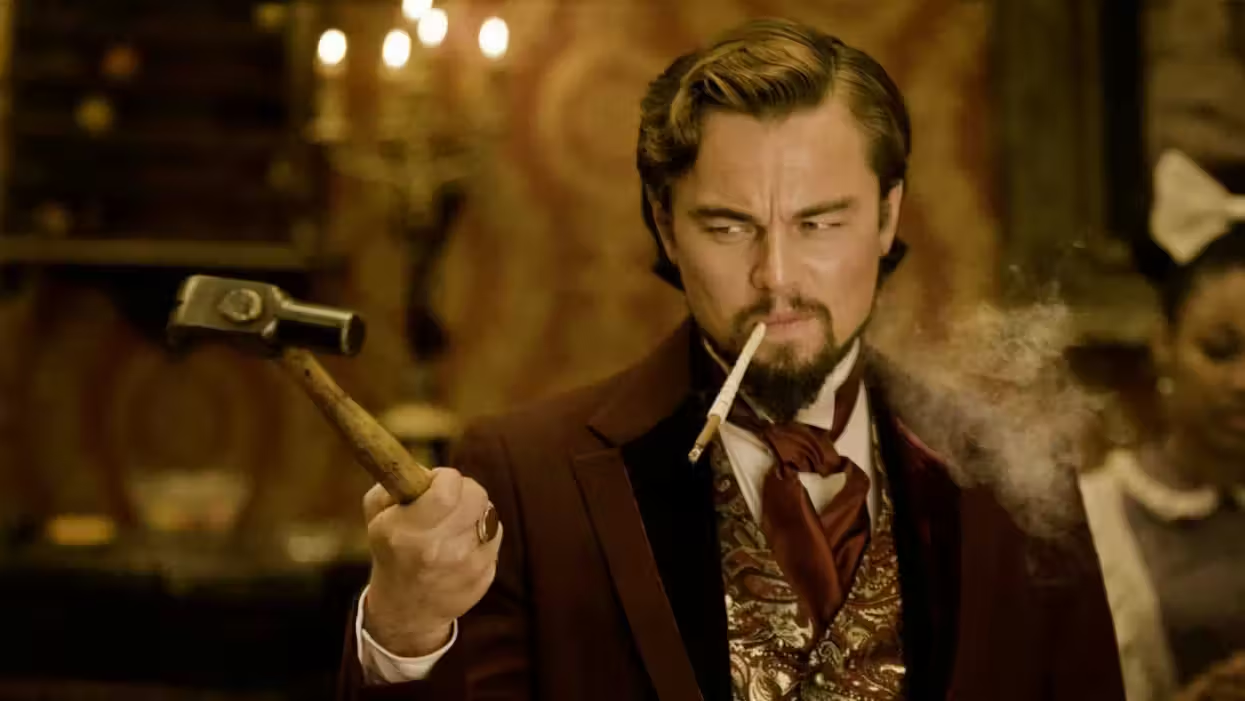
Calvin Candie, Django Unchained
- YouTube www.youtube.com
Quentin Tarantino has said he sympathizes with virtually every villain he's ever written, except this one.
In an interview with the ReelBlend podcast, Tarantino explained that while he could see the point of view of characters like Inglourious Basterds' Hans Landa, Calvin Candie was different. "Calvin Candie was different from the rest of them. I kind of detested the character. I really, really hated him, and it was weird to like write a character that I hated."
DiCaprio matched that energy onscreen. He told the Today show that Candie was "the most deplorable human being I've ever read in a screenplay in my life" and described him as "a young Louis the XIV that had been brought into a world of entitlement and lived his life ... essentially owning other people."
The performance is full of theatrical menace, right up to the infamous dinner scene where DiCaprio accidentally shattered a glass and cut his hand open, and kept going anyway, earning a standing ovation from the cast.
Frank, Once Upon a Time in the West
- YouTube www.youtube.com
Before Henry Fonda showed up on set for Once Upon a Time in the West, he'd already made a costume decision. Brown contact lenses and a Vandyke beard... the traditional markers of a screen villain.
Sergio Leone rejected all of it immediately.
The whole point was that the audience would recognize Henry Fonda, who was the face of American decency in films like The Grapes of Wrath and 12 Angry Men, and then watch him shoot a child.
Fonda told Michael Parkinson in 1975 that Leone "had cast me because he could imagine at this time, the audience saying, 'Jesus Christ, it's Henry Fonda!'"
That subversion is a huge part of the draw of the film.
Liberty Valance, The Man Who Shot Liberty Valance
- YouTube www.youtube.com
Lee Marvin was one of the few actors who could share a screen with both John Wayne and James Stewart and steal scenes from both of them. His Liberty Valance is pure intimidation. He's a sadistic outlaw who exists to terrorize a town that lacks the spine to stop him.
In "Drinks with Liberty Valance: Lee Marvin Shoots from the Hip," a Robert Ward interview reprinted in The Daily Beast, Marvin traced the character's violence back to his own war experience, specifically to a moment in the Pacific when he was impossibly young, acting on a violent instinct he didn't yet understand.
"That was my relationship with my father. Through the gun. Always the gun. Does that help explain Liberty Valance? And why I loved Jack Ford?"
The performance works because Marvin had been somewhere real.
Little Bill Daggett, Unforgiven
- YouTube www.youtube.com
Gene Hackman initially turned the role down (via American Film Institute). He told Clint Eastwood, who directed and starred, that he was done with violent films. Eastwood convinced him to reconsider by framing the film as a critique of violence rather than a celebration of it, and Hackman ended up with his second Oscar.
The character works because he doesn't see himself as a villain.
Eastwood told American Film Institute, "He didn't wear the usual costume of a bad guy. He was a sheriff who had noble ideas. He had this small town, and he ran it with a lot of strength. ... He had dreams like everyone else does, he didn't see himself as a heavy, he wasn't a snarling heavy or anything like that. He just didn't see himself as a bad guy. He thought he was always doing this on the side of right."
That self-righteous blindness is part of what makes Little Bill terrifying.
Rufus Buck, The Harder They Fall
- YouTube www.youtube.com
Jeymes Samuel's The Harder They Fall is the rare Western that puts Black characters at the center of the genre rather than the margins, and Rufus Buck is the film's cold-blooded villain.
Idris Elba described the character to Netflix as someone who "doesn't really talk that much," the kind of man who "will just walk in here and kill everyone."
The film opens with Buck murdering Nat Love's parents in front of him as a child, and everything that follows is a collision course toward reckoning. Elba's performance is built on silence and restraint, which makes the violence feel sudden and absolute every time it lands.
Based loosely on the real Rufus Buck, a Creek and Black outlaw hanged in 1895, the character is dangerous and unique.
Which villain is your favorite?