How a Line from ‘The King of Comedy’ Turned Discomfort into Cinema
It was so uncomfortable, but we couldn’t stop watching.
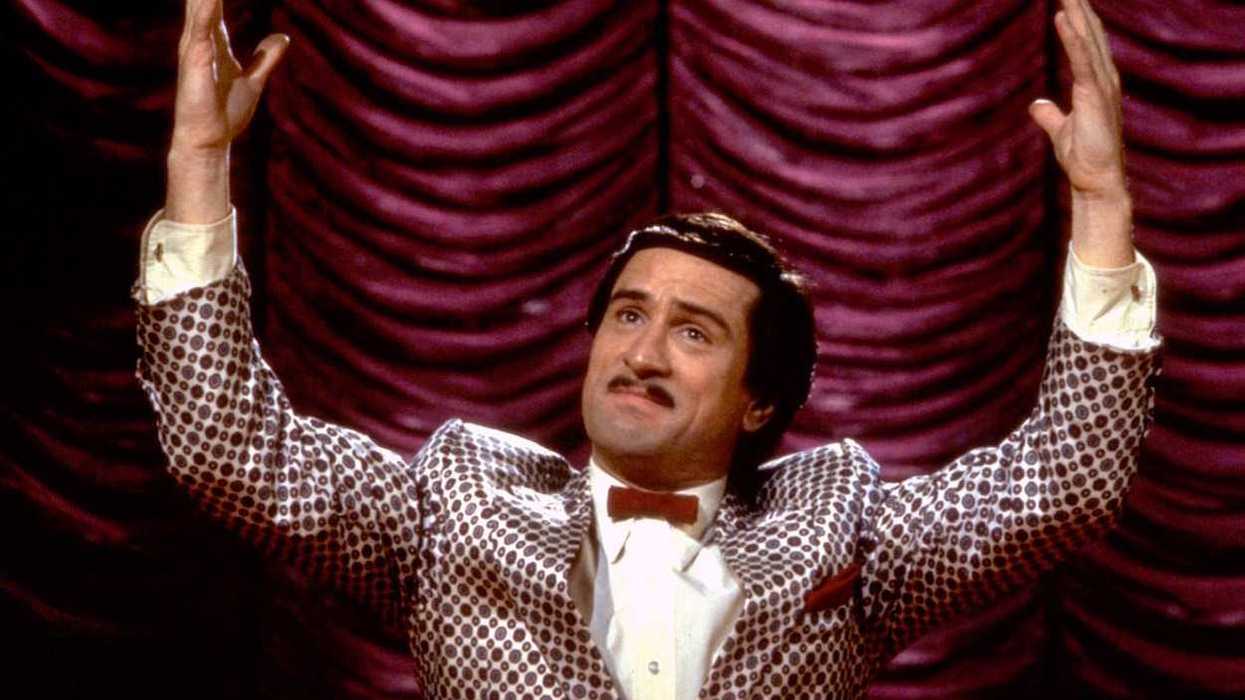
'The King of Comedy' (1982)
The King of Comedy (1982), directed by Martin Scorsese, presented us with some of the most uncomfortable yet compulsively watchable scenes in film history. While the movie did make us laugh infrequently, every single laugh came from a position of aching discomfort.
Scorsese’s films have shown us that he has a penchant for obsessive characters, but The King of Comedy took matters so far that the obsessiveness felt deliberately personal and troubling. Despite the disturbing nature of the film’s subject matter, the 1982 film is thoroughly compelling and brimming with powerful, unforgettable scenes. It truly is one of Martin Scorsese’s finest films.
“Better to be king for a night than a schmuck for a lifetime” is a line said by Rupert Pupkin on stage at a moment when the story reaches its distressing peak.
How does Martin Scorsese make discomfort cinematic? What can we learn from this?
Let’s jump right in and explore.
Context Of The Line
The King of Comedy, directed by Martin Scorsese, features Robert De Niro as Rupert Pupkin, an obsessive, aspiring stand-up comedian desperate to prove his worthiness and become famous. Pupkin lives with his mother and rehearses imaginary talk show scenes, constantly believing that he is onto something real and that these rehearsals are all part of the process of achieving stardom.
Rupert Pupkin is obsessed with successful comedian Jerry Langford (Jerry Lewis), and he imagines himself as an esteemed guest on Langford’s show. After being repeatedly rejected by Jerry Langford and his staff, Pupkin’s obsession manifests itself through stalking and ultimately, the act of actually kidnapping the comedian.
The line “Better to be king for a night than a schmuck for a lifetime” is delivered by Rupert Pupkin on air, moments after he reveals that he has kidnapped and tied up Jerry Langford. While the crowd erupts with laughter at what is clearly a fact, Pupkin explains his logic.
According to him, kidnapping Langford was the only way he could get this opportunity, and even though there would be consequences, it was worth it because he could be a “king for a night”. For Pupkin, the consequences began way before he kidnapped Langford. While he believed in his own talent, powerful gatekeepers did not.
What is essentially an admission of a crime becomes the strongest comedic performance in Scorsese’s twisted world, which explores dark satirical themes of celebrity culture, obsession, and the American dream gone awry.
How Scorsese Made Discomfort Cinematic
“Better to be king for a night than a schmuck for a lifetime” isn’t just a great line in one of the best scenes of the movie; it crystallizes Rupert Pupkin’s obsessiveness and his desperation in a single sentence. While on one level it is a simple statement of fact, it serves as an exceptional comedic piece for a crowd that has no idea that it is actually the truth.
From a filmmaking perspective, Scorsese captures this troubling Rupert Pupkin performance just like a regular comedic performance. There is very little camera movement. He forces the audience to confront the truth and to examine Pupkin’s work by being the only people who know the reality. By doing so, the audience is split into two: One is us, completely aware of the darkness behind Pupkin's words, and the other is the audience witnessing the performance, who think all of this is one big joke.
Scorsese focuses solely on Rupert Pupkin’s performance, creating a detachment from everything else. This sense of isolation amplifies our feeling of unease. It makes us feel awkward and uncomfortable being the only ones who know the bitter truth.
The King of Comedy does an excellent job of depicting the extent to which fandom can go by presenting us with not just Rupert Pupkin but also Masha, played by Sandra Bernhard, who is also an obsessive fan in her own way. These are just two people in a much fiercely significant group of fans who want what Jerry Langford has and are willing to do whatever it takes to snatch it.
What This Can Teach Us About Writing Obsessive Characters
“Better to be king for a night than a schmuck for a lifetime” is, in many ways, the manifestation of just how far obsessiveness can go. It perfectly captures the fearlessness and bravery that come from this obsessiveness and does not stop people from committing crimes. It takes us to a place where boundaries start to disappear, and new rules are established by those who are determined to get what they want. Here are three writing lessons about writing obsessive characters like Rupert Pupkin:
Rules? What Rules?
Obsessive characters such as Rupert Pupkin rewrite every rule that gets in the way of what they want. They conjure up their own philosophy and worldview that justifies their actions. As a writer, make sure your obsessive characters have a core mantra; something they believe in no matter what.
Revealing Broader Truths About Society
Rupert Pupkin’s unrelenting passion for comedy cannot be ignored. The fact that it is hard to be an up-and-coming artist in a thriving comedic scene is also not something that we can overlook. Scorsese quietly justifies a part of Rupert’s reasoning in a manner that we can understand or relate to at least to some extent. Yes, his act of kidnapping is a massive overstep, but the fact that he got to that point reveals something about our society.
Push Boundaries, Don’t Break Them
While Rupert Pupkin certainly breaks boundaries, The King of Comedy remains within certain confines of storytelling. Of course, there are no rules for this, and there is no extent to which your character may act, but the fact that Rupert Pupkin is so focused on his performance and getting what he deserves makes his character more believable. He does not go around kidnapping multiple comedians. His obsession is finite. When he gets an opportunity to perform, he seems as though he has rehearsed for that moment all his life. Keeping matters within certain boundaries makes The King of Comedy freakishly real and uncomfortable.
Summing It Up
“Better to be king for a night than a schmuck for a lifetime” is one of the strongest moments from The King of Comedy because it is unadulterated and painfully real yet comedically relevant. It makes one part of the audience laugh while the other cringes at the very thought of how true Pupkin’s words are. This makes it a colossal achievement in writing, and The King of Comedy one of the finest films Martin Scorsese has ever directed.
What is the most unforgettable moment from The King of Comedy? Tell us in the comments.