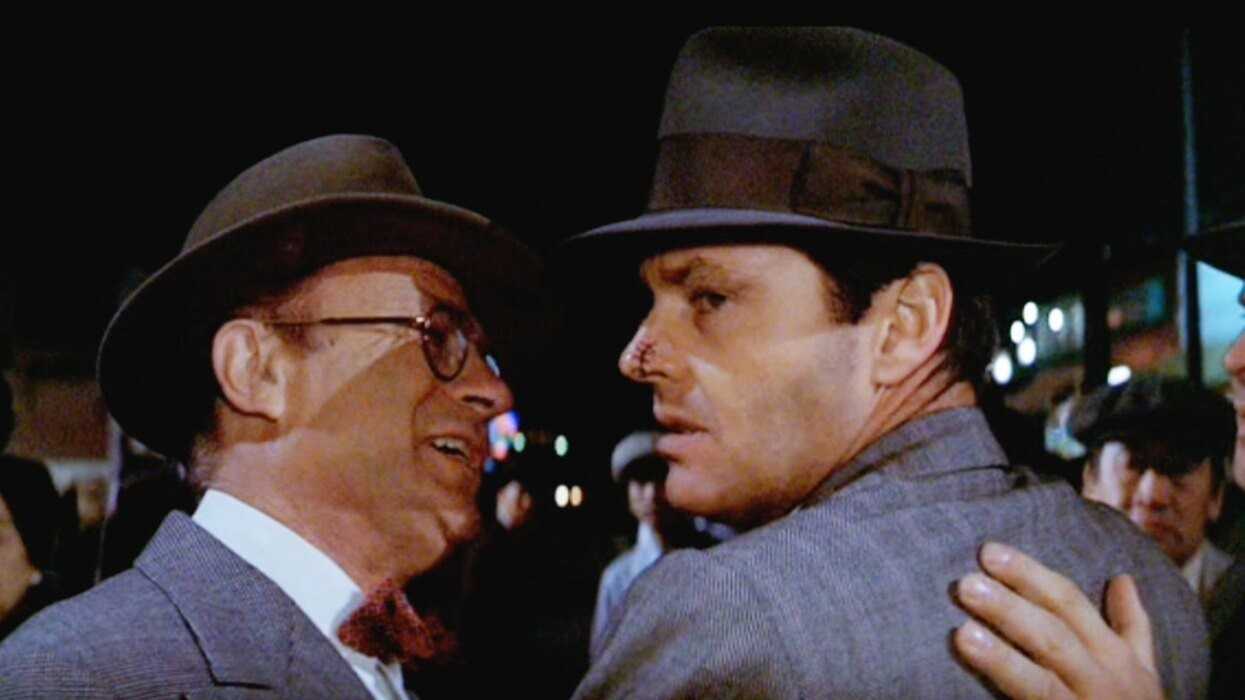
The final moments of Chinatown (1974) leave viewers in stunned silence.
Private investigator Jake Gittes (Jack Nicholson) watches helplessly as Evelyn Mulwray (Faye Dunaway) is gunned down, her daughter pulled into the arms of the very man she was running from. The police, the system, and morality itself all collapse into a single, suffocating instant. Then comes the line—delivered almost casually, like a sigh:
“Forget it, Jake. It’s Chinatown.”
Why did those words cut deeper than the violence that preceded them? Why does that line, more than the gunshot or the revelation of corruption, endure as the definitive closing statement of both Chinatown and the noir tradition at large?
Its power lies not just in what it says, but in what it refuses to offer—comfort, closure, or hope.
This article digs into how that single phrase was forged through creative conflict, how it functions within the world of the film, and how it transformed into something larger than cinema: a cultural shorthand for futility in the face of corruption.
Chinatown’s ending doesn’t remain just a scene. It becomes noir’s soul.
The Birth of a Line: Screenwriter, Director, and a Clash of Visions
Robert Towne’s Optimistic Original: “It’s Only Chinatown”
Screenwriter Robert Towne’s screenplay imagined a very different conclusion for Chinatown. In his version, Evelyn survives, kills her father, Noah Cross (John Huston), and escapes with her daughter—an ending that carries at least a trace of justice and redemption. Accounts of Towne’s drafts suggest that Walsh’s parting words to Jake were also conceived in a gentler register, closer to consolation than dismissal. Rather than a blunt command to surrender, Towne’s approach implied that Evelyn’s death—and Chinatown itself—could be framed as a localized tragedy, not the embodiment of hopelessness.
Towne’s outlook reflected a writer who saw noir as bleak but existential—not necessarily nihilistic. His ending gestured toward the possibility of closure, however messy, and carried the faint suggestion that corruption might be defeated in another story, on another day.
In other words, he wanted Jake’s devastation to sting, not to crush him completely.
For screenwriters, Towne’s draft illustrates how endings carry moral weight. They’re never just narrative wrap-ups; they’re declarations of what the story believes about the world. Towne leaned toward empathy, reminding us that even in noir, the degree of despair is ultimately a choice.
Roman Polanski’s Bleak Intervention: “Forget It”
Director Roman Polanski, however, had no patience for half-measures. Scarred by personal tragedies, including the murder of his wife Sharon Tate by the Manson family, Polanski carried a worldview where evil was not confined but inevitable. For him, the idea of softening the ending was dishonest. He insisted on rewriting the line to “Forget it, Jake. It’s Chinatown.”
By stripping it of consolation, Polanski made it not a comfort but a command—a demand for surrender.
The shift changed everything. Where Towne’s phrase suggested Chinatown as a backdrop for a solvable crime, Polanski’s version turned it into a black hole of corruption. Evelyn’s death could have been just another case gone wrong; instead, it emerged as proof that the system itself was too rotten to fight. In a way, “Forget it” became the law, not just advice.
Directors can take a clue from Polanski’s intervention: endings must align with the worldview of the film.
It’s not about pleasing the audience but telling the truth of the story. He showed that leaning into the harshest version of an ending can elevate a film from memorable to legendary.
The Alchemy of Collaboration: Forging the Final Phrase
The line we know today—“Forget it, Jake. It’s Chinatown.”—was born from the clash between Towne’s empathy and Polanski’s fatalism. The command “Forget it” collides with the explanation “It’s Chinatown,” creating a phrase that feels at once brutally final and chillingly vague. It acknowledges despair but grounds it in a setting that feels specific yet symbolic.
This hybrid phrasing is what gives the line its timeless quality. It carries the sting of Polanski’s darkness while retaining Towne’s grounding in place. Together, they crafted a closing statement that explains nothing yet seems to explain everything.
The line’s ambiguity is its genius; it denies clarity but leaves an echo that never fades.
This Towne-Polanski collaboration underscores the power of creative tension. Screenwriters and directors will inevitably clash, but those clashes can yield something richer than either could envision alone. The line’s endurance is proof that friction, when harnessed, can produce art that transcends its creators.
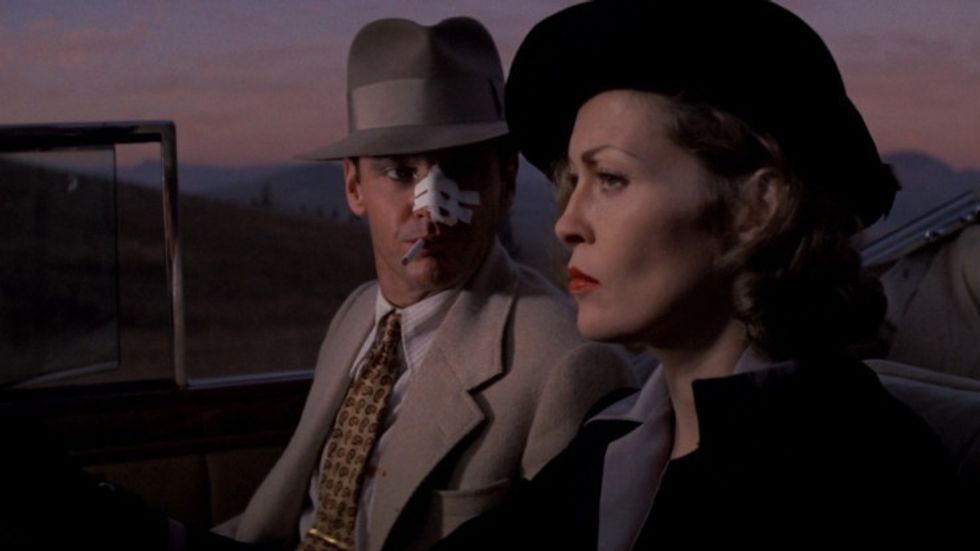 'Chinatown' Credit: Paramount Pictures
Decoding “Chinatown”
So, what does the line “Forget it, Jake. It’s Chinatown.” mean? Let's break it down.
Literal Meaning
On the surface, Chinatown is just a district of Los Angeles where the LAPD discouraged intervention. Officers were instructed to “do as little as possible” in cases involving the area, reflecting cultural divides, language barriers, and a history of botched policing. For Jake, it’s a place where the rules don’t apply, where attempts to help often end in unintended harm.
When Walsh utters the line, he’s not speaking in riddles. He’s reminding Jake that Chinatown is a place defined by paralysis, a setting where the usual instincts of justice fail. Evelyn’s death isn’t an exception—it’s Chinatown working exactly as Chinatown does.
Writers can learn here that even the most layered metaphors should be rooted in literal truth. A line’s resonance often starts with the simplicity of its in-world meaning. Build from reality first, then expand into symbolism.
Metaphorical Meaning
Beyond geography, “Chinatown” is Jake’s personal curse. Years earlier, while stationed there, his actions had led to a woman’s death. That history haunts him throughout the film, and when Walsh repeats the word “Chinatown,” it’s less a location than a psychic wound. It means futility, corruption, and moral paralysis—a place where doing the right thing guarantees the wrong result.
The metaphor works because it universalizes Jake’s pain. Chinatown becomes any situation in which the individual is powerless before larger forces—be it systemic corruption, political rot, or the indifference of fate. This highlights the fact that Jake’s defeat is not unique; it’s archetypal.
It also demonstrates the potency of tying a metaphor to a character's backstory. A single word—“Chinatown”—becomes loaded with dread because it belongs to Jake’s personal tragedy.
The lesson: let your symbols live inside your characters, not outside them.
Thematic Summation
Ultimately, the line distills Chinatown’s central theme: the triumph of systemic corruption. Noah Cross embodies this when he tells Jake, “You see, Mr. Gittes, most people never have to face the fact that at the right time and the right place, they’re capable of anything.” Cross’s victory—securing both Evelyn’s daughter and control of the water supply—proves that justice has no place in this world.
“Forget it, Jake. It’s Chinatown” lands like the final brick sealing that coffin. Evelyn’s death, though on the surface an accident, was always inevitable in a system designed to protect predators. This closing line reminds us that the story can’t be closed.
What this gives filmmakers is a roadmap for endings that haunt. When a line encapsulates the thematic truth of a film, it lingers far longer than spectacle. The goal isn’t to tie up loose ends but to leave audiences wrestling with the implications.
Redefining Noir
Beyond the Classic Noir: From Cynicism to Existential Despair
Classic film noir endings often carried a bitter punch—Sam Spade turning in Brigid in The Maltese Falcon (1941), or Walter Neff confessing in Double Indemnity (1944). These conclusions were cynical, but they reaffirmed some form of justice, however bleak.
In contrast, Chinatown offers no justice, only resignation. Jake is more than disillusioned. He’s powerless.
That’s what makes the line revolutionary. While closing the story, it shifts noir into existential territory. Where earlier noirs suggested corruption could be named and punished, Chinatown insists corruption is the ecosystem itself. Here, the hero doesn’t fail—he was doomed from the start.
Pushing genre conventions one step further often yields transformation. Towne and Polanski, instead of discarding noir tropes, intensified them, turning cynicism into despair. That escalation reshaped the genre for decades.
 'Chinatown' Credit: Warner Bros.
The Blueprint for Neo-Noir: A Legacy of Bleak Finales
After Chinatown, neo-noir filmmakers embraced endings that left audiences gutted. David Fincher’s Se7en (1995), with its infamous “What’s in the box?!” moment, owes a debt to Chinatown’s refusal to provide resolution. Martin Scorsese’s The Departed (2006) and Denis Villeneuve’s Prisoners (2013) both echo the same bleak DNA—heroes undone not by personal flaws alone but by systems too corrupted to overcome.
The line’s influence lies in its audacity. It proved that audiences could handle despair if it felt truthful. Rather than turning away from hopelessness, neo-noir directors leaned into it, recognizing that the absence of closure could be more powerful than false catharsis.
Writers and directors should see this as permission: endings don’t have to reassure. If the story demands devastation, lean into it. Audiences remember the courage of truth more than the comfort of compromise.
Anatomy of a Perfect Ending
Why does the line endure above countless others? Because it achieves a paradox: it explains nothing yet feels like the only explanation possible. It closes the story without resolving it, leaving the audience with unease rather than clarity. It’s vague, specific, dismissive, and profound—all at once.
Great closing lines resonate, as opposed to summarizing. “Forget it, Jake. It’s Chinatown” is not about plot mechanics but about emotional truth. It lodges itself in the psyche because it feels inevitable, like an echo from which there is no escape.
We could learn precision here. A line doesn’t need length or flourish to be iconic. It needs weight, rhythm, and alignment with the theme. In these five words, Chinatown achieved what most films fail to do in a monologue.
“It’s [Anything]”: The Line’s Journey Into the Cultural Lexicon
From Cinema to Shorthand: A Phrase for Helplessness
Over the years, the line has leapt from the screen into headlines, memes, and political commentary. Journalists riff on it to describe dysfunction in Washington: “Forget it, Jake. It’s Congress.” Climate writers twist it into: “Forget it, Jake. It’s the planet.” The phrase has become a catch-all for situations so broken they defy solutions.
Its adaptability proves its power. People instinctively reach for the line when confronted with systems too corrupt or tangled to fix. What began as a whisper in a noir tragedy has become everyday shorthand for collective helplessness.
A line transcends when it taps into a universal condition. The more personal its origins, the wider its reach.
Parody, Homage, and Dilution
No line this famous escapes parody. The Simpsons, Family Guy, and countless other shows have retooled it for laughs. Each homage cements its place in cultural memory but also risks weakening its impact. When used as a punchline, the line shifts from devastating to kitschy.
Still, the very fact that it survives parody shows its durability. Few movie lines can withstand repetition without fading; this one thrives on it, even when played for humor. Its DNA has woven into the language itself.
The takeaway here is a double-edged sword: fame can erode meaning, but it also guarantees permanence. The best writers can do is strive for lines so strong that even mockery cannot erase them.
The Unforgettable Whisper
In the end, “Forget it, Jake. It’s Chinatown” is more than a piece of dialogue. It’s the product of creative conflict, the thematic spine of Chinatown, and the definitive expression of noir’s darkest truth—that corruption is always going to win, but it’s also going to define the rules of the game.
The line continues to resonate because it tells a truth we recognize in our own world: some systems are too vast, too broken, and too corrupt to fight. It’s a bleak message, but a necessary one. That’s why the line has outlived its film, evolving into a cultural shorthand for futility in the face of power.
It remains one of cinema’s most haunting final whispers—not because it explains the story, but because it refuses to.
The last words of Chinatown don’t let us walk away with answers. They leave us with the ache of knowing there aren’t any.
- 'Chinatown' Screenwriter Robert Towne Offers Pearls of Screenwriting Wisdom in WGA Interview ›
- Yes, 'Chinatown' Is That Good ›
- Watch: Why 'Chinatown' is Considered One of the Greatest Screenplays of All Time ›
- Listen to David Fincher and Robert Towne Talk 'Chinatown' ›
- How A Line From ‘The King Of Comedy’ Turned Discomfort Into Cinema ›
- Shadows and Sin: 9 Essential Film Noir Quotes That Define the Genre ›
- 7 Chilling Closing Lines That Will Leave You Thinking Endlessly ›