Every once in a while, my husband and I are stricken by an urgent need to revisit the world of Armando Iannucci. (Maybe because so much of our everyday lives feels like a political farce, amirite? Happy birthday, America.)
Last night was one such instance, leading us to pull out In the Loop, a film that still feels timely and surprising despite being over 15 years old. And still so quotable.
Iannucci has spent three decades making political dysfunction funny. He also gave us The Thick of It, Veep, and The Death of Stalin. We've praised his work across NFS more than once. In the Loop made our list of the smartest satire films ever made, and the Veep pilot landed on our ranking of the best comedy TV pilots for how fast it locks in tone.
I wanted to dive into what makes Iannucci’s writing so incredible and found some resources for us. Writing political comedy isn’t so difficult, difficult, lemon difficult.
- YouTubeyoutu.be
Plot First, Jokes Later
The liveliness of the characters and the randomness of their language mean many of the actors are free to improvise or offer alts. But before any improvisation happens, Iannucci and his writers lock the story.
"We spend a lot of time working out the plot," he told IndieLondon ahead of In the Loop's release. “Once we’ve nailed that down, I get the writers to write the script … but not quickly because it’s still early stages and we want to still move stuff around. We do little read-throughs to see how it fares."
Even then, scripts circulate through the room, get rewritten by other writers, and get reshuffled again before a table read. The joke work comes after the structural work, not instead of it.
During rehearsals, writers stay involved, he said.
“I keep saying to people, 'It's not about trying to come up with 101 new funny things, it’s more just seeing what actually would happen under those circumstances.' Things emerge from that process which the writers then feed back into the script, and then on set we do the same process again."
Hey, comedy writers—a scene built on a strong plot beat can survive one flat line. A scene built only around a good line collapses as soon as the joke doesn't land.
No Ego in the Room
Iannucci's writers' room runs on a pretty big rule. He's after writers "who have a comedy brain," as he put it to BAFTA Guru.
"I think that's it. It's difficult to categorize—it's not so much that they write or they perform, or they act, or they do stand-up. It's just that they have a comedy brain."
He's found writers this way before. Chris Addison landed in The Thick of It off his stand-up alone, with no acting background, because Iannucci recognized the same instinct in his delivery that he wanted for the character Ollie.
Once someone's in the room, the expectation is a total lack of possessiveness. Scripts pass writer to writer until, by Iannucci's own account, nobody remembers who wrote which line. He's also talked about what carries a writer through a blank page.
"You've got to believe what you're writing is funny,” he told BAFTA. “Don't try and write what you think someone else finds funny, but which you don't find funny. Don't sell yourself short. I dunno, sometimes it's a very instinctive thing, you can see someone who maybe not has done very much, but who is instinctively funny."
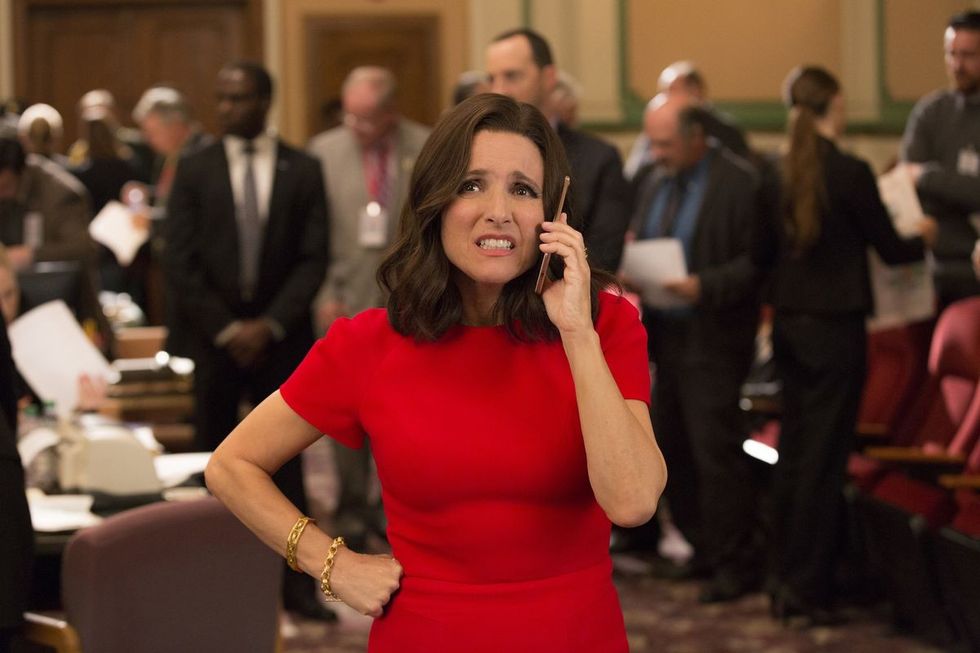 Veep Credit: HBO
How and When to Let Actors Improvise
After the scripts are done, things are allowed to be creative on set. "We write it in great detail, but the directing process involves the cast loosening it up a bit," he told Televisual when discussing Veep.
He added later, when asked about the perfect conditions for improv:
“I try to encourage us to shoot it in the easiest way possible without too many marks to hit so we can shoot the whole scene without any interruptions. That allows the actors to get two or three goes at the scene. Then once it’s under the skin, they’re more familiar with the scene. Also then I’m more familiar with the scene and, looking on the monitors, I’m beginning to see exactly where the scene is and I’m looking to see characters who may not have said something but are in the back of the shot and whether they can say or do something funny. So we’re still adjusting the scene and layering it even more with every fresh take.”
Guest actors aren't asked to invent jokes, but they're asked to react in character. There can be plenty of comedy in a unique response.
For his core cast, the read stays looser. He tells actors to adjust dialogue on the day if a line doesn't sound like something the character would say.
"It's important that in every scene, you've thought of every moment," he told Backstage. “Is it leading to something funny, is it developing something funny, or is it funny in itself? Very often, the line that contains information can feel very bald and raw and just there to reveal an element of the story."
Research as a Comedy Guide
This is true for anything you write that you want to feel grounded and realistic. Don't invent absurdity when you can go find it.
Iannucci didn't guess. For Veep, he spent time around real Washington aides and officials. In a 2015 conversation with High Profiles, he described learning that big strategic calls often come down to a single meeting, not a careful chain of them.
"When we were researching In the Loop and Veep in Washington, a lot of people were saying: You’d think these big strategies would involve meeting after meeting after meeting, but no, there’s a meeting, because there’s no time."
Real specificity beats invented specificity every time, and it's the reason The Thick of It's ministers and Veep's staffers feel like people you've met rather than types you've seen before. We ranked Veep among the most iconic on-screen U.S. presidents for exactly that reason, and our roundup of political films makes the same case for In the Loop. The dysfunction feels observed, not exaggerated.
Reflecting on The Thick of It's origins for the Royal Television Society, Iannucci said the show was built to feel like real conversation caught on camera rather than a script performed for one.
"It was as if we were eavesdropping on reality," he said.
So go out and eavesdrop. What's your favorite Iannucci project?